
Understanding Soft Foot in Pump Installations
Soft foot in pump installations refers to an uneven or unstable support condition beneath a machine’s mounting foot. When one or more feet on a pump baseplate do not make solid contact with the foundation, it creates a condition where the machinery is not rigidly supported. This instability hinders precise alignment, leading to ongoing vibration, premature bearing failure, and unnecessary grouting or repair attempts. Soft foot is a common yet often overlooked issue during both initial machine installation and routine maintenance of pumps, compressors, and allied rotating equipment.
What Causes Soft Foot?
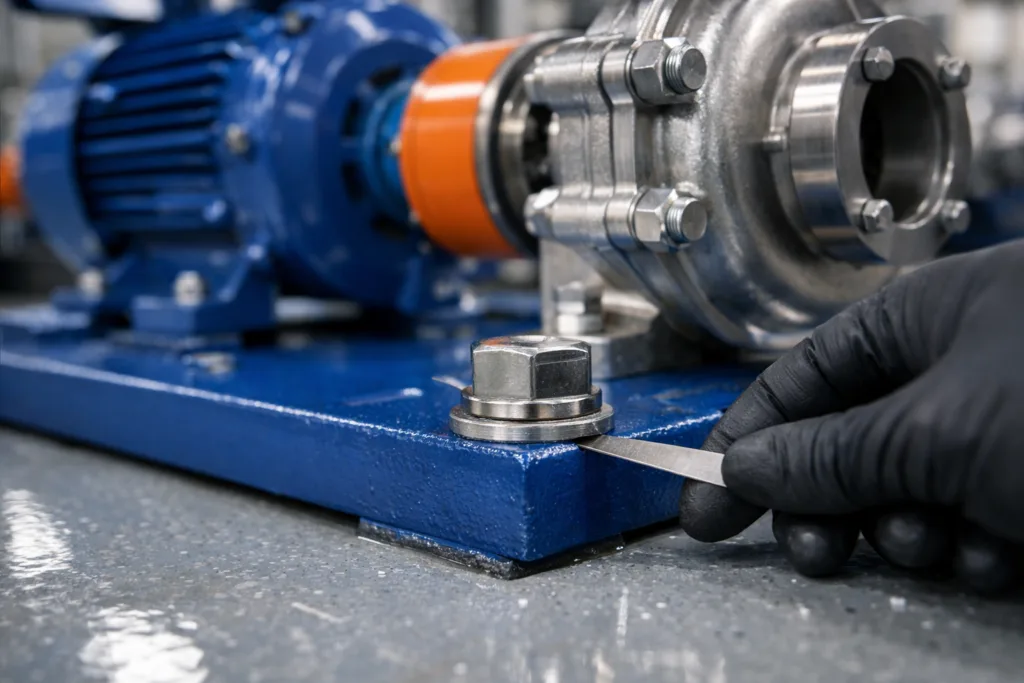
Several factors can lead to soft foot, such as foundation surface irregularities, excessive paint or grout beneath feet, manufacturing tolerances, plate deformation, damaged fasteners, or even debris trapped under the machine foot. Over time, cycles of load and temperature can also warp metal or create unevenness in concrete machine pads. Problems often escalate when shimming, grouting, or mechanical corrections are rushed or performed without proper measurement.
The Relationship Between Soft Foot and Equipment Alignment
Proper alignment requires all feet of rotating machinery to be uniformly supported. If a soft foot condition exists, aligning the shafts can become impossible—every adjustment on a jack bolt or shim stack may simply warp the machine frame or twist mating flanges instead. This creates persistent misalignment, amplifying wear on couplings, bearings, and seals. A void in support can also cause pump bases to “sag” over time, leading to leaks and premature foundation deterioration.
Why Addressing Soft Foot Is Critical
Ignoring soft foot risks repetitive failures, unnecessary downtime, and escalating maintenance costs. Without rigid support:
- Alignment jobs are never truly successful, often needing repeat corrections
- Equipment vibrates, increasing fatigue and audible noise
- Loosened hold-down bolts can create safety hazards
- Grout cracking, hydraulic oil leaks, and other symptoms may persist
How to Detect and Diagnose Soft Foot
Detecting soft foot typically starts with a dial indicator or laser measurement while tightening or loosening each hold-down bolt. If the measurement at any foot exceeds typical tolerance (often above 0.05mm or 2 mils), soft foot correction is necessary. Gaps beneath the foot can also be checked with feeler gauges, while “wobble” or rocking upon tightening is a key symptom. Advanced alignment tools can help distinguish soft foot from parallel or angular shaft misalignment. Checking for voids during grouting can help ensure no unexpected soft foot is introduced during installation.
Types of Soft Foot
- Parallel soft foot: All four feet are parallel, but the base is not coplanar
- Angular soft foot: Feet make contact at a corner only
- Combination soft foot: Involves both parallel and angular issues
Traditional Soft Foot Correction Methods
Historically, technicians have used metal shims (precut or hand-cut), stacking of various thicknesses, spot grinding of the base, or the addition of grout beneath the machine foot to address soft foot. While these methods can work, they present certain limitations. Metal shims are labor-intensive to prepare, may corrode, lose their shape over time, or “pump” grease and oil. Spot grinding must be done carefully to avoid introducing new unevenness. Grouting can fill voids but may crack if machine loads shift or bolts are overtightened. These challenges have driven the search for improved alternatives that deliver consistent, long-term support under real-world conditions.
Soft Foot, Epoxy Shims, Troubleshooting, Pump Alignment, Grouting
This section will explore how these elements are interrelated. Achieving rigid support for pump bases (even under tough plant conditions) often requires a combination of troubleshooting techniques. Epoxy shims present a high-performance option for precision correction.
Epoxy Shims as a Solution: Overview and Benefits
Epoxy shims are pourable or moldable resin compounds designed to create precise, high-compressive strength supports beneath machinery feet. They bond strongly to both metal and concrete, self-level to fill finite gaps and remain dimensionally stable after curing. Modern epoxy shims are formulated to resist vibration, chemicals, and load cycling, outperforming most cut metal and hand-mixed cementitious alternatives. For foundational stability on pump bases, products like ZDS-1410AB offer verified strength and reliability.
Key Properties of Epoxy Shims
- High compressive and tensile strength
- Non-shrinking
- Can be poured into tight gaps (fluid or putty grade)
- Chemical and weather resistant
- Excellent support even at thin bond lines
When Should You Use Epoxy Shims?
Epoxy shims are ideal when precision is essential and typical metal shims are impractical or introduce new risks. They excel under these conditions:
- Gaps or voids larger than 1 mm
- Irregular or pitted concrete bases
- Critical alignment requirements (pumps, compressors, gearboxes)
- High vibration service
- Corrosive, wet, or chemical-prone environments
Comparing Epoxy Shims to Traditional Shimming Techniques
| Property | Epoxy Shims | Metal Shims |
|---|---|---|
| Support Consistency | Full-surface contact | Edge/corner contact; can slip |
| Corrosion Resistance | Excellent | Poor (rusts) |
| Installation Speed | Faster for irregular surfaces | Slow, custom cut needed |
| Load Distribution | Uniform | Often point loads |
| Shape Adaptability | Molds to surface | Limited |
| Durability | High, crack-resistant | May deform or corrode |
How Epoxy Shims Work in Correcting Soft Foot
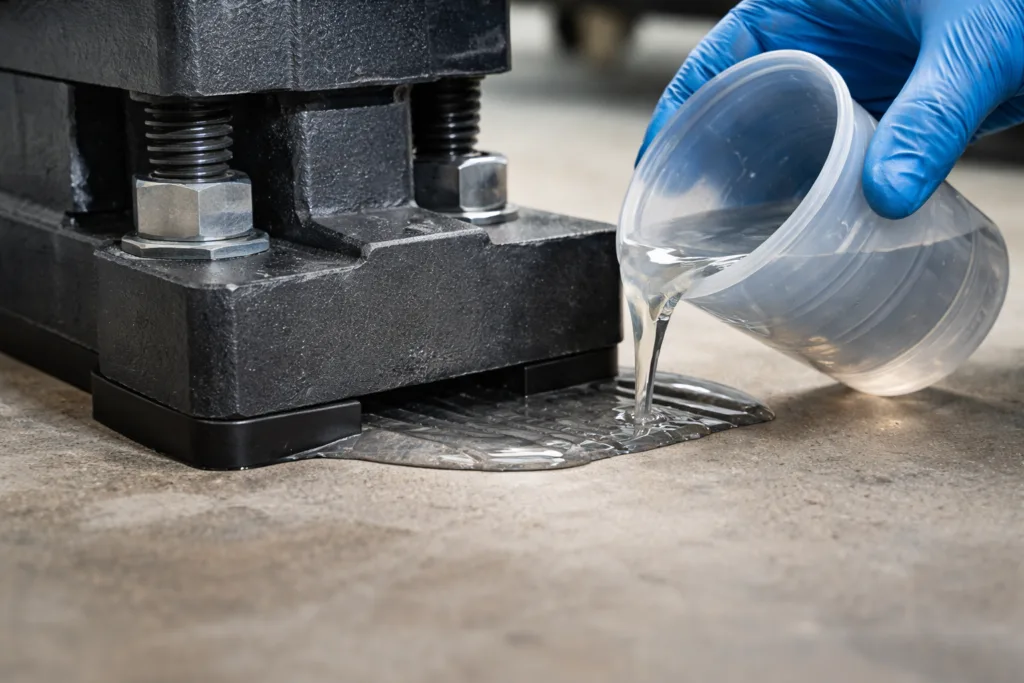
Correcting soft foot with epoxy shims involves preparing the foot area, formwork (if needed), and then pouring or placing epoxy. The resin fills all irregularities beneath the foot, hardening to form a custom-fit shim that bonds permanently to the base and foot.
Installation Steps: Practical Guide
- Ensure the area is clean—remove oils, dust, and loose paint
- Dry fit the pump and check gaps with gauges
- Install temporary side forms to contain the epoxy
- Mix epoxy according to the specified ratio and pot life (see product TDS)
- Pour or trowel under the machine foot; avoid air entrapment
- Allow full cure before tightening hold-down bolts
If very fine gaps exist, consider a low-viscosity version like ZDS-3382AB for tight spaces, ensuring complete void filling and support.
Epoxy Grouting vs. Epoxy Shims: Which to Choose?
Epoxy grouting is often used for large-area support beneath baseplates, while epoxy shims are targeted at precise foot corrections. Large voids or general base instability may require both—grouting the base first for bulk stability, then using epoxy shims to micro-correct any remaining local soft foot at each mounting bolt. Both share high compressive strength and chemical resistance, but shims enable site-specific adjustment and contact under individual feet.
Solving Soft Foot in Complex Installations
On large or multi-foot installations, parallel and angular soft foot can combine, requiring care to measure, mark, and correct each foot independently. Control over grout and shim curing times is critical—some bases may benefit from a staged sequence: prepping, pouring grout, verifying alignment, and shim correction as a final step.
The Role of Precision in Epoxy Mixing and Application
The performance of the epoxy shim depends on accurate mixing (by weight or volume), temperature awareness, and proper working time management. Experienced field staff, like those familiar with ZDSpoxy protocols, emphasize testing the mixed resin’s viscosity before pouring. This ensures air release and minimizes the chance of incomplete fills under high load points.
Common Mistakes When Correcting Soft Foot—And How to Avoid Them
Errors during soft foot correction can create future headaches. Typical mistakes include:
- Skipping substrate cleaning (trapped oil weakens the bond)
- Poor formwork, leading to epoxy leaks and voids
- Choosing incorrect resin type (e.g., too viscous or fast setting)
- Over-tightening bolts during cure, which can shear the shim
- Ignoring temperature or humidity requirements for epoxy curing
Maintenance and Inspection After Epoxy Shim Installation
Periodic bolt-tightness checks and vibration analysis post-install are recommended. Ideally, monitor alignment and vibration trends after a few hundred service hours. Epoxy shims hold their performance when properly installed, rarely needing rework during typical pump overhaul cycles.
Pump Alignment: Getting It Right and Keeping It Right
After soft foot correction, always repeat a full alignment check (preferably with dial indicators or laser alignment tools). When foundation work or movement occurs, verify shim and grout support remains robust. For bases exposed to chemicals or washdowns, select shim and grout types with documented resistance to site requirements.
Case Study: Successful Soft Foot Correction Using Epoxy Shims
A refinery in Southeast Asia noticed ongoing vibration warnings on one of its critical process pumps. Initial attempts at alignment failed, despite repeated metal shimming. Detailed investigation revealed a 2 mm gap beneath the outboard foot with irregular surface pitting. Engineers removed all old shims, degreased, then installed a bespoke pourable epoxy shim with temporary formwork. The following day, the base was rechecked: alignment achieved, vibration dropped substantially, and bearing wear stopped escalating. Follow-ups a year later confirmed ongoing reliable service.
Epoxy Shims in Grouting and Foundation Retrofit
When retrofitting old bases or converting from cement-based grouts, epoxy shims offer a practical way to address local distortions or damage. Their filling and bonding capabilities complement modern high-strength grouts, restoring rigid support to older pump units without face milling or risky welding repairs.
Cost and Value Analysis: Epoxy Shims vs. Traditional Shims
While epoxy compound costs may be higher per cubic centimeter, install labor is lower, rework rates are minimal, and remediation is rarely needed. In contrast, metal shims often lead to recurring problems, site downtime, or emergency fixes. Across a facility or fleet, the total cost of ownership sharply favors engineered epoxy solutions for critical machinery bases.
Safety, Storage, and Handling of Epoxy Materials
Modern epoxies are formulated for safe handling, but always use the recommended PPE, including gloves and eye protection. Store in a cool, dry place—excess moisture or heat can degrade certain resin components. Unopened units from trusted suppliers, such as those used by ZDSpoxy, typically remain shelf-stable for more than 12 months, but always follow the technical datasheet for storage guidelines.
Environmental and Long-Term Durability Benefits
Unlike metal shims, epoxies resist corrosion and are generally stable against oil, hydrocarbons, and moderate acids or bases. When cured, they release no odor or VOC and can extend the longevity of grouted foundations by preventing ingress of chemicals beneath machine feet. In high-moisture or outdoor installations, specialized epoxy shim types ensure contact integrity even after temperature cycling or flooding events.
Quick Reference: Troubleshooting Guide for Soft Foot Issues
- Check for rocking or odd movement during bolt tightening
- Measure feet height with feeler gauges—note any deviations
- Confirm base flatness and grout condition
- Clean and dry support areas before correction
- Select epoxy shim or grout formula to match gap size and operating conditions
Summary of Critical Takeaways
Soft foot is an often-hidden but serious threat to reliable pump operation. Precision diagnosis, thorough cleaning, and use of advanced epoxy shims minimize downtime and deliver long-term support under tough plant conditions. Unlike traditional approaches, modern epoxy shims provide adaptive, durable, and verifiable correction—particularly valuable when equipment uptime, vibration control, and rigid alignment are non-negotiable. Performed with care, this approach also prevents trouble from recurring in future inspection and maintenance cycles.
Frequently Asked Questions
How do you know if your pump has soft foot?
Soft foot typically shows as rocking, uneven bolt torques, or gaps detected by feeler gauges when mounting pumps. Laser or dial indicator alignment tools also help spot it.
Can epoxy shims be used under all machinery feet?
Epoxy shims are suitable for nearly all machinery types, especially those with uneven bases, irregular mounting surfaces, or when enhanced chemical resistance is required.
What problems occur if soft foot is left uncorrected?
Leaving soft foot uncorrected leads to persistent misalignment, vibration, increased wear, and eventual failures in machine bearings, couplings, and seals.
How long does it take for an epoxy shim to cure?
Epoxy shim cure times vary by product; most reach handling strength within 6–24 hours and full mechanical properties in about 48 hours at moderate temperatures.
What’s the difference between grouting and shimming?
Grouting fills large foundation voids and bonds baseplates, while shimming targets precise, localized corrections under machinery feet for final support and alignment.
How thick can epoxy shims be applied?
Depending on the formulation, epoxy shims can be poured or built up from as thin as 1 mm up to about 25 mm per layer, ensuring full contact and support.