
Understanding can you coat on damp concrete, moisture before coating
When it comes to applying industrial coatings, the biggest threat to a successful and durable finish is often invisible: substrate moisture. The question, can you coat on damp concrete, moisture before coating, comes up on job sites worldwide—and for good reason. Moisture trapped under coatings can cause unsightly and costly defects such as bubbling, whitening, and delamination, sabotaging even the most rigorously planned renovation. This article aims to tackle why moisture matters, how to assess it practically on site without instruments, and how to make smart decisions about when to coat and when to wait.
Why Moisture Management Is Essential for Concrete Coating Success
Concrete is a naturally porous material that absorbs and holds water. When coatings are applied over damp substrates, trapped moisture can vaporize and disrupt the curing process. This results in surface blisters (bubbling), a milky-white appearance (blushing or whitening), or even separation between layers (delamination). These failures are not just an aesthetic problem; they undermine the performance and longevity of your coating investment, whether that’s on a terrace, balcony, or outdoor floor, an industrial warehouse, or a residential garage.
What’s at Stake? Common Moisture-Induced Coating Failures
- Bubbling: Moisture vapor drives up through the slab, pushing against the fresh coating and forming unsightly raised pockets.
- Whitening/Blushing: Water interacting with the resin or curing agent causes areas of the coating to turn milky white, signaling a chemical disturbance.
- Delamination: The bond between the coating and concrete is broken by water or vapor pressure, causing layers to peel or lift away entirely.
Where Does Moisture Come From?
Understanding the sources of moisture is key for any successful coating project. Sometimes moisture is expected—after rain, power-washing, or in humid climates. But concrete can also draw moisture from below (rising damp, groundwater, or poorly sealed substrates), or accumulate it on the surface overnight through condensation.
How to Check Concrete Moisture—Without Fancy Instruments
On fast-moving jobsites, you may not always have digital probes, calcium chloride kits, or moisture meters. Luckily, there are field-proven methods to quickly check for dampness before you coat:
Plastic Sheet Method (Plastic Film Test)
Simple, cheap, and surprisingly effective. Here’s how to do it:
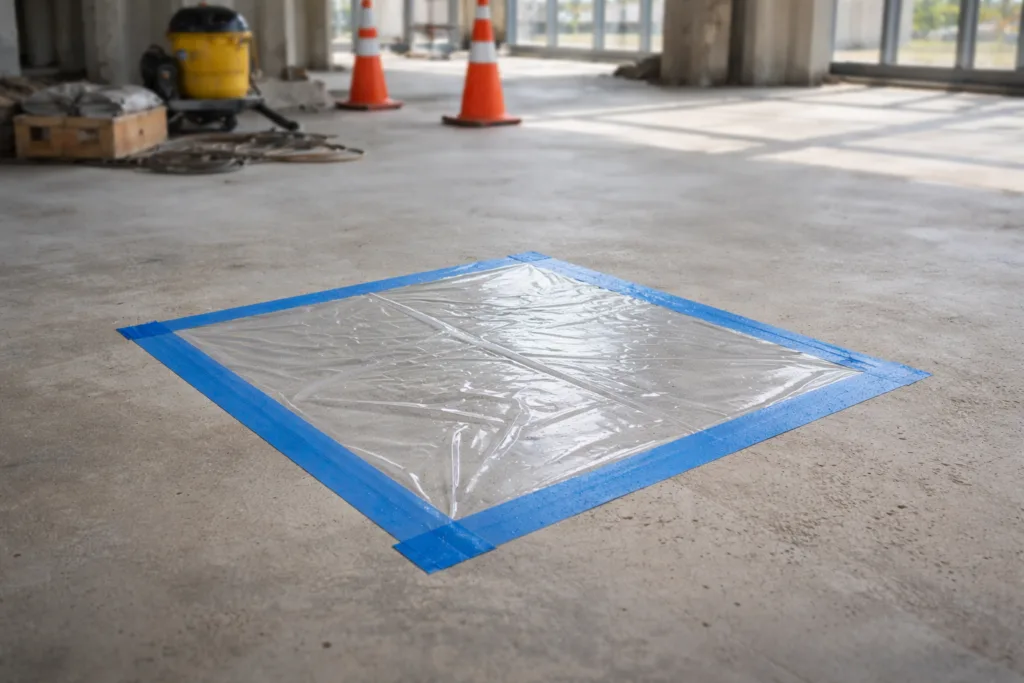
- Tape a square of thick plastic (e.g., a garbage bag or painter’s film, about 50×50 cm) tightly to the floor. Seal all edges with tape.
- Wait at least 2–4 hours (overnight for best results).
- Remove the sheet and check the underside and the slab. If there are water droplets under the film or the concrete looks noticeably darker, moisture is evaporating up aggressively—wait before coating.
Dew and Condensation in the Early Morning
Check your slab in the cool hours after sunrise. If beads of water or a shiny wetness appear on the surface, that’s dew—evidence of condensation, meaning the concrete is colder than the air and attracting moisture. This is a red flag for immediate coating.
Touch and Color Test
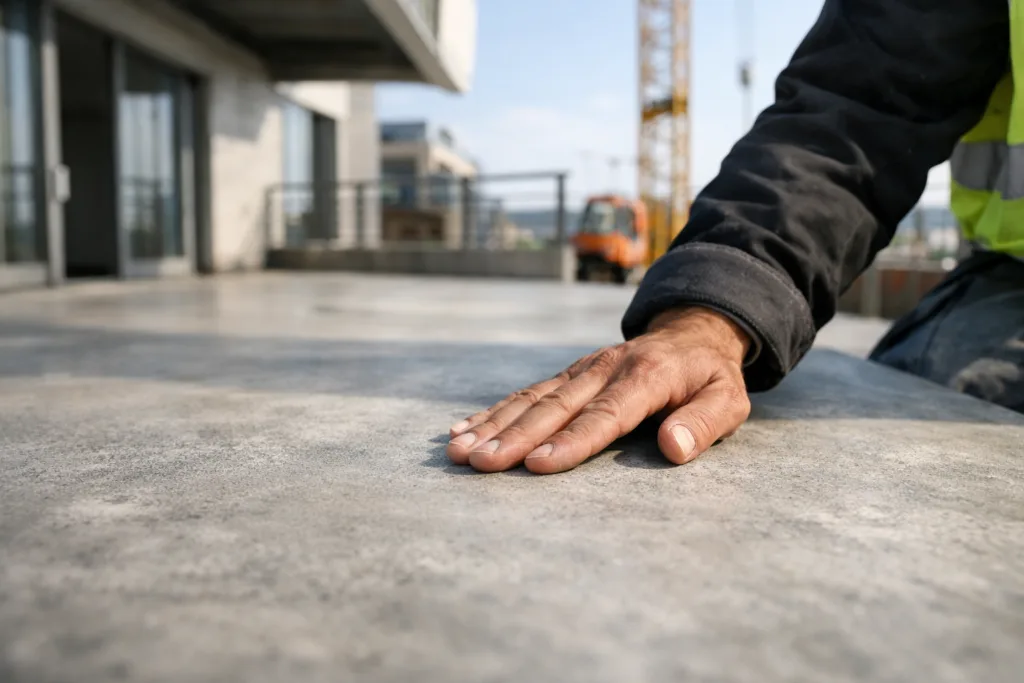
Feel the concrete. Is it cool and damp to your palm? Even without visible water, a substrate that feels cold and moist is likely holding more water than it should. Compare with a known dry patch from a protected indoor area. Also, inspect for dark patches or variances in color, which suggest lingering moisture inside the slab.
Field Judgment: Deciding When You Can Coat and When You Must Wait
There’s no single “magic” number—the call depends on the curing system, expected site performance, and environmental conditions. As a practical rule, avoid coating if any of the following are present:
- Condensation, dew, or obvious surface wetting in the last 12 hours
- Dark waterstains remaining from previous rains or cleaning
- Freshly poured concrete less than 28 days old (subject to system specifics)
- Plastic film test shows droplets after 2–4 hours
Patience here saves money and rework later. Even for urgent projects like swimming pool waterproofing, proper drying is key to achieving a true water barrier and resisting osmotic pressure.
Can You Ever Coat on Damp Concrete? Engineering Options Explained
While the safest route is always to coat on a fully dry substrate, there are advanced systems designed for limited moisture scenarios:
- Specialized Primers: Some two-component epoxies and polyurethanes can tolerate slightly damp — not actively wet — concrete. These systems chemically bond despite residual moisture, but must be matched to field measurement and manufacturer data.
- Breathable Coatings: Certain materials allow moisture vapor to escape without delamination risks, but may require careful engineering and should only be used in applications where long-term water ingress is unlikely.
If you’re working on an exterior wall renovation or a slab subject to intermittent outdoor exposure, consultation with a resin expert or the technical data sheet is wise—the wrong pairing can cause rapid failure.
Adjusting Your Project When You Face Moisture Challenges
- Use forced ventilation, fans, and gentle heat (avoid open flames) to accelerate drying.
- Allow extra pause between cleaning and priming—sometimes 24–48 hours can change the outcome.
- Plan your coating window for midday or early afternoon when substrate and air temperature are stable and above the dew point.
- Record visual checks and plastic sheet test results in your project log for transparency.
Practical Site Experience: Key Details That Prevent Failure
From a manufacturing perspective, ZDSpoxy emphasizes that even advanced primers have defined moisture tolerance limits. Field crews sometimes overlook edge seepage, trapped water in joints, or micro-pooling in surface depressions. Using the plastic sheet test at multiple representative spots—sunlit and shaded, near walls and open floor—helps prevent surprises after the coating is down.
Myths and Misconceptions About Coating on Damp Substrates
- “Quick-dry” resins cure on wet slabs: Rapid curing does not mean waterproof application! All resins need proper mechanical and chemical adhesion.
- Visible dryness is enough: Moisture below the surface is invisible but can still cause failures.
- Thicker coats are safer: Extra thickness can trap even more moisture, increasing the chance of bubbles or blisters forming.
When Is It Safe to Coat? Summary Table
| Condition | Decision | Notes |
|---|---|---|
| Plastic film test (wet) | Wait | Surface is evaporating rapidly; high failure risk |
| Dew/condensation present | Wait | Danger of whitening and poor adhesion |
| Cool/damp to touch | Wait | Subsurface is still moist |
| Uniform, light color; touch-dry | Proceed (with caution) | Use appropriate system if slight moisture is present |
| 48+ hours dry weather, warm site | Coat | Low risk if tests are clean |
Site-Friendly Moisture Assessment: Step-by-Step
- Check the weather history for recent rain or cleaning events.
- First thing in the morning, scan for dew or condensation.
- Apply the plastic sheet test before noon.
- Feel the slab; compare with interior dry areas for temperature and touch feedback.
- Decide: Wait or proceed with proper system—document your choice for site records.
Can You Coat on Damp Concrete, Moisture Before Coating?
The simple truth is: You should only coat on dry concrete unless you are using a certified moisture-tolerant primer or working within explicit guidelines from material suppliers. Most field failures can be traced to skipping drying time or trusting visual dryness alone. Your decision can make or break the entire floor system longevity, especially for outdoor or commercial exposures.
Final Checklist Before Applying Coatings
- Plastic film test passed (no moisture)
- No visible condensation or dew in last 12 hours
- Surface is touch-dry and has returned to normal color
- All cracks, joints, and edges inspected for hidden water
Best Practices in Site Reporting and Quality Control
- Keep daily logs of temperature, humidity, and moisture checks
- Take photos and note test locations
- Document waiting times between cleaning/rain and coating
Ensuring Long-Term System Performance
Coating failures often emerge months after the initial job. Proper moisture management, along with quality waterproofing renovation solutions on critical surfaces, can extend the life and appearance of your install many times over.
What If the Project Can’t Wait? Emergency Solutions
If a schedule is non-negotiable and the concrete can’t fully dry, consider switching to a proven 2K polyurethane or rapid-cure system (consult technical data). However, these are professional tools requiring careful system matching and awareness of all field limitations.
Ecological and Site Safety Factors
Using forced air or mild heating to accelerate drying is acceptable, but always ensure good ventilation to avoid VOC build-up, and never use direct flames or overheat a floor slab, as this can crack and damage the substrate.
Applying Coatings in High-Humidity Climates
For sites in monsoon or rainy zones, extend drying pauses between all stages and beware of late-afternoon humidity spikes. Early morning observations and tactical use of the plastic film test can help avoid hidden moisture traps.
Conclusion: The Value of Precision, Patience, and Realistic Assessment
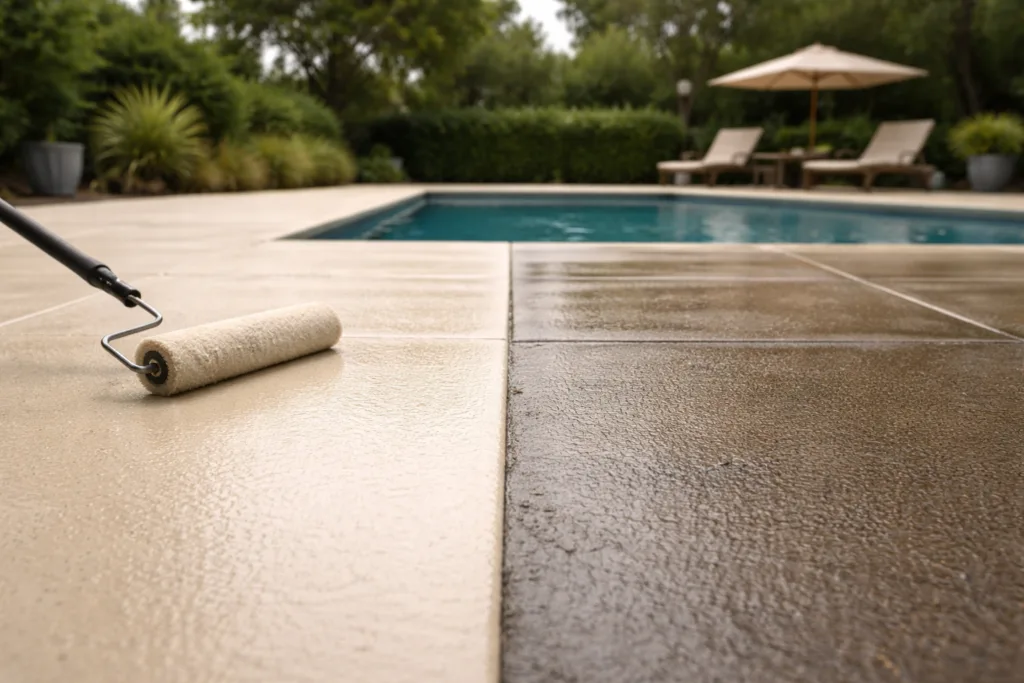
In the world of flooring and waterproofing, success depends as much on judgment and observation as it does on technology. When in doubt, slow down and test: the cost of a single failed coating is always higher than a lost day of drying. Rely on practical, repeatable field methods—the plastic film test, dew checks, and your own hands—to make coating decisions that last, whether you’re renovating a pool, a wall, or a showcase outdoor surface. A clean, dry, and well-observed slab is your best insurance against bubbling, whitening, and delamination—and the key to professional, lasting results.
Frequently Asked Questions
What is the biggest risk of coating over damp concrete?
The main risks include bubbling, whitening, and coating delamination, which all compromise durability and finish quality.
How does the plastic film test work for moisture detection?
It involves taping plastic to the substrate and checking for condensation after a few hours—a reliable sign of excessive moisture release.
Are there any coatings that can handle damp concrete?
Some advanced primers and specific resin systems tolerate slight moisture, but products must be system-matched and field-tested first.
Is visual inspection alone enough to judge dryness?
No, because sub-surface moisture can remain hidden; always combine touch, color, and plastic film checks for best results.
What can be done if the weather won’t cooperate for drying?
Forced air, gentle heating, or rescheduling the application window are your safest options; avoid coating at risk.
Why does whitening and bubbling happen under coatings?
When trapped moisture vaporizes, it disrupts resin curing, causing blushing (white areas) or bubbles as pressure builds beneath the film.
Related Reading
- How to Fix and Prevent Bubbles in Floor Coatings – Real-World Solutions
- Hairline Crack vs. Moving Joint: Field Repair Secrets for Long-Lasting Waterproofing
- Custom Flooring Resin Manufacturing – USA Project Insights and Coating Innovations
- Waterproof in 5 Steps: The Engineer’s Rapid Decision Tree for System Choice
- Epoxy Flooring Curing Explained: Master Time, Temperature & the Recoat Window