
Introduction: Why Temperature Dictates the Curing Dynamics of Epoxy Flooring
When it comes to epoxy flooring installations, a deep understanding of curing time, temperature, pot life, and recoat window is critical. These terms are more than just technical jargon—they directly impact your project’s flow, cost, quality, and long-term performance. Contractors who master these dynamics can avoid delayed schedules, costly failures, and even dangerous exothermic runaways. The behavior of epoxy resin is tightly bound to the environmental conditions on-site, with temperature playing a decisive role at every stage. This article explores real-world challenges and provides a detailed temperature-curing reference chart to empower professionals and facility managers alike.
Curing Time, Temperature, Pot Life, Recoat Window: Foundational Terms Explained
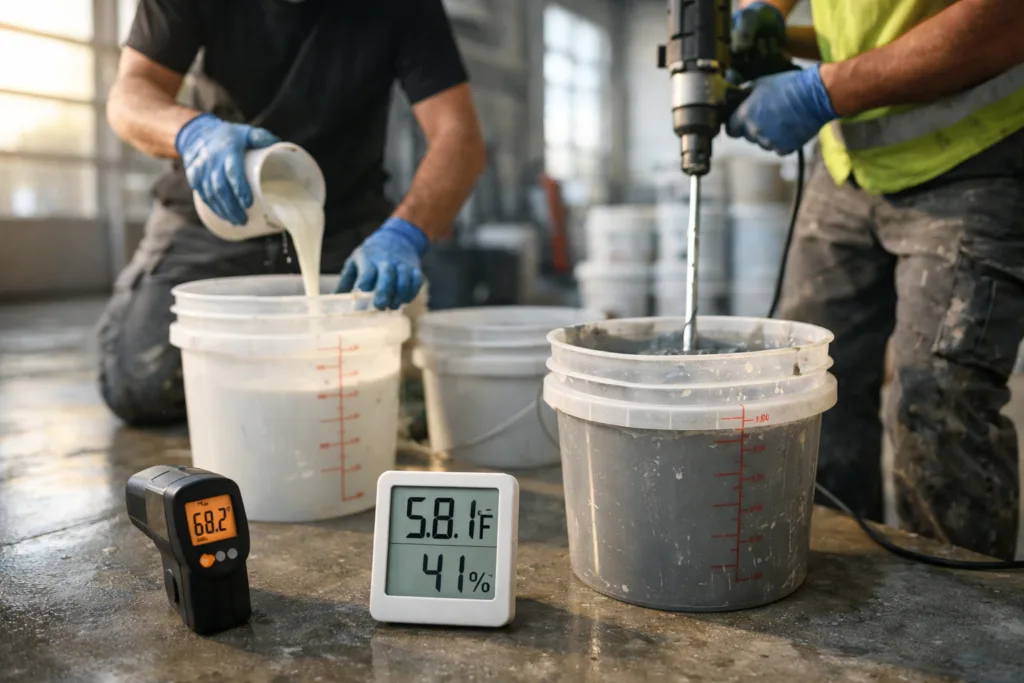
Before tackling advanced strategies, it’s vital to understand these foundational definitions:
- Curing Time: The total period required for epoxy to transform from a liquid to a fully set and chemically crosslinked solid. It includes both initial set and full cure phases.
- Temperature: The ambient and substrate temperature significantly impact the rate of reaction and curing throughout the process.
- Pot Life: The practical working time (after mixing) before the epoxy becomes too thick or exothermic for application. This is a safety-critical and scheduling parameter.
- Recoat Window: The specific timeframe in which a subsequent coat can be successfully applied for optimal adhesion, without sanding or risking delamination.
How Environmental Temperature Drives Curing Time and Pot Life
Every epoxy system reacts to temperature changes. When the environment gets warmer, chemical reactions speed up: pot life shortens, curing time drops, but so does working time. In contrast, low temperatures slow reactions, extend curing and limit adhesion quality if unchecked. The practical outcome? The same epoxy mix can behave like a sprint or a marathon depending on the conditions. For jobs on live sites—like busy manufacturing plants—this knowledge defines failure or success.
Understanding the Chemistry: Why Does Temperature Matter?
Epoxy flooring resins cure via a chemical reaction between resin and hardener molecules. This reaction is “temperature-dependent.” At higher temperatures, the molecules move faster, collide more often, and cross-link rapidly. But this can also lead to increased peak temperatures inside the mix (exotherms)—sometimes dangerously so. At colder temperatures, molecules move sluggishly, reducing cross-linking rates and possibly compromising final film properties or chemical resistance.
Pot Life vs. Working Time vs. Cure Time: Key Differences All Contractors Should Know
Pot life is not the same as working time. Pot life relates to how long the product is workable in the container, while working time describes the period you can apply and finish the epoxy on the surface. These times can differ drastically, especially with large batches in high temperatures where mass accelerates the reaction. Cure time is even longer—it extends until the system fully solidifies and reaches final properties. Misreading these differences can cause surface defects or failed adhesion.
Temperature-Curing Reference Chart: A Contractor’s Daily Tool
| Ambient Temperature (°C) | Typical Pot Life (min) | Hard Dry Time (hrs) | Full Cure Time (hrs) | Recommended Recoat Window (hrs) |
|---|---|---|---|---|
| 5 | 90-150 | 24-36 | 96-120 | 16-24 |
| 10 | 60-120 | 16-24 | 72-96 | 12-20 |
| 20 | 35-50 | 10-14 | 48-72 | 8-16 |
| 25 | 20-35 | 7-12 | 36-48 | 5-12 |
| 30 | 15-25 | 5-8 | 24-36 | 3-8 |
| 35+ | 8-15 | 3-6 | 16-24 | 2-4 |
Note: These are typical ranges for standard industrial epoxy systems. Consult resin manufacturer’s technical data for product-specific figures. Always adapt for large mix volumes, substrate temperature, and ambient humidity.
Thermal Runaway: Avoiding High-Temperature Hazards During Epoxy Installation
“Thermal runaway” occurs when an epoxy batch generates excessive heat due to accelerated reactions. In hot weather—or if you mix a large batch all at once—pot life can plummet, and the center of the mass can even smoke or scorch. This not only ruins the mix but also exposes installers to burns and releases fumes. Experienced contractors use smaller batches, ice-pack coolers, or stage mixing to avoid exothermic surges.
Low-Temperature Curing Challenges: Poor Adhesion and Surface Defects
Cold environments slow down the cure—it might seem convenient for longer working time, but the risks go up. At low temperatures (typically below 10°C), epoxies may not cure fully, leaving surfaces weak, tacky, and prone to delamination or water spotting. Adhesion to concrete can drop dangerously. Most manufacturers suggest minimum ambient and substrate temps (often 10°C/50°F). In some cases, forced heating (tenting, heat blowers) is needed for reliable results.
How Substrate Temperature and Ambient Humidity Complicate the Picture
It’s not just the air temperature. What matters is the minimum temperature of the concrete, steel deck, or tile floor you’re coating. If the substrate is cold (due to night air, ground contact, or shade), epoxy may not cure even if the ambient air is warm. High humidity can also produce surface blush, amine blooming, or fish eye defects in some systems. Always check both air and substrate conditions before mixing.
The Role of Batch Size and Mixing Discipline
Batch size matters enormously. A half-liter cup of epoxy may last half an hour on a mild summer morning, while a full 4-liter bucket in the same sun might begin to gel or smoke in ten minutes. ZDSpoxy’s field experience shows that breaking large pours into multiple small batches, and rigorously following mix ratios (never “eyeballing” harder or resin proportions), can cut failure rates dramatically. Always use clean, graduated containers and change the mix paddle every shift to avoid contamination.
Epoxy System Selection: Matching Cure Profiles to Site Temperatures
Not all epoxy systems are the same. Some are specially formulated for fast-cure at low temperatures; others are slow-cure for high-heat environments. The ZDS-1011AB Epoxy Fast-Curing Dual Layer Floor Coating, for example, offers a unique formula adapted for rapid turnaround without thermal spike in moderate climates. Always consult product technical data sheets and request trial samples before large installs.
Recognizing and Managing the Recoat Window
Missing the optimal recoat window can compromise inter-coat adhesion, leading to peeling or poor film formation. Most two-component epoxies have a “sweet spot” (often between tack-free and full cure) where the next layer bonds chemically before full crosslinking. If overcoated too late, sanding or surface activation is usually necessary. Strictly following the recoat window on the technical data sheet prevents call-backs and system failures.
Real-World Case: Curing Failure in a Cold Logistics Warehouse
Consider this scenario: a logistics contractor prepped a concrete slab at 7°C, mixing standard flooring epoxy (not formulated for low cure temps). Pot life seemed long, but after two days, the coating remained tacky, attracting dust and resisting forklift traffic. The issue? Inadequate substrate temperature meant the crosslinking reaction essentially stalled. The fix required tenting and indirect heaters to elevate slab temp above 12°C, restarting the cure, followed by surface repair. Proper temperature checks could have averted costly delays and lost time.
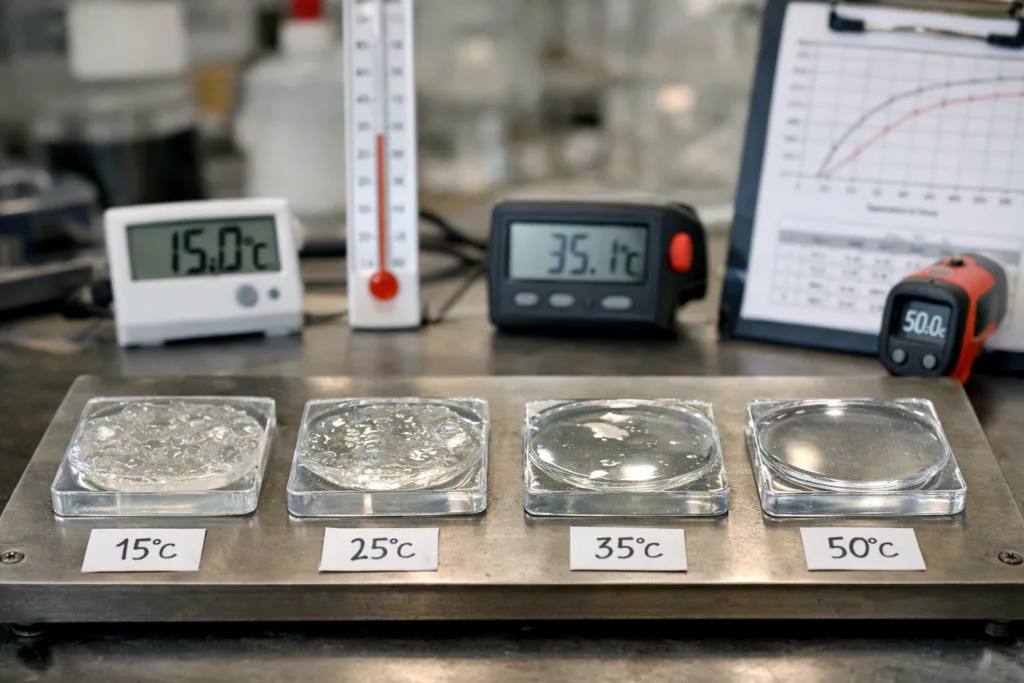
Strategies for Hot Climates: Tips for Managing Fast-Reaction Epoxies
- Mix smaller batches (never more than you can lay in 10 minutes in summer heat)
- Use cooling trays or ice-packs UNDER mixing buckets—never add water or ice directly to resin
- Precondition resin and hardener in air-conditioned space if possible
- Install earlier in the day (avoiding afternoon peak)
- Select slower-cure versions for large jobs
Cold Weather Application Preparation: Best Practices for Low-Temperature Curing
- Pre-warm both substrate and resin components (store drums indoors, use heated blankets)
- Schedule installs for midday, when surfaces are at their warmest
- Choose an epoxy with a curing agent designed for cold conditions
- Extend cure periods before returning areas to service
- Always monitor both air and floor temperature throughout application and cure
How Pot Life Impacts Project Planning, Labor, and Material Waste
If you overestimate pot life, material can harden in the bucket, resulting in wasted resin and lost time. Short pot life in warm weather means more frequent batch mixing, increased labor, and a greater risk of errors. Conversely, slow cure in cold conditions ties up crews and delays site turnover. Practical jobsite scheduling always factors in published pot life data adjusted for real-time conditions.
Choosing the Right Primer for Temperature Range
Primer selection is as critical as topcoat. Some primers, like the ZDS-1012AB Epoxy Primer for Concrete/Ceramic Floors, are optimized to ensure bond strength even in shifting site temperatures. Applying the wrong primer or skipping this step risks delamination, especially in fast-service or cold area installs.
Common Pitfalls: Top Causes of Curing and Adhesion Failures
- Poor surface preparation (oil, dust, moisture, salt, or old coatings reduce adhesion)
- Mixing errors (inaccurate ratio, poor paddle mixing, dirty containers)
- Overly thick application (traps air, impedes cure)
- Missing the recoat window (inter-coat failure)
- Ignoring substrate temperature (cure stalling or “ghosting”)
Quality Control Checks: Ensuring Consistency and Compliance
Reliable curing—and passing post-install QC—requires attention to detail:
- Check temperature and humidity with calibrated meters before and during work
- Track pot life and cure times for each batch—label all mixed containers
- Document “time of mix,” “time on floor,” and “recoat time” for every section
- Perform hardness and adhesion tests at turnover
Surface Moisture and Its Interaction with Cure Windows
Excess surface moisture can disrupt curing, especially at low temperatures where drying is slower. Resin can foam, create weak boundary layers, or trap vapor below the film. It’s crucial to confirm concrete is below 4–5% moisture content and use vapor barriers or dedicated primers if risk exists.
Advancements: Modern Epoxy Formulas for Challenging Curing Windows
Today’s two-part flooring systems, such as rapid-cure polyaspartics and specialty cold-cure epoxies, offer new flexibility. For instance, ZDS-1223AB Polyaspartic Clear Topcoat for Fast Flooring can drastically shrink cure windows, allowing overnight or even same-day turnaround, minimizing business interruption. Always match product selection to the project’s environmental constraints.
Documentation and Record Keeping: Professional Best Practice
Professional installers log weather and surface readings, batch details, and recoat intervals. These records provide an invaluable reference for later troubleshooting, warranty support, or refining process. ZDSpoxy encourages clients to maintain a site log for every significant flooring project.
Safety, Compliance, and PPE: Don’t Let Fast Cure Cause Neglect
Fast reaction times shouldn’t mean sacrificing safety. Full PPE—including gloves, goggles, and respirators—should be used, and workplaces must be adequately ventilated during mixing and cure. Residual exotherm can cause burns—never handle or discard hardening epoxy in standard trash until fully cool. Comply with all local VOC and emissions requirements for indoor projects to protect both staff and end users.
Curing Time, Temperature, Pot Life, Recoat Window: Summing Up the Practical Lessons
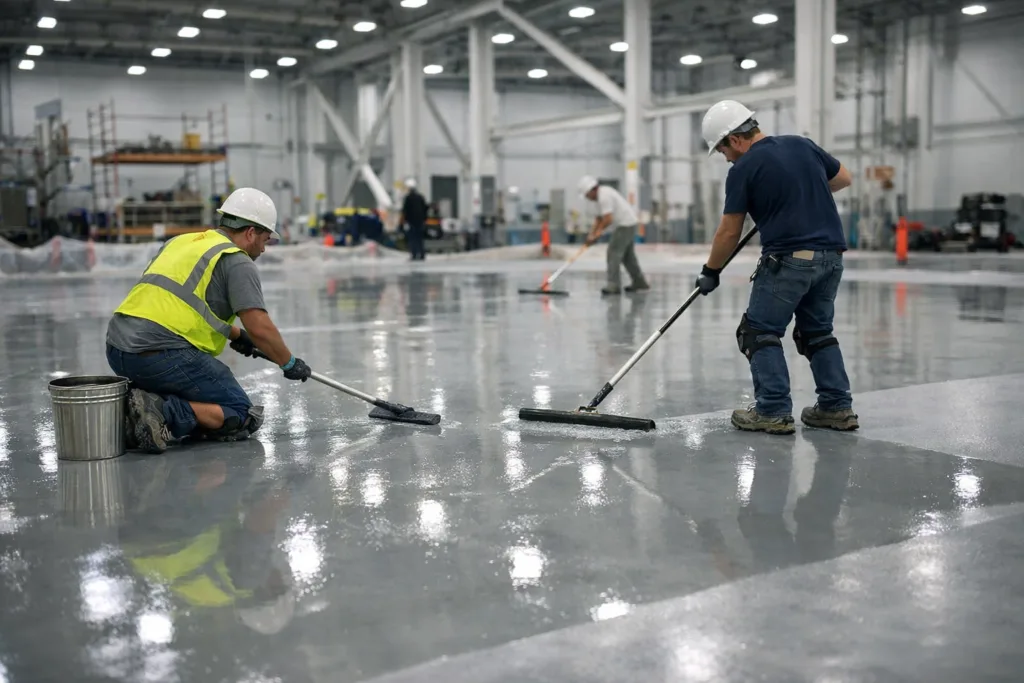
Mastery of curing time, temperature, pot life, recoat window transforms epoxy flooring from a risky gamble to a reliable process. Knowing how weather, site, and system interact means faster turnover, superior bond strength, and a clean, defect-free finish. Always check technical data, test in local conditions, and document every batch. Small adjustments make a big difference in both safety and performance.
Frequently Asked Questions
How does temperature impact epoxy pot life and cure time?
Higher temperatures accelerate epoxy reactions, shortening pot life and cure time, while lower temperatures slow curing, extend working time, and may risk incomplete crosslinking.
What can I do if the substrate is colder than the ambient air?
If the substrate is much cooler, it can delay or even stop epoxy curing. Warm up the substrate with heaters or delay application until both air and surface are within recommended temperature ranges.
How do I avoid missing the recoat window?
Carefully monitor the working environment, record the hours since application, and always follow technical datasheet guidelines for your specific system to avoid exceeding the recoat window.
Why does batch size affect pot life so much?
Larger volumes of mixed epoxy generate more heat, speeding up the reaction and reducing pot life dramatically—especially at higher temperatures. Always mix only as much as you can lay quickly.
Is it safer to use slow-cure epoxies at high temperature sites?
Yes, slow-cure systems are less prone to thermal runaway and buy installers more working time in hot conditions. Verify compatibility with your application requirements.
How can I ensure my epoxy floor passes quality control checks?
Carefully track pot life, curing times, and environmental data; perform adhesion and hardness tests; and record all project parameters for compliance and troubleshooting purposes.
Related Reading
- Essential Guide: Demystifying Pot Life, Working Time & Cure Stages for Contractors
- 7 Critical Insights for Epoxy Curing in Hot and Cold Weather
- Mastering Mix Ratios: Proven Methods to Prevent Epoxy Curing Failures
- The 7-Step Contractor’s Checklist for Choosing the Right Epoxy Primer
- Critical Concrete Moisture Tests No Installer Should Miss