
Epoxy Grout for Crusher Foundation
When it comes to heavy-duty mining equipment, the foundation beneath a crusher is a silent workhorse ensuring reliable, safe operation. The use of epoxy grout for crusher foundation lays the groundwork for performance in cone and gyratory crushers by dampening vibration, enhancing load transfer, and improving overall stability. As industries move toward high-capacity, precision crushing, the standards for foundation materials and grouting methods have tightened, placing epoxy grout at the forefront of dependable support.
The unique blend of mechanical strength and chemical resilience found in epoxy grout for crusher foundation offers a measurable advantage over traditional cementitious alternatives. This article explores the critical features of cone and gyratory crusher equipment, analyzes vibration risks, details grout layer thickness, and guides you through acceptance criteria to ensure your installation passes every test—practically and safely.
Understanding Crusher Equipment: Characteristics That Shape Grouting Needs
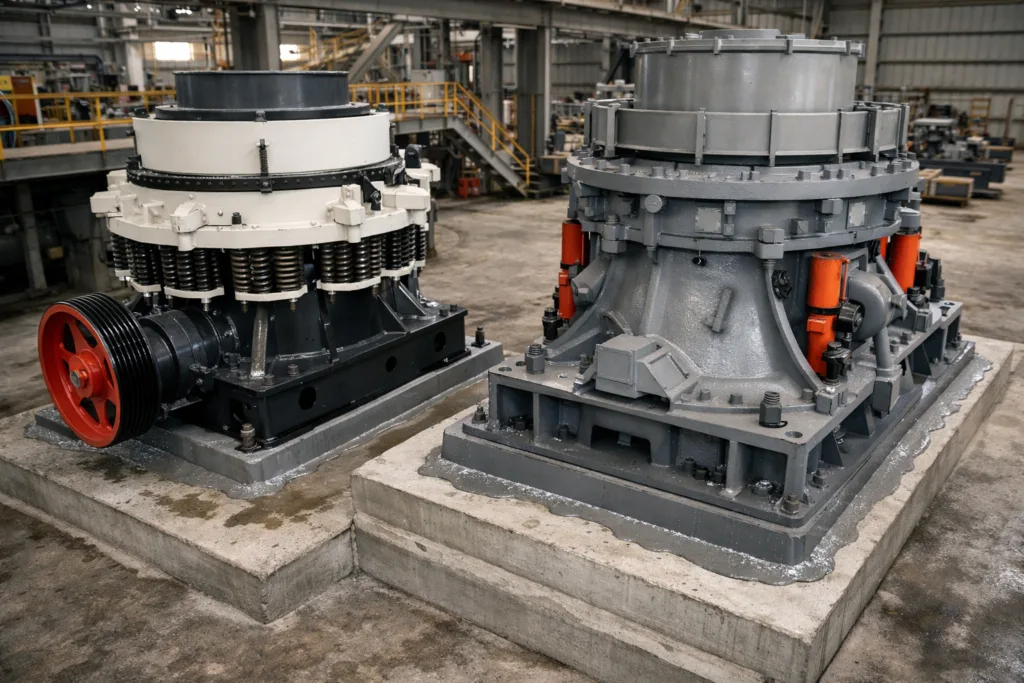
Large-scale crushing plants employ different machines, with cone and gyratory crushers among the most commonly used for robust mineral processing. Each type presents specific operational dynamics that influence epoxy grout for crusher foundation application.
Equipment Types: Cone vs Gyratory
- Cone Crushers: Widely used for secondary and tertiary crushing, cone crushers operate with a conical mantle mounted on a central vertical shaft. High-speed rotation and eccentric movement exert significant forces on the foundation, demanding high compressive and tensile grout strength.
- Gyratory Crushers: Favored for primary rough crushing, gyratory crushers feature a massive spindle. These machines operate under intense loads, and their wider base means the foundation area must resist complex vibration patterns and high impact events.
Equipment Load Distribution and Dynamic Forces
The crusher’s operation creates cyclic loads, resulting from material fragmentation and transmission of mechanical energy. These dynamic impacts travel directly to the foundation, making uniform load transfer and vibration damping absolute priorities. Epoxy grout’s non-shrink, high-fluid consistency ensures intimate contact and broad area coverage, minimizing weak spots.
| Crusher Type | Main Features | Foundation Challenge |
|---|---|---|
| Cone Crusher | Conical movement, rapid load cycles | Requires elastomeric and compressive support |
| Gyratory Crusher | Large spindle, heavy-duty crushing | Demands wide coverage, vibration control |
Vibration Risks in Crusher Foundation Engineering
Crushers generate considerable vibrational energy, transmitting it through both the machinery frame and into the foundation. Unaddressed vibration can mean disaster for both equipment and plant personnel.
Consequences of Insufficient Grouting
- Foundation Settling: Unfilled gaps or poorly bonded grouts allow movement, leading to misalignment and uneven load distribution.
- Crack Propagation: Excess vibration causes concrete micro-cracking, ultimately resulting in progressive structural failure.
- Bolt Loosening: Vibration may cause anchor bolts to lose tension, risking catastrophic equipment detachment.
Epoxy Grout’s Role in Vibration Control
Epoxy grout for crusher foundation gains its edge from its inherent toughness and flexibility compared to cementitious grout. The resin matrix absorbs and dissipates vibrational energy, acting as a shock absorber between baseplate and concrete. Key benefits include:
- Vibration Attenuation: Reduces transmission of mechanical shocks, protecting delicate components.
- Load Transfer Uniformity: Spreads dynamic forces, reducing localized stress.
- Longevity: Maintains performance characteristics over time, with minimal shrinkage, compared to other grouting options.
Critical Grout Layer Thickness for Crusher Foundations
Layer thickness plays a major role in the mechanical performance and longevity of epoxy grout for crusher foundation. Too thin, and the grout can’t absorb vibration or fill the space; too thick, and uncontrolled exotherm (heat) can compromise structural integrity.
Recommended Thickness Guidelines
- Conventional Range: Most manufacturers recommend between 25 mm and 100 mm, depending on the crusher’s size and operating load.
- Optimal Thickness Selection:
- For Cone Crushers: 35–70 mm, due to focused dynamic loads.
- For Gyratory Crushers: 50–100 mm, to account for broad footprint and higher impact energy.
Thickness and Performance Table
| Grout Layer Thickness | Application | Performance Impact |
|---|---|---|
| 25–40 mm | Light-duty, small cone crusher | Fast cure, limited vibration damping |
| 40–70 mm | Medium/large cone crushers | Balanced strength, good vibration absorption |
| 70–100 mm | Gyratory crushers | Maximum stability, superior load spread |
Layer Thickness: Best Practice Tips
- Follow equipment manufacturer and grout supplier guidelines precisely.
- Avoid exceeding recommended maximums; thick layers may overheat during curing, leading to shrinkage and loss of structural integrity.
- Prepare substrate and formwork to maintain consistent grout depth.
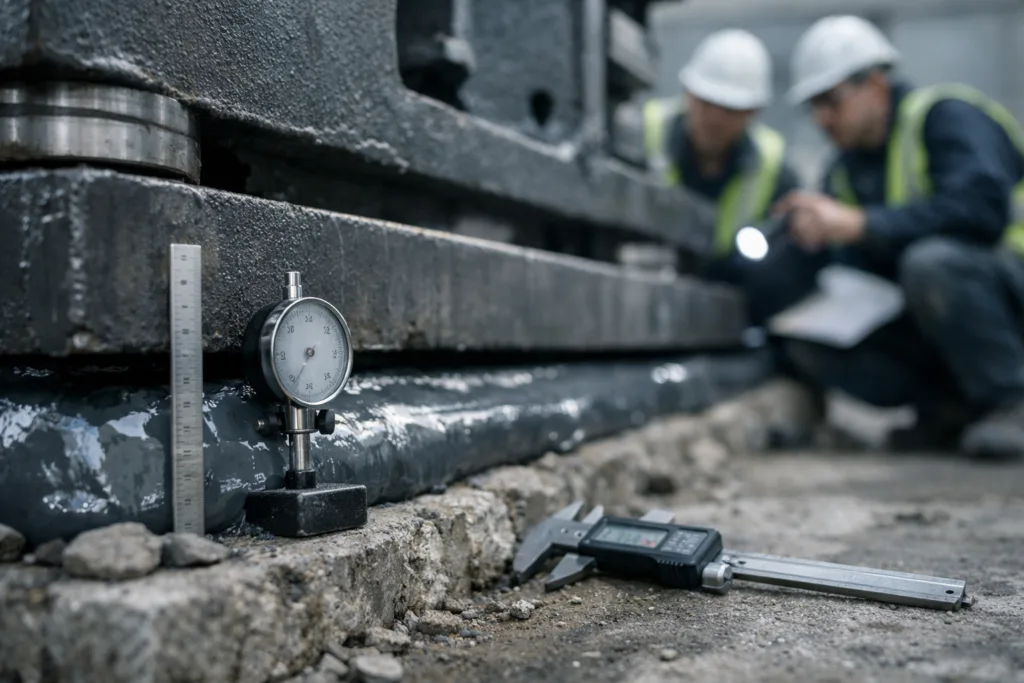
- Always measure thickness during and after placement for quality assurance.
Acceptance and Inspection Criteria for Crusher Foundation Grouting
Proper verification ensures that the epoxy grout for crusher foundation meets both functional and safety requirements. Accepting a grouted foundation requires rigorous inspection that shouldn’t be skipped—after all, this stage determines whether your installation will endure years of tough service.
Key Inspection Parameters
- Curing Time: Has the grout reached minimum strength before load introduction?
- Layer Uniformity: Is grout thickness consistent throughout the base?
- Bond Integrity: Are there any visible cracks, voids, or unbonded sections?
- Adhesion Tests: Can the grout resist delamination from both steel and concrete surfaces?
- Compressive Strength: Does the grout meet design specifications?
Acceptance Table
| Criterion | Test/Observation Method | Required Value |
|---|---|---|
| Curing Time | Elapsed time check | Manufacturer’s minimum (often 24–48 hrs) |
| Uniform Thickness | Depth gauge/mapping | Within ±5 mm of specified |
| Bond Integrity | Visual inspection, hammer tap | No voids, solid bond |
| Adhesion | Pull-off test | >2 MPa typical |
| Compressive Strength | Lab test samples | >80 MPa common |
Quality Control Steps
Document all inspection outcomes, retain test samples for future reference, and require sign-off from site engineering and supplier technical representatives. Should any criteria fall short, coordinate corrective action—don’t settle for partial performance.
Material Selection: Choosing the Right Epoxy Grout for Crusher Foundation
The market offers a wide array of epoxy grout formulations, each tuned for different environmental and mechanical requirements. Selecting the right grout is fundamental for safety and longevity in crusher installations.
LSI Factors for Selection
- Compressive Strength: Higher values increase load capacity and shock resistance.
- Chemical Resistance: Essential in acid-prone or corrosive mining environments.
- Flowability: Guarantees filling of intricate or inaccessible spaces.
- Low Shrinkage: Maintains load paths over the life of the equipment.
- Extended Pot Life: Needed for large pours and complex bases.
Common Additives and Modifiers
- Aggregates: Improve bulk properties, lower resin content, and lower shrinkage.
- Fillers: Used to adjust viscosity and tailor mechanical performance.
- Microfibers: Enhance crack resistance and impact absorption.
Practical Installation Steps for Epoxy Grout in Crusher Foundations
Proper installation underpins performance. Even the best epoxy grout for crusher foundation will fail if placed incorrectly. The following sequence reflects best practices used throughout the industry.
Preparation
- Remove debris, dust, and oil from both concrete and baseplates.
- Roughen concrete substrate for mechanical anchoring.
- Seal formwork to prevent grout leakage.
Mixing and Application
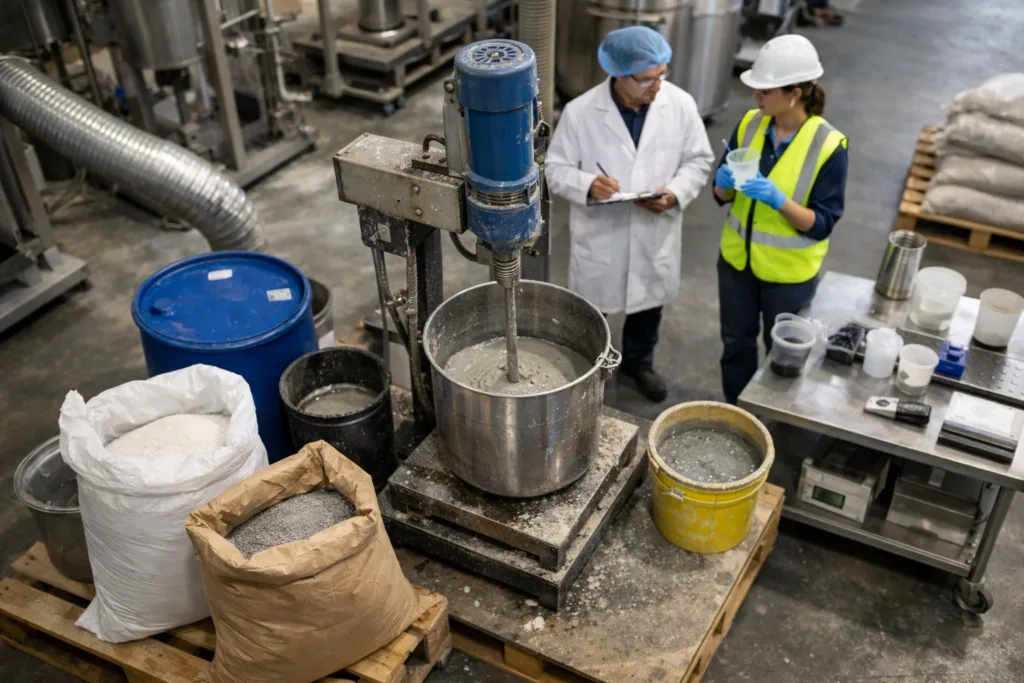
- Mix resin, hardener, and aggregates according to manufacturer’s ratio. Mechanical mixing ensures uniform dispersion.
- Pour grout continuously, starting at one end, using gravity or low-pressure pump.
- Vibrate or tap forms gently to release trapped air and promote flow.
- Do not overwork the grout; avoid double-pouring.
Curing and Removal
- Allow minimum curing time before equipment startup.
- Remove forms without shock or prying.
- Protect grout from water, vibration, or freeze-thaw cycles during curing.
Surface Preparation for Crusher Foundation Grouting
Epoxy grout for crusher foundation only performs as well as the surface it bonds to. Meticulous surface preparation is non-negotiable.
Essential Prep Activities
- Surface Cleaning: High-pressure air blowers and industrial vacuums strip dust and fragments.
- Moisture Control: Dry concrete ensures polymer adhesion; use heat lamps or fans in damp conditions.
- Profile Creation: Shot-blasting or grinding roughens concrete to anchor the resin matrix.
- Chemical Cleaning: Solvent wipes eliminate grease and oil, preventing adhesion failure.
Verification Procedures
- Perform water-droplet adhesion or pull-off tests on concrete.
- Reject any substrate with unremovable contaminants or moisture content above recommended maximums.
Common Issues and Troubleshooting in Crusher Foundation Grouting
Even seasoned teams may encounter setbacks. Identifying and correcting problems early keeps the installation on track and the foundation robust.
Typical Problems with Epoxy Grout
- Cold Joints: Result from interrupted pouring; cured edges prevent full adhesion.
- Air Entrapment: Bubbles mar strength and can become crack nuclei.
- Premature Setting: High ambient temperature causes rapid cure, limiting work time.
- Excessive Exotherm: Overly thick pours heat up, risking thermal shrinkage.
Practical Fixes
- Divide large pours into sections or use lower-exotherm formulations.
- Control environmental temperature and humidity in the pour area.
- Use vibration to eliminate bubbles.
- For cold joints, cut back cured grout and reapply after surface roughening.
Comparison: Epoxy Grout vs Cementitious Grout for Crusher Foundations
Selecting between epoxy grout for crusher foundation and cement-based alternatives can impact both installation success and lifecycle costs.
| Aspect | Epoxy Grout | Cementitious Grout |
|---|---|---|
| Compressive Strength | 80–100 MPa | 40–60 MPa |
| Shrinkage | Minimal | Moderate–high |
| Chemical Resistance | Excellent | Poor–moderate |
| Vibration Absorption | High | Low |
| Curing Time | Fast (24–48 hr) | Slow (3–7 days) |
| Suitable Layer Thickness | 25–100 mm | 20–60 mm |
The evidence favors epoxy grout for crusher foundation installations in high-impact, critical applications. Cementitious options may suffice in budget-sensitive or less demanding environments, but rarely match the performance or longevity required for modern crushers.
Life Cycle and Maintenance of Epoxy Grout Foundations
No foundation lasts forever without attention, but epoxy grout for crusher foundation helps make that maintenance cycle a predictable, manageable expense.
Preventive Measures
- Schedule periodic visual and hammer inspections for cracking or debonding.
- Re-tighten anchor bolts at prescribed intervals as grout may creep slightly with constant vibration.
- Clean and seal exposed grout surfaces every 3–5 years in aggressive chemical environments.
Repair Protocols
- Small cracks or surface chips can be repaired with fast-curing patch epoxy.
- Major failures require cutting away damaged grout, profiling the concrete, and complete repouring.
- Inspection after repairs must duplicate initial acceptance criteria.
Industrial experience consistently shows well-maintained epoxy grout for crusher foundation installations last ten years or more, often outlasting equipment itself.
Safety and Environmental Considerations When Using Epoxy Grout for Crusher Foundation
Working with industrial epoxy grout for crusher foundation brings its own health, safety, and environmental responsibilities.
Personal Safety
- Wear chemical-resistant gloves, sleeves, goggles, and respiratory masks.
- Provide proper ventilation for workers mixing and placing grout.
- Have first aid protocols and spill kits available onsite.
Environmental Protocols
- Use low-emission (low VOC) epoxy systems when possible.
- Prevent uncured resin from contacting soil or water.
- Dispose of containers and unused product following local hazardous waste regulations.
- Clean-up tools and mixing area using recommended solvents only.
Learn more about Heavy Machinery Epoxy Grout Systems. or zds-1410ab
ZDSpoxy Brand Voice: Manufacturing Insights into Epoxy Grout for Crusher Foundation
From a manufacturer’s perspective—such as ZDSpoxy—epoxy grout formulation for crusher foundations requires balancing engineering realities with field challenges. Industrial-grade epoxy resins demand precise selection based on viscosity, cure time, exothermic reaction control, and shrinkage.
At ZDSpoxy, material scientists begin by evaluating site conditions and equipment demands. The selection of base resin (bisphenol, novolac, or advanced hybrid) determines chemical resistance and flow characteristics. Pot life and cure time are carefully tailored for multi-hour pours under variable plant temperatures, using fillers like silica or engineered aggregates to boost compressive strength and minimize exotherm.
Surface preparation is emphasized; even the best epoxy will fail without a robust substrate. ZDSpoxy’s technical team recommends mechanical profiling, thorough cleaning, and moisture control as standard practice. Mix ratios are rigorously tested to optimize flow and minimize air entrapment—for crusher bases, too much air can be a recipe for early joint failure. Quality assurance focuses on adhesion, compressive strength, and pull-off tests. Most failures stem from either improper mixing or incomplete surface prep—issues easily remedied with strict onsite QC.
If you’re seeking an epoxy resin manufacturer or custom epoxy system supplier for critical machinery such as crusher foundations, consider consulting technical experts like those at ZDSpoxy, who provide tailored solutions for demanding installations.
Case Study: Successful Epoxy Grout for Crusher Foundation Implementation
Consider a mining plant upgrading its primary gyratory crusher, facing excessive vibration and anchor bolt failures due to inadequate cementitious grouting. After switching to a high-performance epoxy grout, following best practices for surface prep, formwork, and controlled pour thickness, the foundation endured a full production cycle with no failures. The result? Reduced maintenance shutdowns, improved alignment retention, and higher equipment output.
Key Takeaways
- Careful material selection and installation eliminate historic problems.
- Close adherence to inspection criteria predicts long-term reliability.
- Consulting with experienced manufacturers improves outcomes.
Best Practices Checklist for Epoxy Grout for Crusher Foundation
- Confirm substrate preparation and moisture content.
- Verify all formwork and containment for leaks and proper thickness.
- Mix and place epoxy grout according to supplier protocol.
- Monitor grout temperature during placement, avoid thick lifts.
- Document curing progress and inspect before load introduction.
Recent Innovations in Epoxy Grout Technology for Crusher Foundations
Modern epoxy grout systems integrate microfibers for crack resistance, hybrid resin blends for faster cure in cold climates, and even self-levelling formulations for complex base geometries. These advances enable precision alignment and reduce the risk of installation errors, lengthening the effective lifecycle of crusher installations. Manufacturers continue to push for greener, lower-VOC chemistry without sacrificing durability—benefiting sites with strict air quality rules.
Global Standards and Compliance for Epoxy Grout in Heavy Machinery Foundations
International standards from organizations such as ASTM, DIN, and GB/T (China) guide grout selection, installation, and acceptance for heavy equipment foundations. Projects should reference key standards such as ASTM C878 for compressive strength and ASTM C579 for chemical resistance testing.
- Adherence assures regulatory compliance and plant safety.
- Documentation supports future audits and planning for upgrades.
Sustainability and Waste Reduction in Crusher Foundation Grouting
Epoxy grout for crusher foundation, as part of advanced construction practices, enables minimal waste and high resource efficiency. Batch mixing and precise formwork ensure nearly all product is used in-place, limiting site footprint. Modern systems are formulated for longer shelf stability, reducing expiration-related disposal. Some suppliers reclaim unused resin or aggregates—creating a closed-loop process.
[epoxy grout for crusher foundation]
Epoxy grout for crusher foundation stands as a cornerstone of safe, productive, and long-lasting mining facility operations. Its unique blend of mechanical strength and chemical resilience supports cone and gyratory crushers under extreme vibration and shock loads. The right grout thickness, meticulous surface preparation, and acceptance testing ensure the installation meets every operational standard. Whether you’re planning an upgrade or tackling a new plant build, investing effort in optimal grouting will pay dividends for years to come.
Frequently Asked Questions About Epoxy Grout for Crusher Foundation
What is epoxy grout for crusher foundation?
Epoxy grout for crusher foundation is a polymer-based material used to fill the gap between heavy crushers and their concrete bases, ensuring vibration control, load transfer, and protection against shock and environmental forces.
How thick should the epoxy grout layer be for gyratory and cone crusher foundations?
Epoxy grout thickness typically ranges from 35–100 mm, with cone crushers favoring 35–70 mm and gyratory crushers needing 50–100 mm to account for broader coverage and heavier forces.
Why is vibration control important in crusher foundation grouting?
Vibration control prevents foundation settling, cracking, and anchor bolt loosening, safeguarding both equipment integrity and site safety. Epoxy grout’s flexibility and damping properties make it ideal for this need.
What are the key inspection criteria for accepting a crusher foundation grouting?
Inspection criteria include curing time, uniform grout thickness, bond integrity, adhesion (pull-off test), and compressive strength—each verified before equipment startup.
What are common problems during epoxy grout installation?
Typical issues include cold joints, air entrapment, premature setting, and excessive exotherm. Corrective steps include sectioned pours, temperature control, vibration, and careful mixing.
How long will a properly maintained epoxy grout foundation last in mining applications?
A well-installed and maintained epoxy grout foundation can last for 10–20 years, often outliving the crusher itself, provided periodic inspections and prompt repairs are done.
Conclusion
Robust, reliable, and resilient—epoxy grout for crusher foundation is the preferred solution for modern heavy-duty mineral processing facilities. By understanding equipment characteristics, controlling vibration risk, selecting optimal grout thickness, and adhering to strict acceptance criteria, plant engineers and operators ensure lasting stability and performance. Collaboration with experienced manufacturers and adherence to best practices unlock the full longevity and reliability of a crusher installation. Looking ahead, continuing advances in formulations mean epoxy systems will remain vital to safe, sustainable industrial construction. Whether you’re upgrading an aging foundation or launching a new facility, the investment in high-quality epoxy grout pays dividends — for your equipment, workforce, and bottom line.