
Introduction: Why Grouting Reciprocating Compressors Matters in Extreme Vibration Environments
Grouting reciprocating compressors is a critical engineering task, especially in environments where extreme vibration threatens equipment reliability. Without a stable foundation, these powerful machines can suffer from misalignment, excessive wear, and early failure. Grout forms the essential interface between the compressor base and its foundation, locking metal components in place, absorbing loads, and mitigating the damaging effects of constant vibration. This article explores effective grouting for reciprocating compressors, examines material choices—including advanced epoxy systems and traditional cement-based options—and offers practical insights on installation, maintenance, and troubleshooting for vibration control.
Understanding Reciprocating Compressor Vibration
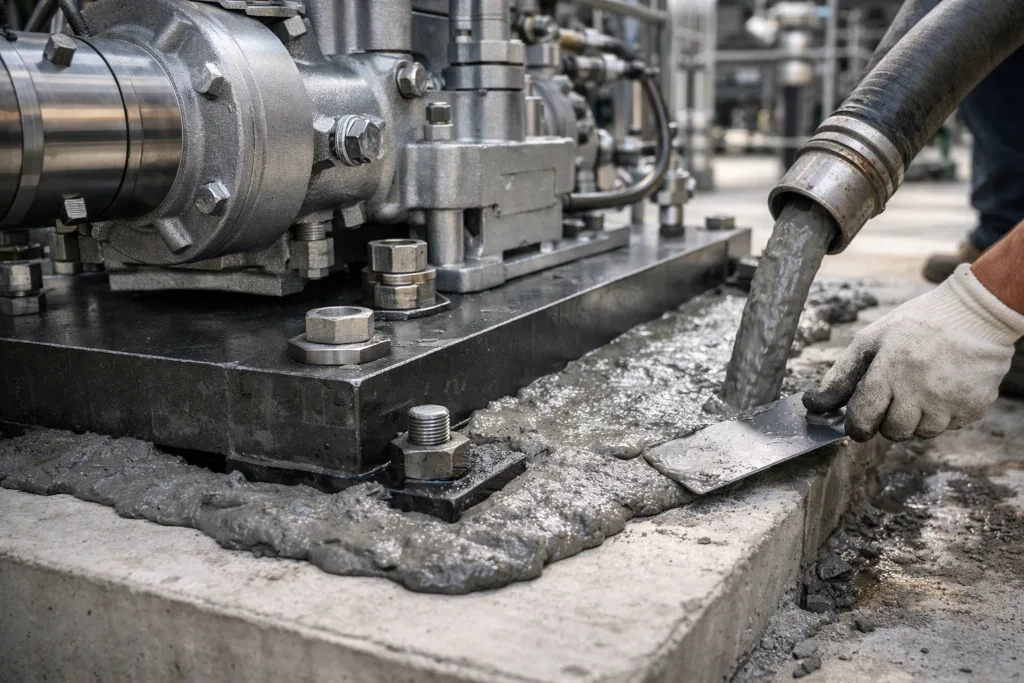
Reciprocating compressors create pulsating forces, thanks to the movement of pistons and connecting rods. These forces translate into vibration, which, if uncontrolled, can travel through metal components and foundation structures. Over time, vibration can loosen anchor bolts, crack concrete, or deform the compressor frame itself. The result? Lower efficiency, rising maintenance costs, and sometimes catastrophic failure.
The Physics of Vibration in Metal Components
Vibration results from dynamic loads—forces that change direction and intensity. In reciprocating compressors, vibration is generated by the reciprocating mass, coupling misalignment, and resonance within metal components. The type, frequency, and amplitude of vibration depend on operating speed, compressor design, and installation quality. High-frequency vibration is especially dangerous, as it can fatigue metal and compromise grouting integrity if not properly engineered.
Why Grout Is the First Line of Defense
Proper grout absorbs and redistributes these dynamic loads, preventing vibration from damaging the compressor base. It acts as a shock absorber and as a rigid bond, minimizing micro-movement in metal components. Epoxy grout, with its high compressive strength and excellent adhesion, is particularly effective at controlling vibration. Cementitious grouts, meanwhile, offer cost efficiency for less demanding situations.
The Role of Grouting in Reciprocating Compressors
Grouting ensures that the compressor baseplate is tightly anchored to its foundation, maintaining alignment and structural integrity. By filling gaps and eliminating voids, grout enhances vibration control and keeps metal components stable, even under heavy load cycles. A well-designed grouting system is essential for compressor reliability, especially where vibration levels are extreme.
Key Functions of Grout in Compressor Installations
- Anchors the compressor base to the concrete foundation
- Distributes dynamic loads evenly
- Reduces micro-movement and vibration transmission
- Protects baseplate from corrosion and contamination
- Improves operational safety and lowers maintenance costs
Materials Used in Grouting: Epoxy vs. Cement-Based Options
Choosing the right grout material depends on vibration levels, temperature, baseplate geometry, and installation timelines. Epoxy-based grouts lead the industry for applications where vibration control is paramount.
Epoxy Grouts: Advantages and Trade-Offs
| Property | Epoxy Grout | Cementitious Grout |
|---|---|---|
| Compressive Strength | High (10,000–14,000 psi) | Moderate (4,000–8,000 psi) |
| Bond to Metal Components | Excellent | Good |
| Resistant to Vibration | Superior | Moderate |
| Chemical Resistance | High | Low–Moderate |
| Application Complexity | Requires careful mixing | Simple mix/apply |
| Cost | Higher | Lower |
Epoxy grout is ideal for reciprocating compressors in environments with extreme vibration, aggressive chemicals, or tight tolerances. Cement-based grouts still have their place—but only where vibration is mild and budget constraints dominate.
Installation Reality: Epoxy Mixing and Application
Epoxy grouts require precise mixing ratios and careful batch size control. Large pours can generate excess heat, called exotherm, reducing working time and potentially creating shrinkage or voids. Contractors must ensure formwork is well-sealed and air is properly released. ZDSpoxy engineers recommend gradual mixing and periodic gel time checks to guarantee batch consistency—a step often missed in rushed site conditions.
How Vibration Affects Compressor Performance and Longevity
Extreme vibration accelerates bearing wear, seal failures, and fatigue cracks in metal components. Micro-movement in the compressor baseplate leads to misalignment, increasing friction and energy consumption. Unstable foundations magnify vibration, making maintenance more frequent and expensive. Proper grouting addresses these risks head-on.
Common Symptoms of Poor Grouting
- Loose anchor bolts
- Cracks in the concrete foundation
- Visible movement at the compressor base
- Unexplained bearing or seal failures
- Excess noise and vibration
Best Practices: Installing Grout for Vibration Control
To maximize vibration control, follow these key steps for grouting reciprocating compressors:
- Surface Preparation: Clean baseplates—remove oil, grease, and dust. Moisture and contamination prevent proper grout adhesion.
- Primer Selection: In damp environments or where long-term adhesion is critical, use a solvent-free epoxy primer. See Solvent-Free Primer for Wet Concrete for details on advanced primer choices.
- Formwork Setup: Seal all gaps. Formwork must contain grout and allow for proper flow beneath the baseplate.
- Mixing Discipline: Ratio accuracy prevents cure failure. For epoxy grout, stir thoroughly for batch consistency—refer to ZDSpoxy mixing guides when using high-performance grouts.
- Pours and Air Release: Pour in continuous batches, avoiding air entrapment. Use mechanical vibrators or spiked rollers to eliminate bubbles.
- Cure Management: Maintain temperature within specified limits. Early loading or rapid temperature changes can compromise grout strength.
Troubleshooting Grouting Issues for Reciprocating Compressors
Even with the best practices, unexpected issues can arise. Key troubleshooting tactics include:
- Check for voids beneath the baseplate using ultrasonic or striking tests
- Inspect anchor bolt tightness after curing
- Look for uneven curing or color changes, indicating mix inconsistency
- Monitor vibration after installation—significant reduction signals proper grouting
If air pockets or incomplete bonding are found, specialized repair grouts like Epoxy Concrete Repair can restore integrity without full regrouting.
Case Study: High-Performance Epoxy Grout for Compressor Bases
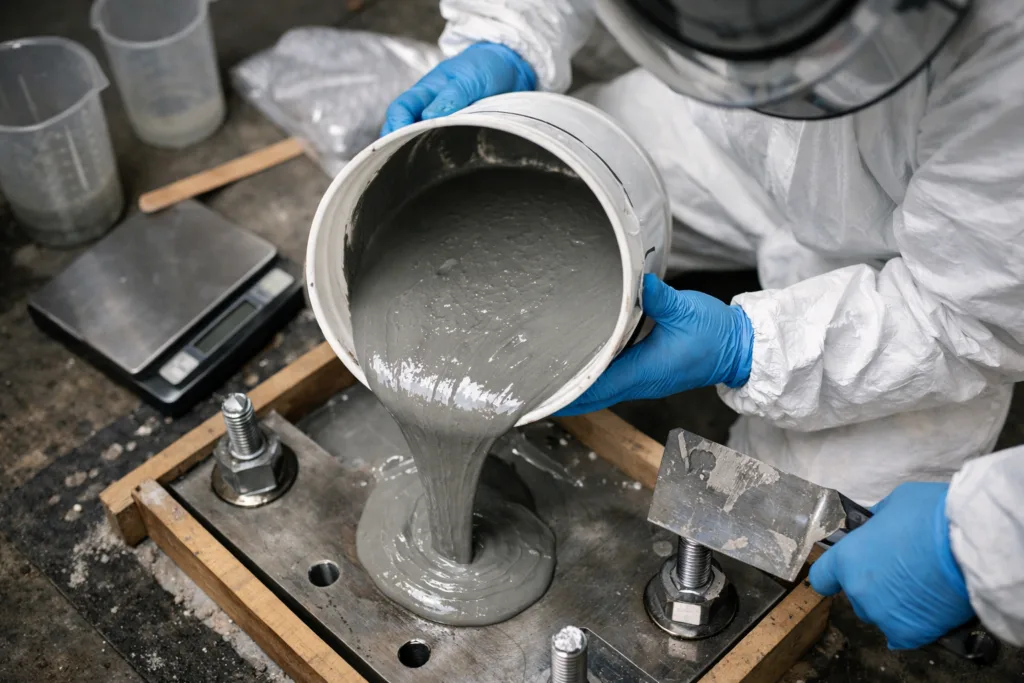
ZDSpoxy’s high compressive epoxy grout systems, such as ZDS-1410AB, are used to grout reciprocating compressor bases in severe vibration environments. These systems deliver stable, shrink-resistant bonds with tested reliability under pulse loads. The compressive strength (often exceeding 12,000 psi) keeps baseplates anchored even during sudden surges or shutdowns. Mixing and curing must follow strict protocols to avoid hot spots, especially with large pours.
Maintaining Grout Integrity: Routine Inspection Tips
Routine checks extend the life of grouted compressors. Inspect the grout for cracking, debonding, or fluid leaks. Periodically re-torque anchor bolts and monitor vibration trends. Foundation repairs should be prompt to prevent secondary damage. ZDSpoxy recommends maintaining a log of all inspection findings for ongoing reliability.
Advances in Grouting Technology for Vibration Control
Modern epoxy grouts incorporate additives for improved flowability and lower exotherm, making them easier to pour in large installations. Low-viscosity options enable tight-gap filling, essential for advanced compressor mounting designs. Automation in mixing and application boosts quality and repeatability on high-volume jobs, lowering the risk of user-induced errors. Look for material certifications, batch records, and onsite quality checks for assurance.
Installation Checklist: Ensuring Long-Term Reliability
Before commissioning a reciprocating compressor, review:
- Surface preparation completed (clean, dry, primed)
- Formwork tightly installed
- Mixing ratios double-checked
- Grout poured without interruption
- Air release methods used
- Cure time observed as per specifications
Tool-assisted planning helps. Calculate the required grout volume for your compressor base using our Epoxy Grout Volume Calculator Project Quote for accuracy and cost control.
Safety and Compliance: Handling Epoxy and Cement-Based Grout
Follow all PPE and ventilation guidelines when handling epoxy or cement-based grout. Store materials out of direct sunlight and keep batch records for compliance. Epoxy formulations must be checked for VOC content on sensitive sites. Proper disposal and site cleaning prevent environmental contamination.
Practical Tips for Vibration Control in Reciprocating Compressors
- Choose an epoxy grout with tested compressive strength and vibration resistance
- Never neglect surface prep (oil, moisture, dust)
- Use mechanical vibration testing pre- and post-grouting to verify effectiveness
- Maintain a cure log, noting temperature and humidity
- Consult batch data for consistent performance
Grouting Reciprocating Compressors: Handling Extreme Vibration

Proper grouting is not just a technical requirement—it’s the cornerstone of reliability for reciprocating compressor installations. Handling extreme vibration means selecting the right grout, installing it precisely, and maintaining its integrity over the lifecycle of the equipment. Follow the outlined best practices, troubleshooting tips, and safety guidelines to avoid costly failures and maximize your compressor’s lifespan.
Frequently Asked Questions
What is the main purpose of grouting reciprocating compressors?
The main purpose is to anchor the compressor base securely, minimize vibration, distribute loads, and improve reliability by preventing micro-movement and misalignment.
How does vibration affect compressor performance?
Excessive vibration causes misalignment, increases bearing and seal wear, leads to premature component failure, and raises maintenance costs. Proper grout minimizes these risks.
Which grout material is best for extreme vibration?
Epoxy grout is best for handling extreme vibration due to its high compressive strength, excellent metal bonding, and superior durability compared to cement-based grouts.
How can I identify poor grouting in my compressor installation?
Look for loose anchor bolts, cracks in the foundation, baseplate movement, increased vibration or noise, and early component failures as signs of poor grouting.
What steps are essential for proper grout installation?
Thorough surface prep, accurate mixing, well-sealed formwork, continuous pours, air-release, and scheduled curing are essential for effective grout installation.
How often should compressor grout be inspected?
Routine inspections—at least quarterly or after major events—help detect issues early. Inspect for cracks, debonding, leaks, and anchor bolt stability each time.
Related Reading
- Recovering Maintenance Budgets with Superior Grouting: How Seal Life is Affected
- Proven Vibration Elimination for Refinery Pumps: Practical Methods
- Top-Rated Grouting Techniques for Retrofit Pump Bases
- Metal Fabrication Lessons: Optimize Stability with Baseplate Grout Hole Design
- Engineer’s Guide to Grouting Vertical Inline vs Horizontal Split Case Pumps