
Introduction: The Critical Role of Grouting in Turbo-Machinery Foundations
Grouting is a fundamental step in the installation of turbo-machinery, affecting performance, reliability, and lifespan. In industrial settings, soleplates and baseplates act as the primary interfaces between machinery and foundation. Choosing the right grouting technique, whether soleplate or baseplate, impacts vibration damping, alignment precision, and maintenance access. This article explains key differences, examines grouting material selection, and highlights practical case studies for turbo-machinery professionals seeking optimal results.
For those planning a new installation or troubleshooting vibration problems, understanding the grouting nuances can mean the difference between seamless operation and costly downtime. If you’re calculating project requirements, the Epoxy Grout Volume Calculator Project Quote can help estimate materials for both soleplate and baseplate systems.
Understanding Grouting and Its Importance for Turbo-Machinery Alignment
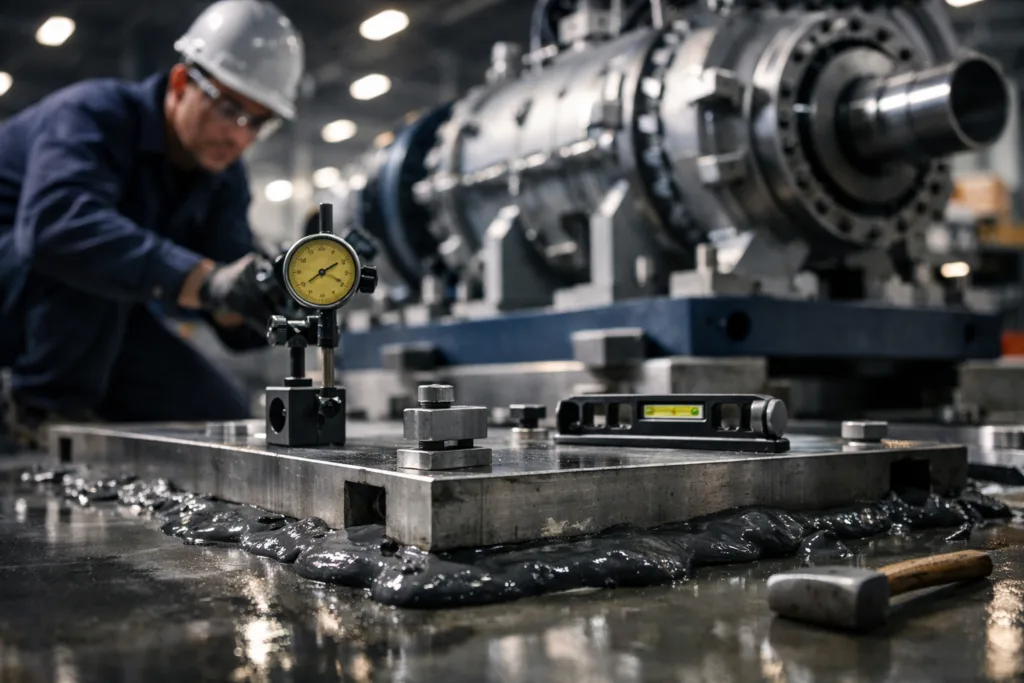
Grouting fills the gap between the machinery plate and foundation, distributing load and anchoring the machine. This prevents movement caused by vibration, shock, and operational loads. Accurate alignment is essential; even slight shifts can affect efficiency or cause costly failures. Soleplate and baseplate grouting address these demands differently, so choosing the best approach requires knowing the site conditions, equipment, and maintenance plans.
What Is a Soleplate?
A soleplate is a steel plate placed below machinery feet or anchoring points. It allows precise levelling during installation, acting as a stable interface. Grout is applied around and underneath the soleplate to secure it to the foundation, ensuring load transfer and vibration isolation. Soleplates often feature alignment holes, machined surfaces, and recesses for anchor bolts.
Soleplate Grouting: Workflow and Key Considerations
Soleplate grouting involves preparing the foundation surface, positioning the soleplate, and applying the grout. Success depends on careful surface cleaning, proper mixing ratios, and controlled pouring. With Heavy Machinery Epoxy Grout, engineers can achieve high compressive strength and excellent adhesion. Curing times, ambient temperature, and grout formulation influence results.
What Is a Baseplate?
A baseplate is a larger steel structure that supports the complete machinery assembly, sometimes including the soleplate itself. The baseplate typically has a greater surface area, mounting multiple machine feet and distributing loads across a broader foundation footprint. Grouting under the baseplate aims for total contact, reducing gaps that can become points of stress.
Baseplate Grouting: Application and Optimized Techniques
Baseplate grouting requires formwork for containment and consistent grout thickness. Techniques like full-bed and chock grouting are used, depending on machinery vibration patterns and loads. Properly grouted baseplates limit foundation movement, enhance vibration damping, and simplify future maintenance. Selecting a grout with flowability, low shrinkage, and high chemical resistance is key for baseplate longevity.
Comparing Soleplate and Baseplate Grouting for Turbo-Machinery
| Criteria | Soleplate Grouting | Baseplate Grouting |
|---|---|---|
| Alignment Precision | High (small, controllable area) | Moderate to High (depends on size & access) |
| Vibration Damping | Effective at individual points | Superior for distributed loads |
| Ease of Maintenance | Accessible; individual plates removable | Requires larger-scale intervention |
| Installation Speed | Quick for small machinery | Longer for complex assemblies |
| Material Use | Less volume, targeted application | Greater volume, uniform coverage |
Advantages of Soleplate Grouting
- Excellent for precision alignment of critical machinery.
- Facilitates easy adjustments or replacements.
- Reduces localized stress points, protecting anchor bolts.
- Ideal when machinery needs frequent alignment checks.
Advantages of Baseplate Grouting
- Distributes vibration and load across larger foundation area.
- Superior damping for heavy-duty turbo-machinery applications.
- Minimizes risk of uneven settlement or gap formation.
- Suitable for high-power compressors, turbines, and generators.
Disadvantages and Limitations
- Soleplate grouting may require more initial alignment labor.
- Baseplate grouting can demand extensive formwork and curing time.
- Both methods are sensitive to foundation quality and surface prep.
- Ineffective grouting leads to vibration, misalignment, or premature wear.
Vibration Damping and Grouting Material Selection
Effective vibration damping depends largely on the grout type and installation. Epoxy grout is preferred for turbo-machinery due to its high compressive strength, durability, and resistance to chemical attack. It also exhibits low shrinkage and good flowability into tight gaps. Cementitious grout may be used for less critical applications but lacks the resilience of high-quality epoxy systems.
ZDSpoxy engineers emphasize that selecting the right epoxy grout involves assessing compressive strength, flow characteristics, pot life, and the degree of vibration expected. For machines exposed to high shock and variable thermal conditions, products like High Temperature Epoxy Grout ZDS-4120AB ensure reliable damping and long-term dimensional stability.
Alignment Precision: Techniques and Best Practices
Precision alignment is a must for turbo-machinery. Common practices include using dial indicators, laser alignment systems, and shims beneath soleplates. Grouting must only commence once alignment tolerances are met. Misalignment causes vibration, seal leakage, and bearing failures. To prevent these issues, follow strict mixing and placement procedures for the grout, and verify curing with hardness tests before final machine commissioning.
Ease of Maintenance: Access and Replacement
Soleplate grouting offers easier access if machinery must be realigned or replaced. Baseplate systems, while offering superior support, require more extensive intervention for major overhauls. Engineers must factor in mechanical access, anchor bolt removal, and future expansion needs when selecting the grouting technique.
Material Selection: Epoxy vs. Cementitious Grout for Turbo-Machinery
| Feature | Epoxy Grout | Cementitious Grout |
|---|---|---|
| Compressive Strength | High (up to 100 MPa+) | Moderate (30–60 MPa) |
| Shrinkage | Minimal | Possible cracking/shrinkage |
| Flowability | Excellent for tight gaps | Lower, may need vibra-tamping |
| Chemical Resistance | Superior | Lower |
| Temperature Tolerance | Wide range (customizable) | Standard up to 60°C |
| Cost | Higher | Lower |
Key Steps for Installing Soleplate Grouting
- Inspect and prepare the foundation—ensure a dust and oil-free surface.
- Position soleplate and verify alignment (dial indicator or laser).
- Seal formwork areas; control grout flow path.
- Mix grout according to manufacturer instructions—batch size matters for working time.
- Pour grout, avoiding air entrapment for maximum strength.
- Allow full cure before loading the machinery.
Key Steps for Installing Baseplate Grouting
- Construct suitable formwork—ensure no leaks or movement.
- Set baseplate, confirm levelling and alignment.
- Mix and pour grout in controlled layers, using vibration or pour techniques for dense filling.
- Monitor curing, check for exotherm (temperature rise) that might cause shrinkage.
- Test compressive strength before machine commissioning.
Common Grouting Failures and How to Avoid Them
- Poor surface prep leads to weak bond and loose plates.
- Incorrect mixing ratios affect strength and curing.
- Air entrapment during pour causes soft spots.
- Insufficient curing results in incomplete strength development.
- Excessive vibration during cure can cause cracking.
Case Study: Vibration Damping with Soleplate Grouting in Turbo-Compressors
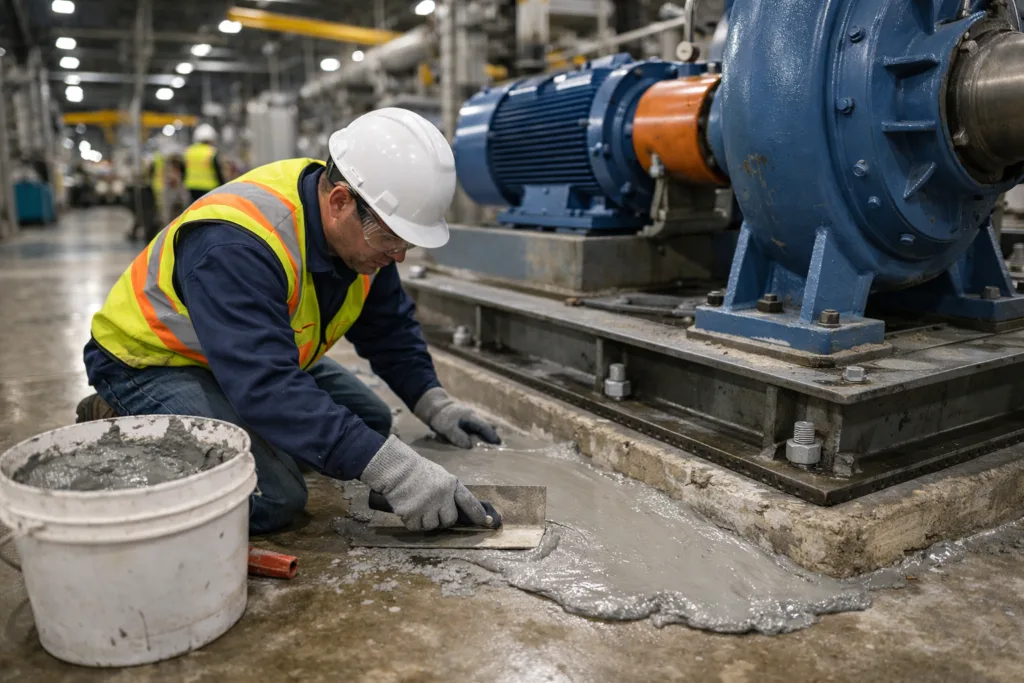
A petrochemical plant experienced excess vibration in a newly installed turbo-compressor. Engineers diagnosed uneven soleplate grouting due to improper surface cleaning and inadequate grout flow into recesses. By switching to a high-performance epoxy grout and recalibrating pouring techniques, vibration decreased by 40% and maintenance intervals doubled. The takeaway? Skilled grout placement and quality materials are essential for turbo-machinery longevity.
Case Study: Baseplate Grouting for High-Power Steam Turbines
An energy facility installed a steam turbine with a full bed baseplate. Using a deep-cure, epoxy grout with low exotherm properties, the crews ensured uniform load distribution and dimensional stability. Over five years, vibration readings remained stable and machine alignment stayed within .001 inch. When revising maintenance protocol, the team credited precise baseplate grouting with minimizing foundation repair needs. This emphasizes the enduring value of careful material selection and installation practices.
Grouting for Alignment: Tips and Expert Insights
Always establish clear alignment protocol and document pre-grout measurements. Use shims selectively and remove them after grout cure. Don’t rush—plans should allow for full material cure, especially with thick epoxy beds. For tight-gaps, consider products designed for fine seam filling like ZDS-4131AB Low Viscosity Epoxy Grout, which prevents voids and ensures high bond strength in critical turbo-machinery installations.
Maintenance and Inspection Considerations
Routine inspections should check for cracks, migration, or loose anchorage around grouted plates. Thermal cycles, chemical exposure, and vibration can degrade grout over time. Keep detailed maintenance records and schedule re-torquing of bolts post-cure as per the original installation plan.
Design Optimization: Grout Hole Layout in Baseplates
The arrangement of grout holes in baseplates affects filling efficiency and air release. Place holes near anchor points and machine feet. Use venting holes to allow trapped air and excess mix to escape, avoiding soft spots. ZDSpoxy recommends pre-cast or drilled venting paths for complex baseplate designs.
Environmental and Site Conditions in Grouting Performance
Ambient temperature, humidity, and substrate moisture impact grout cure and bond. Epoxy grouts often require dry surfaces, while some formulations work on damp substrates. Always follow product instructions for temperature and mixing ratios. Storage, shelf life, and transport practices can affect material performance as well.
Industry Standards and Compliance for Grouting
Turbo-machinery grouting operations follow API, ASTM, and plant-specific standards for strength, curing, and chemical resistance. Always select materials with documented batch consistency, QC data, and proven performance. PPE, correct ventilation, and safe handling of resin components protect workers and ensure outcomes meet compliance benchmarks.
Summary: Best Practices for Grouting in Turbo-Machinery Installations

Both soleplate and baseplate grouting have distinct advantages and limitations in turbo-machinery alignment and vibration damping. Soleplates offer precision and accessible maintenance; baseplates excel at damping and load distribution. Choosing the right epoxy grout and following careful, site-tested installation steps prevent failures. Review material properties, consider future maintenance needs, and document alignment protocols for lasting turbo-machinery performance.
Frequently Asked Questions
How do I choose between soleplate and baseplate grouting?
Evaluate machinery size, vibration profile, alignment precision needs, and maintenance plans. Soleplate grouting fits small equipment and frequent adjustment; baseplate grouting is preferred for heavy-duty, high-vibration systems.
Is epoxy grout always better than cementitious grout for turbo-machinery?
Epoxy grout offers superior compressive strength, shrinkage control, and chemical resistance. Cementitious grout may suffice for low-load, non-critical machines. Assess site conditions and performance requirements before deciding.
Can I use one grout type for both soleplate and baseplate applications?
Some epoxy grouts are formulated for both applications, but confirm compatibility for alignment, curing, and temperature tolerance. Tailor grout choice to installation method, machinery demands, and foundation specifications.
What maintenance should I perform after grouting?
Inspect for cracks, voids, and anchor bolt movement. Schedule periodic re-torquing of fasteners and review machine alignment. Document all maintenance actions for troubleshooting future vibration or wear issues.
What are signs of poor grouting installation?
Common indicators include increased vibration, misalignment, grout cracking, loose anchor bolts, and premature wear in bearings or seals. Immediate action can prevent major downtime and costly repairs.
How can environmental factors affect grouting performance?
Temperature extremes, substrate moisture, and chemical exposure can affect grout curing, bond strength, and longevity. Always use products suited to your site conditions and monitor curing closely.
Related Reading
- 7 Proven Solutions for Steam Turbine Grouting to Prevent Misalignment
- Understand How Poor Grouting Impacts Pump Seal Life and Maintenance Costs
- 9 Grouting Techniques That Eliminate Foundation Failures in Pump Installation
- How Grout Hole Design Enhances Baseplate Stability in Metal Fabrication Projects
- Solving Vibration Issues: Reciprocating Compressor Grouting for Metal Reliability