
Introduction: Understanding What Is Marine Grade Epoxy Resin
Marine environments challenge every material engineered for the waterline. That’s where the question arises: what is marine grade epoxy resin? Simply put, marine grade epoxy resin is a specialized two-part resin system tailored for boat building, repair, and offshore protection. Its formulation is designed to shield against water, salt, and mechanical abuse—prized for its reliability, not just for its chemistry but its field-proven performance. Whether you’re sealing a deck, filling a seam, or rebuilding a hull, knowing what distinguishes marine grade makes all the difference in lasting results.
Defining ‘Marine Grade’: What Makes Marine Epoxy Special?
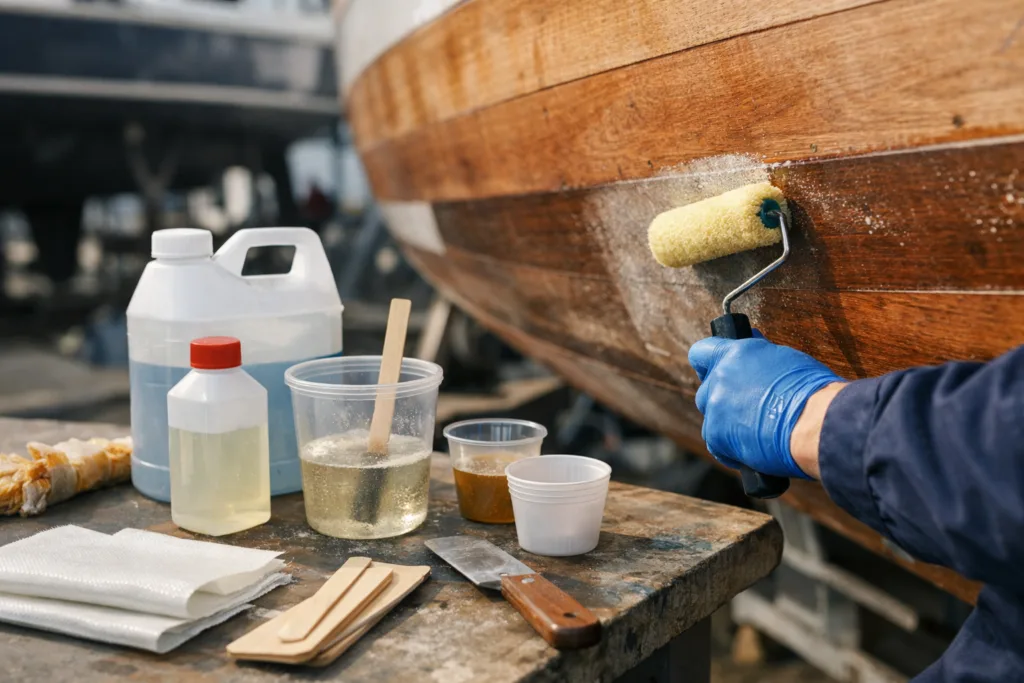
In the industry, “marine grade” signals more than just water resistance—it’s a blueprint for performance under the harshest conditions. Marine epoxy resin must endure continuous wetting, salt exposure, and mechanical loads that would compromise ordinary resins. Core requirements include low water absorption, high salt spray resistance, flexible yet tough bonding, and chemical compatibility with paints and fairing systems. So, marine epoxy resin meaning isn’t a broad marketing term—it’s a specific suite of properties and standards recognized by engineers and shipbuilders worldwide.
Difference Between Marine Grade and Standard Epoxy
While most general-purpose epoxies deliver strong adhesion and surface protection, they often struggle with swelling, hydrolysis (water-driven breakdown), and UV-induced chalking after repeated exposure to marine environments. In contrast, marine grade epoxy formulas balance lower water absorption rates, specialized cross-linkers to prevent salt or moisture attack, and a toughness profile that withstands hull flex and vibration without losing cohesion. Marine grade is engineered for the life aquatic—there’s a reason most boatyards specify it for below- and above-the-waterline repairs over regular types.
Key Properties of Marine Grade Epoxy Resin
The properties that define a true marine epoxy resin aren’t just about being waterproof. What matters most?
- Water Resistance: Low moisture transmission, resisting both liquid and vapor uptake.
- Salt Spray & Chemical Endurance: Maintains strength and clarity when exposed to sea water and marine atmospheres.
- Adhesive Strength: Sticks to wood, fiberglass, metals—built for marine substrates.
- Toughness & Flexibility: Balanced modulus for both handling shocks and moderate flex without cracking.
- Low Water Absorption & Hydrolysis Resistance: Critical for hull repairs or laminating structures exposed to daily wet/dry cycles.
- Good Wetting and Penetration: Creeps into fibers and microcracks, maximizing bond area and water exclusion.
- Suitable Cure Profile: Sufficient working time for boat assembly, yet reliable cure for fast return to service.
Water Resistance and Salt Spray Endurance
Waterproof epoxy resin is the foundation for marine builds and repairs. The expectation is not only to repel water but to maintain adhesion and structure after hundreds of immersion/drying cycles. Many marine epoxies carry test records showing zero blistering in ASTM D870 (immersion) and high pass rates for salt fog tests—key metrics for offshore and vessel projects. Without robust waterproofing, fiber-reinforced hulls and wood joinery would quickly degrade.
Adhesion and Toughness Balance
Marine grade epoxy resins deliver not only high bond strength but enough give to absorb impacts, vibrations, and the natural swelling of wooden substrates. A high Shore D hardness is common, but so is a modicum of flexibility as measured by elongation at break. This dual property is what keeps decks sealed and repairs crack-free as boats flex in heavy seas.
Shrinkage Risk, Water Absorption, and Hydrolysis
Low shrinkage ensures cures do not pull away from the substrate, and water absorption rates below 1% (by 24-hour immersion test, ASTM D570) are common targets. Hydrolysis resistance, the capacity to withstand long-term water contact without structural breakdown, is a defining marine necessity. Without it, adhesives and coatings would fail from within, even before any visible sign of trouble.
The Spec Checklist: How to Evaluate Marine Epoxy Resin
To make informed choices, specifiers, builders, and repair professionals use checklists that go beyond basic marketing claims. What specifications matter most for marine epoxy?
Suggested Marine Epoxy Spec Table Template
| Property | Test Method | Typical Value |
|---|---|---|
| Mix Ratio (by weight/volume) | Manufacturer | 2:1, 3:1, 1:1 (varies) |
| Viscosity (A:B mixed, 25°C) | ASTM D2196 | 400–1200 mPa·s |
| Working Time / Pot Life (100g, 25°C) | ASTM D2471 | 20–50 minutes |
| Tack Free Time | Lab/Field | 2–6 hours |
| Full Cure (room temp) | Lab/Field | 24–72 hours |
| Hardness (Shore D) | ASTM D2240 | 70–85 |
| Flexural Strength | ASTM D790 | ≥60 MPa |
| Elongation at Break | ASTM D638 | 1–8% |
| Water Absorption (24h at 23°C) | ASTM D570 | ≤1.0% |
| Heat Resistance (Tg, °C) | DSC | 50–70°C+ |
| VOC Content | ISO 11890-2 | ≤60 g/L |
| Certification | ABS, DNV, ISO | As specified |
How to Read and Compare Marine Epoxy Specs
Site teams and procurement staff often overlook critical numbers like water absorption rate, cure profile, or flexural properties. To compare systems, match the properties above to project needs—for instance, rapid hull patching in cool weather versus long-open-time laminating in warm climates. Many suppliers, like those found on the Marine Epoxy Resin Manufacturer page, clearly list these specs for direct side-by-side comparison.
Typical Composition and Mixing Ratios
The backbone of marine epoxy is its blend of base resin (A) and curing agent (B). Common ratios, like 2:1 or 3:1, are set to balance working time and final strength. Lower viscosity versions flow easily into joints, while medium viscosities are used for laminating and gap-filling. Always follow manufacturer recommendations for mixing—you’ll find specific instructions on products such as ZDS-2060AB, which details the right AB ratio for effective marine bonding.
Viscosity: Flow, Wetting, and Cavity Filling
Marine builds demand resins with the right balance of flow—not so thin they drain off surfaces, not so thick that they fail to wet glass or wood completely. Application success depends on choosing and handling the proper type for your job.
Marine Epoxy Mix Ratio Best Practices
Precision matters. Always use clean, calibrated mixing containers and, if possible, a gram scale. For repeatable outcomes, manufacturers like ZDSpoxy train teams on both weight and volume mixing—critical for complex boatyard assemblies or emergency repairs at sea. Cross-checking the A:B ratio with the datasheet is your best insurance against sticky failures or incomplete cures. For further guidance on this process, explore Epoxy Mix Ratio Mastery: Preventing Marine Cure Failure with Weight & Volume Techniques.
Workability: Pot Life, Working Time, and Cure Time in Marine Environments
For successful marine projects, understanding marine epoxy cure time, pot life, and working time isn’t optional—it’s jobsite survival. Pot life (the usable time in a mixed batch before thickening) is heavily influenced by temperature and batch size. Experienced users avoid mixing large batches on hot days and plan application steps to use all mixed resin quickly, minimizing waste and avoiding hardened residue mid-job.
Cure Profile: Tack Free and Full Strength
After application, marine epoxies move through key stages: tack free (when dust will not stick), sandable (light finishing), and full cure (resistant to water and mechanical load). For most general-purpose marine formulas, tack free may be achieved in 3–5 hours at 25°C, with full chemical resistance developing in 24–72 hours. Understanding these windows is vital for assembly, fairing, and coating operations.
Factors Influencing Cure: Temperature and Humidity
Temperature swings and high humidity change everything. Pot life can halve for every 10°C rise; likewise, cold, damp conditions dramatically slow down cure rates. Site teams, especially those on tight schedules or working on the water, must monitor ambient variables and adjust batch sizes. Professional guides like Pot Life vs Working Time vs Cure Time: The Essential Marine Epoxy Timing Guide help teams adapt and prevent costly mistakes.
How to Verify Marine Epoxy Grade in Practice
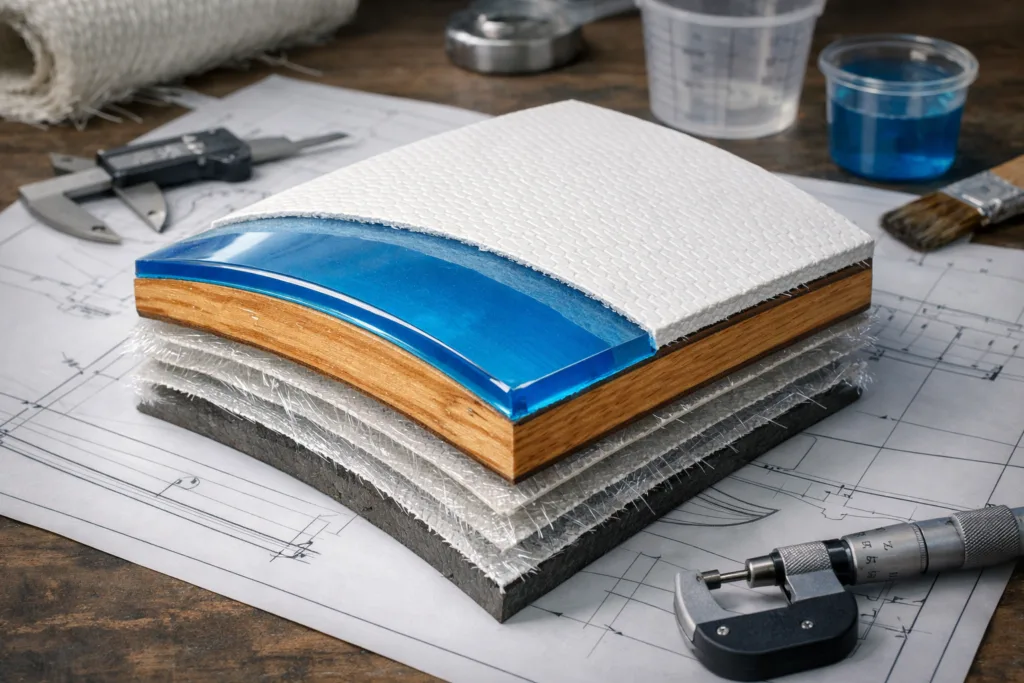
Look beyond literature and test claims. Marine ratings often involve proof—certification, VOC testing, and actual batch performance. Certifications from ABS, DNV, or ISO (like ISO 9001) confirm a resin’s credentials; VOC checks protect air quality for shipyards and crew. For health, safety, and environmental compliance, always reference supporting test records.
VOC, Certification, and Compliance
Insist on low-VOC products to ensure safer working conditions and proper environmental compliance, especially for indoor or closed-cabin applications. Certification details are usually found on product technical data sheets or, for specialized marine fit-outs, available directly from manufacturing partners.
Top Marine Applications for Epoxy Resin
Marine epoxy resins are chosen for some of the toughest jobs in the field:
- Boat Hull and Deck Laminating: Rebuilding, sheathing, or reinforcing wood, glass, or composite hulls.
- Marine Joinery, Fairing, and Filling: Repairing wood structures, filling seams, and fairing hull surfaces.
- Hardware Bonding and Waterproof Repairs: Securing bolts, mounting brackets, and patching leaks or dings in wet locations.
Specialty applications also include underwater patching (see products such as ZDS-1002AB for rapid underwater pool repairs) and high-flex laminations for sailing performance upgrades.
Boat Hull and Deck Laminating
These tasks rely on penetrating and encapsulating grips of marine epoxy—locking out water, boosting mechanical strength, and sealing fibers. Builder crews choose resins with proven laminate compatibility, like those featured in trusted marine lines.
Marine Joinery, Fairing, and Filling
Wood gaps, scratches, and voids demand filling compounds that are as resilient as the resins behind them. Matching systems (like ZDS-189 Wood Repair Putty) are purpose-formulated for easy shaping and marine durability, ensuring repairs keep pace with the elements.
Hardware Bonding and Waterproof Repairs
Stainless bolts, bronze cleats, and thru-hull fittings depend on a bond line that will not soften in hot or damp conditions. Marine epoxy excels here, sealing out water while providing the strength to handle dynamic marina and offshore loads.
Field Case: How ZDSpoxy Approaches Marine Grade Formulation
On ZDSpoxy’s formulation line, every batch is checked for viscosity, mix ratio accuracy, and water resistance before shipment. If a project calls for ultra-low exotherm (“cool cure”) or specific flow profiles for tight radius hulls, the lab can customize cure speed, hardness profile, or flexibility as required—always under strict QC records. Field data routinely informs product updates: for instance, lessons from on-site deck repairs have led to tighter viscosity control and improved batch labeling to avoid site mix-ups. ZDSpoxy sees marine epoxy as a chain: performance is only as strong as its weakest tested link.
Common Issues and Misconceptions About Marine Epoxy
Not all “marine” labeled epoxies meet professional standards. The most frequent pitfalls include:
- Assuming all epoxies are waterproof or flexible enough for hull applications.
- Mixing large batches, causing hot, unworkable exotherms.
- Failing to adjust for ambient conditions, resulting in incomplete or spotty cures.
- Overlooking the need for compatible primers or fairing additives.
Misunderstandings like these explain why technical due diligence and a solid spec table remain central to any successful project near the waterline.
What Is Marine Grade Epoxy Resin? (FAQ Section)

What does “marine grade” actually mean in epoxy resin?
Marine grade epoxy is specifically designed for continuous and repeated water exposure, balancing low water absorption, high adhesion, and resistance to salt, chemicals, and hydrolysis. It’s built for the rigors of boat building, marine repair, and offshore structures.
Can marine grade epoxy resin be used underwater?
Certain marine grade epoxies can cure underwater or in damp conditions. Always check technical data: some are surface tolerant while others need dry touch; specialty versions exist for rapid wet repairs.
How do you know if a resin is really marine grade?
True marine grade epoxies list water absorption, salt spray resistance, and compliance with industry certifications (like ABS or ISO). Look for a full technical datasheet and clear mixing, cure, and property information.
What is the typical cure time for marine epoxy?
Most marine epoxies offer 20–50 minutes pot life, 2–6 hour tack free, and full cure within 24–72 hours at room temperature. Cure speed varies with temperature and batch size.
Is marine epoxy safe and eco-compliant?
Low VOC marine epoxies are available. Review VOC content and safety guidance in datasheets for proper handling, especially for enclosed or commercial environments.
What are the main applications of marine epoxy resin?
Common uses include boat hull and deck laminating, wood gap filling, hardware bonding, underwater repairs, and general water sealing in harsh marine settings.
Conclusion: Marine Grade Epoxy Resin—Your Reliable Spec Blueprint
Marine grade epoxy resin is built for life at sea—delivering low water absorption, salt endurance, and resilience to real-world challenges where lesser resins falter. Understanding its key specifications and application requirements, reinforced by proven manufacturer practices, ensures safer, longer-lasting builds and repairs. By aligning your selection and handling with the spec checklist above, you’re not just maximizing performance—you’re safeguarding every project from dock to deep water.
Related Reading
- 5 Key Differences: Marine Epoxy vs Standard Epoxy Explained for Boat Owners
- How to Select the Right Epoxy Primer to Avoid Costly Boat Delamination
- 10 Must-Know Marine Epoxy Resin Facts for Confident Boat Repairs
- 7 Critical Marine Epoxy Properties That Define Superior Long-Term Performance
- Boat Surface Preparation: How to Ensure Epoxy Bonds Every Time