
Choosing between epoxy grout vs cement grout affects more than joint filling. It changes how a tiled or grouted assembly handles moisture, staining, chemicals, cleaning routines, movement, installation speed, and long-term maintenance cost. From our manufacturing perspective, the right decision depends on service conditions, not just initial material price.
For projects facing frequent washing, staining, chemical exposure, or hygiene-sensitive use, it helps to review epoxy grout system options for demanding service conditions before final specification.
Quick answer: when epoxy grout is the better choice and when cement grout is enough
Epoxy grout is usually the stronger choice when joints must resist water absorption, food staining, oils, cleaning chemicals, or aggressive maintenance. It is also a better fit where color consistency, low porosity, and reduced lifecycle upkeep matter.
Cement grout is often enough for dry interior spaces, lower-demand residential jobs, and budget-sensitive work where exposure is limited and routine sealing is acceptable. It remains practical when the project does not justify the higher installation difficulty and material cost of epoxy.
The key is to compare the service environment, cleaning method, substrate condition, traffic level, and maintenance expectations before choosing.
What is epoxy grout?
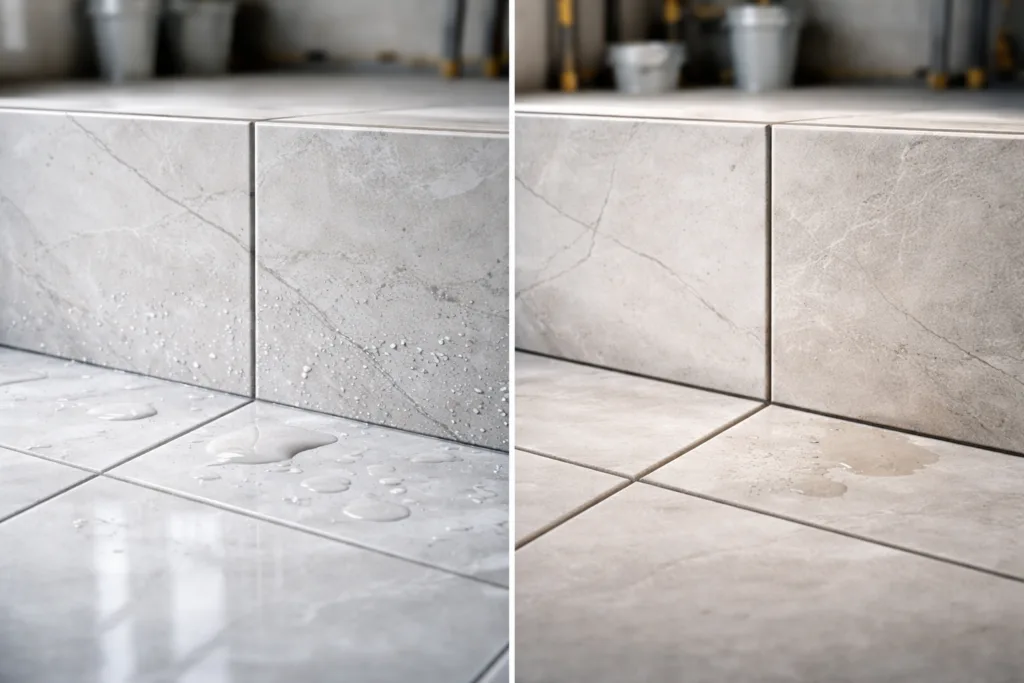
Epoxy grout is a resin-based grouting system typically made from epoxy resin, hardener, and graded fillers. Unlike cementitious grout, it cures through a chemical reaction rather than simple cement hydration. This gives it a denser structure, lower absorption, and stronger resistance to many stains and chemicals.
In practice, epoxy grout is selected when owners need more than basic joint filling. It is used where hygiene, washdown resistance, heavy use, or long-term appearance retention matter. Many common epoxy grout applications across industrial and construction projects involve conditions where conventional cement grout tends to discolor, absorb contaminants, or degrade faster.
What is cement grout?
Cement grout is a cementitious material usually based on Portland cement, mineral fillers, and pigments, sometimes modified with polymers. It is easier to install for many tile crews, generally lower in upfront cost, and widely used in residential and light commercial work.
Its limitations come from its porous nature. Even when well mixed and properly cured, cement grout can absorb moisture and stains more readily than epoxy. Many systems also need sealing and ongoing maintenance to preserve appearance and reduce contamination.
Epoxy grout vs cement grout at a glance
| Factor | Epoxy Grout | Cement Grout |
|---|---|---|
| Base chemistry | Resin and hardener with fillers | Cementitious binder with fillers |
| Water absorption | Very low | Higher |
| Stain resistance | Strong | Moderate to low |
| Chemical resistance | Better in many service environments | Limited |
| Installation difficulty | Higher | Lower |
| Cleanup sensitivity | High, must be timely | More forgiving |
| Need for sealing | Typically no | Often yes |
| Repairability | Can be more difficult | Usually easier |
| Material cost | Higher | Lower |
| Lifecycle maintenance | Often lower | Often higher |
Core material differences: resin-based system vs cementitious system
The biggest difference between epoxy grout and regular grout is the way the material forms its final structure. Epoxy systems cure into a dense thermoset matrix. Cement grout hardens through cement hydration and remains more porous.
This difference affects nearly every buying decision:
- Porosity: epoxy is generally less absorbent.
- Contamination risk: cement grout is more likely to take in dirt, oils, and moisture.
- Chemical durability: resin systems usually handle harsher cleaning and spill conditions better.
- Application tolerance: cement grout is often easier for standard tile crews.
At ZDSpoxy, we see buyers make better specifications when they start with exposure conditions first, then work backward to chemistry selection.
Performance comparison: strength, adhesion, and resistance to cracking
Epoxy grout generally offers higher bond strength and compressive performance than cement grout, especially in systems designed for structural or heavy-duty support. That does not mean every tile joint needs high-compressive resin grout, but it matters in demanding service.
Cement grout can perform adequately in stable, lower-stress installations. However, it is more vulnerable to cracking where there is poor substrate preparation, movement, repeated wetting and drying, or inconsistent curing.
For more structural loading conditions, buyers evaluating machine bases or dynamic loads should look beyond decorative tile grout and consider epoxy grout systems for heavy machinery support and alignment, where compressive strength, vibration behavior, and dimensional stability become central.
Water resistance and stain resistance: which grout holds up better in wet or dirty environments
In wet rooms, kitchens, food service areas, and frequently cleaned floors, epoxy grout usually holds up better. Its lower absorption helps limit darkening, stain pickup, and moisture-related contamination. This is one of the clearest reasons specifiers upgrade from cement grout.
Cement grout can work in wet areas, but it usually needs better maintenance discipline. Sealing may help reduce absorption, but sealers do not turn cement grout into a non-porous system. Over time, repeated moisture exposure and cleaning cycles may still lead to discoloration or surface wear.
If the owner expects easy cleanup after oils, sauces, soap residue, or routine washdown, epoxy is often the safer long-term choice.
Chemical resistance and hygiene performance for commercial and industrial spaces
Where the floor or wall assembly faces sanitizers, detergents, mild acids, oils, or process chemicals, epoxy grout is strongly favored. Its dense cured structure is less likely to trap residue and easier to clean thoroughly. That matters in food processing, laboratories, healthcare support spaces, and industrial service areas.
Cement grout is less suitable where the cleaning regime itself is aggressive. Even if the process chemical exposure is occasional, repeated use of strong cleaners can shorten service life. Hygiene-sensitive spaces often benefit from lower-porosity grouting systems because maintenance outcomes depend on what the material absorbs over time, not just how it looks on installation day.
Flexibility, movement tolerance, and long-term joint stability
Neither epoxy grout nor cement grout should be treated as a substitute for proper movement joint design. However, they behave differently under stress. Epoxy systems can be formulated across a range of hardness and toughness profiles, while cement grout tends to be more brittle in service.
That said, a harder epoxy is not automatically better. In some projects, excessive rigidity can create stress concentration if movement is not properly managed elsewhere. The right choice depends on the substrate, tile format, thermal cycling, and joint design.
When we assess project fit, we look at whether the assembly needs chemical durability only, or a broader balance of compressive strength, adhesion, and movement tolerance.
Appearance and color consistency: what buyers should expect over time
Epoxy grout usually delivers better color consistency because it is less affected by uneven water ratios, surface moisture, or post-installation contamination. Cement grout color can vary more depending on mixing water, sponge cleanup practices, curing conditions, and efflorescence risk.
For commercial interiors where visible staining or patchy joints create complaints, this difference matters. Epoxy is often chosen not just for durability, but because the installed appearance tends to remain more stable under routine use and cleaning.
Cement grout can still look good, but it is more dependent on installer control and owner maintenance.
Application and installation differences: mixing, working time, cleanup, and labor difficulty
This is where many comparisons become too simplistic. Epoxy grout is not just a premium version of cement grout. It behaves differently during installation and needs a crew that understands pot life, temperature sensitivity, mixing accuracy, wash timing, and residue control.
Cement grout is typically more forgiving. Installers are often more familiar with it, and cleanup is less time-sensitive. That can reduce labor risk on straightforward jobs.
Epoxy grout requires more disciplined execution:
- correct resin-to-hardener ratio
- thorough mixing
- careful attention to working time
- timely cleanup before residue hardens
- temperature-aware installation planning
For demanding foundation or equipment settings, formulation matters as much as technique. In high-load scenarios, teams may review materials such as ZDS-4130AB high-compressive epoxy grout for crusher foundations to understand how service demands can shift grout selection far beyond standard tile-joint considerations.

Curing behavior and project scheduling impact
Cement grout cure depends heavily on moisture balance and ambient conditions. Epoxy cure depends on chemical reaction, which is also affected by temperature but in a different way. Cold conditions can slow epoxy cure and increase viscosity. High temperatures can shorten working time and reduce installation margin.
Project scheduling should consider:
- when the area must return to service
- whether early water exposure is expected
- how temperature affects pot life and cure speed
- whether adjacent trades may contaminate fresh joints
Epoxy may justify its higher installation demands when faster return to chemical or washdown service is important, but only if site conditions are managed correctly.
Maintenance requirements: sealing, cleaning, repairability, and lifecycle upkeep
Cement grout often brings lower upfront cost but more ongoing attention. Sealing, stain management, periodic cleaning recovery, and aesthetic touch-up can add hidden lifecycle cost. Once heavily contaminated, cement joints may be difficult to restore uniformly.
Epoxy grout typically reduces sealing and stain-related maintenance. However, if repair is needed, removal and replacement can be more labor-intensive. That trade-off should be discussed early, especially for large facilities where future localized repairs are expected.
The most cost-effective system is not always the cheapest to install. It is the one that fits the owner’s maintenance reality.
Cost comparison: material cost vs labor cost vs total lifecycle cost
Epoxy grout usually costs more in material and often more in labor because installation is slower and less forgiving. Cement grout is cheaper to buy and often faster to install.
But decision-makers should compare three cost layers:
- Material cost: epoxy is higher.
- Installation cost: epoxy often needs more skilled labor and stricter execution.
- Lifecycle cost: epoxy may reduce staining, sealing, cleaning recovery, and premature replacement.
For low-demand projects, cement grout can remain the more rational choice. For higher-demand environments, the lower maintenance burden of epoxy can outweigh the initial premium.
Best use cases for cement grout
Cement grout remains practical in many cases:
- dry interior residential floors and walls
- guest rooms or areas with limited chemical exposure
- budget-sensitive jobs with moderate durability needs
- projects where crews are set up for conventional cementitious installation
- spaces where periodic sealing and maintenance are acceptable
It is a reasonable option when the joint is not expected to resist aggressive cleaning, food staining, standing water, or harsh service conditions.
Best use cases for epoxy grout
Epoxy grout is usually better suited for:
- commercial kitchens and food prep areas
- showers and wet rooms with frequent cleaning
- healthcare and hygiene-sensitive spaces
- heavy-use floors exposed to repeated washing
- industrial areas facing oils or chemicals
- projects where color stability and low porosity matter
In some concrete or mixed-substrate environments, surrounding conditions can influence grout system success. Where dampness or moisture in the base is part of the risk profile, it may be worth reviewing solvent-free epoxy primer options for damp or wet concrete substrates as part of the broader assembly planning.
Common buyer mistakes when comparing epoxy grout vs regular grout
The most common mistake is comparing only purchase price. A lower-cost grout that stains quickly, needs sealing, or requires earlier replacement may not be cheaper over the project life.
Other frequent mistakes include:
- ignoring cleaning chemical exposure
- assuming all epoxy grouts behave the same
- underestimating installation skill requirements
- using cement grout in hygiene-critical or washdown areas
- expecting grout to solve substrate movement problems
- not checking cure conditions and return-to-service timing
We also see buyers use a decorative tile-grout comparison for applications that are really structural, industrial, or equipment-support problems. That leads to the wrong specification framework from the start.
How to choose based on project conditions
A useful decision method is to score the project against actual service demands.
Choose epoxy grout when the project has:
- frequent water exposure or washdown
- oil, food, dye, or stain risk
- chemical cleaners or process chemical contact
- high traffic and difficult maintenance access
- strict appearance retention requirements
- owners who want lower routine upkeep
Choose cement grout when the project has:
- dry, low-demand service conditions
- limited stain and chemical exposure
- tight upfront budget constraints
- simple maintenance expectations
- standard residential or light commercial use
Questions to ask a grout manufacturer or supplier before specifying a system
Before finalizing a grout specification, ask practical questions:
- What moisture, chemical, and temperature exposures are expected?
- What is the working time at actual site temperature?
- Does the system require sealing or special maintenance?
- How does the grout respond to routine cleaning chemicals?
- What substrate conditions can affect bond or cure?
- How difficult is localized repair if damage occurs?
- Is the product intended for decorative joints, structural support, or both?
From our side as a manufacturer, the quality of these questions usually predicts the quality of the final material selection.
How custom epoxy grout formulation can support specific performance needs
Not all epoxy grout requirements are identical. Some projects prioritize stain resistance and cleanability. Others need higher compressive strength, lower shrinkage, chemical resistance, or better application handling under specific site temperatures.
This is where custom formulation becomes useful. At ZDSpoxy, we often think in terms of performance balance rather than one universal epoxy recipe. Filler package, viscosity, cure profile, hardness, and working time can all affect real-world project suitability.
For contractors, specifiers, and procurement teams, that means the right epoxy option may depend on whether the job is architectural, industrial, sanitary, or structural.
Final decision framework
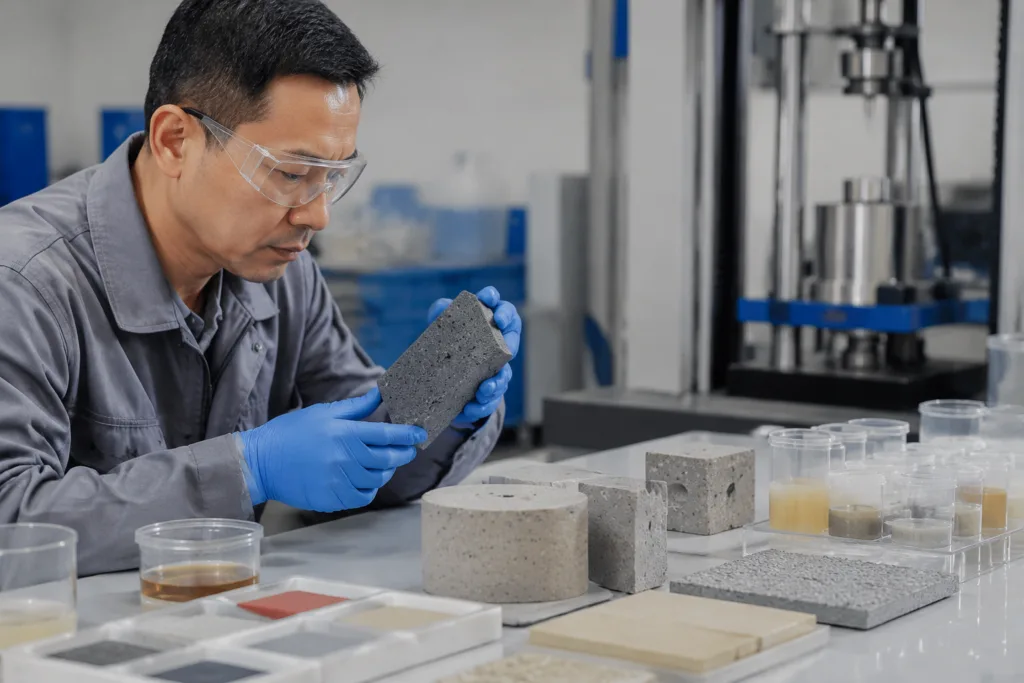
If the priority is low initial cost and the service environment is dry and light duty, cement grout is often sufficient. If the priority is durability under water, stains, chemicals, aggressive cleaning, or long-term maintenance pressure, epoxy grout is usually the better specification.
The most reliable way to choose between epoxy grout vs cement grout is to align the grout chemistry with the actual service conditions, not the bid-day assumption. Better grout decisions come from comparing exposure, cleaning, maintenance expectations, and lifecycle performance together.
FAQs
Is epoxy grout better than cement grout for showers?
Yes, epoxy grout is often the better choice for showers because it resists water absorption, staining, and routine cleaning chemicals better than cement grout, especially in heavily used or poorly ventilated wet areas.
Does cement grout always need sealing?
Many cement grout systems benefit from sealing to reduce absorption and staining, but sealing does not make them non-porous, so maintenance and periodic resealing may still be necessary.
Is epoxy grout harder to install?
Yes, epoxy grout is usually harder to install because it has stricter mixing requirements, more temperature sensitivity, shorter working time in some conditions, and cleanup must be done at the right stage to avoid residue.
Which grout lasts longer in commercial kitchens?
Epoxy grout usually lasts longer in commercial kitchens because it handles food spills, grease, washdown cleaning, and staining better than cement grout in demanding daily service.
Can cement grout be enough for residential tile projects?
Yes, cement grout can be enough for many residential tile projects, especially in dry, low-demand areas where the owner accepts sealing, regular cleaning, and a lower level of stain and chemical resistance.
How should buyers compare epoxy grout vs cement grout fairly?
Buyers should compare them by service conditions, installation difficulty, maintenance needs, expected cleaning chemicals, moisture exposure, and total lifecycle cost rather than material price alone.
Related Reading
- foundation grouting methods for heavy machinery installations
- epoxy grout volume calculator for estimating material needs
- signs grout condition is failing and when re-grouting is needed
- grout stiffness and resonance insights for engineering decisions
- how sulfate-resistant grouts perform in aggressive service environments