
Resinous flooring is a broad term for seamless floor systems made by combining reactive resins with hardeners, fillers, pigments, and sometimes aggregates to create a protective and functional surface over concrete or other prepared substrates. In commercial and industrial settings, the term matters because it covers a wide performance range. A thin-roll coating for a light-duty retail back room is very different from a thick trowel-applied mortar system in a food plant or a chemical-resistant build-up floor in a processing area. From our manufacturing perspective, buyers get better outcomes when they treat resinous flooring not as a single product category, but as a family of engineered systems matched to traffic, chemicals, cleaning methods, thermal cycling, downtime limits, and substrate condition.
Compare flooring resin system options for commercial and industrial projects before writing a specification, because system chemistry, film build, and cure profile often affect service life more than color or gloss choices.
When resinous flooring makes sense
Resinous flooring is commonly specified when concrete alone cannot deliver the required cleanliness, durability, chemical resistance, or maintenance profile. It is especially useful where operators want a seamless finish, easier washdown, dust reduction, controlled slip resistance, and predictable repair planning.
- Warehouses that need abrasion resistance and easier cleaning than bare concrete
- Food and beverage facilities that need hygiene-focused surfaces and resistance to regular washdown
- Pharmaceutical or clean-process areas that require low-dust, seamless, easy-to-sanitize floors
- Automotive and maintenance facilities exposed to oils, tires, impacts, and frequent traffic
- Chemical handling areas that need resistance to splashes, spills, and spot exposure
- Commercial spaces that need decorative appearance with better durability than conventional paint
- Parking and service areas where marking, visibility, and substrate protection matter
The main benefit is not simply that the floor is coated. The benefit is that the floor becomes a designed system. That system can include primer, body coat, broadcast aggregate, topcoat, coving details, line marking, and anti-slip texture, all tailored to operating conditions.
How resinous flooring systems differ by chemistry
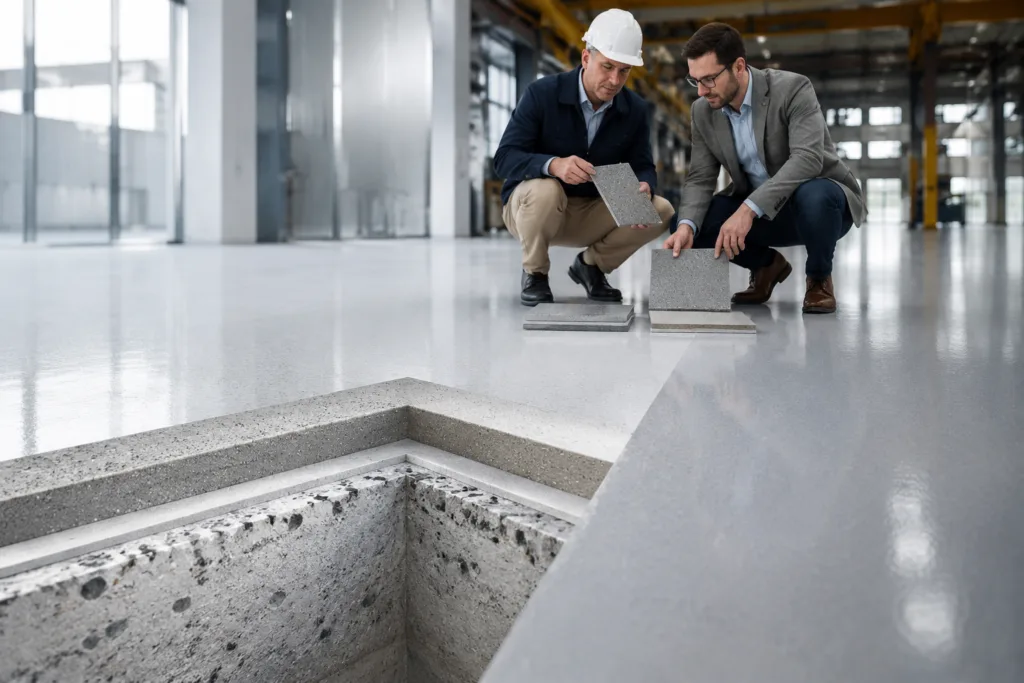
Different resin chemistries solve different problems. That is why selection should start with exposure conditions and installation constraints, not just budget or appearance.
Epoxy systems
Epoxy is the most widely used chemistry for resinous flooring because it balances adhesion, build capability, mechanical strength, and cost-performance. Properly selected epoxy systems can deliver strong concrete bonding, good compressive strength, and useful chemical resistance for many warehouses, workshops, showrooms, and manufacturing spaces. Their limitations usually appear in UV stability, flexibility, and tolerance for rapid thermal shock compared with some alternative systems.
Polyurethane systems
Polyurethane flooring systems are often chosen where higher flexibility, impact resistance, and better tolerance to temperature movement are needed. Some polyurethane cement systems are preferred in wet-process or thermal washdown environments because they handle harsher operating conditions than standard epoxy coatings. These systems can be more demanding to specify correctly, but they are valuable in aggressive process areas.
Polyaspartic systems
Polyaspartic materials are often used when faster return to service is important. They can offer rapid cure and good appearance retention, which makes them attractive in commercial renovations and some industrial maintenance windows. However, short working times can challenge installers, especially in warm conditions, so application planning matters.
MMA systems
Methyl methacrylate systems are known for very fast cure, including in cold conditions. They are often selected where downtime is extremely expensive. The trade-off can include stronger odor and stricter installation management. Buyers should review site occupancy, ventilation, and contractor experience before approving this chemistry.
Hybrid systems
Hybrid systems combine performance traits. A project may use an epoxy primer for concrete penetration, an epoxy or mortar build coat for thickness, and a polyurethane or polyaspartic top layer for UV or wear performance. In our formulation work, hybrid logic is often the most practical approach because one chemistry rarely does everything equally well.
| Chemistry | Typical strengths | Typical limits | Common fit |
|---|---|---|---|
| Epoxy | Strong adhesion, good build, good chemical resistance, cost-efficient | Can yellow, less flexible, slower cure than rapid systems | Warehouses, workshops, production rooms |
| Polyurethane | Flexibility, impact tolerance, thermal performance | Can be more complex to install | Wet processing, thermal cycling areas |
| Polyaspartic | Fast cure, good appearance retention | Short pot life, sensitive application timing | Renovation, fast-track projects |
| MMA | Very fast cure, low-temperature installation potential | Odor and process control concerns | Critical downtime environments |
| Hybrid | Tailored performance by layer | Requires disciplined specification | Mixed-exposure facilities |
Common resinous flooring builds and what they do
The term resinous flooring also includes different build types. Thickness and structure strongly affect performance.
Coating systems
These are thin-film systems, often applied by roller or squeegee. They improve dust control, appearance, and light chemical resistance. They work well for lighter-duty commercial or industrial spaces, but they are not the right answer for severe impact or badly damaged concrete.
Self-leveling systems
Self-leveling floors create a smoother, flatter finish at moderate thickness. They are often used in cleanable spaces where aesthetics and seamlessness matter. Viscosity control is important because good flow should not come at the expense of sag resistance or trapped air release.
Broadcast systems
Broadcast systems include aggregate spread into a wet resin layer, followed by sealing coats. They can improve slip resistance, wear resistance, and decorative appearance while also giving buyers options for texture control.
Trowel-applied and mortar systems
These use higher filler loading and greater thickness to withstand abuse, impact, and substrate irregularity. They are commonly specified when floors need rebuild capability rather than just surface protection.
Slurry systems
Slurry systems sit between thinner coatings and heavier mortars. They can improve build, leveling, and wear resistance while remaining more installation-efficient than some fully troweled systems.
Performance criteria buyers should specify
Commercial and industrial buyers should move beyond generic terms such as heavy duty or durable. Better specifications use measurable or verifiable criteria tied to real service conditions.
- Hardness and abrasion resistance: Important for forklifts, pallet traffic, carts, and dragged equipment
- Chemical resistance: Must be matched to actual chemicals, concentrations, temperatures, and contact duration
- Impact resistance: Needed where tools, parts, or loading equipment may strike the floor
- Flexibility: Useful where slab movement, vibration, or thermal movement is expected
- Thermal resistance: Critical for hot washdown, steam-adjacent operations, or freezer transitions
- UV and color stability: Relevant for sun-exposed entries, showrooms, or partially outdoor spaces
- Slip resistance: Should be defined by environment, footwear, cleaning methods, and contamination risk
- VOC and odor profile: Important in occupied buildings, hospitals, schools, and phased renovations
- Cure speed: Affects shutdown planning and return-to-service timing
Where decorative layering is part of the specification, a clear protective finish may be required. In that context, a system such as ZDS-400AB high-gloss clear epoxy topcoat for decorative floors represents the kind of top-layer logic buyers should evaluate for appearance retention, cleanability, and wear profile.
Technical properties contractors watch closely
Contractors usually succeed or fail on the details that may not appear in a simple product brochure. A technically acceptable resin can still produce poor field results if working properties do not match site conditions.
Viscosity and flow
Low viscosity can help penetration and leveling, while higher viscosity can help build and edge control. The right range depends on whether the layer is a primer, body coat, slurry, or topcoat.
Pot life and working time
These are not the same. Pot life describes how long mixed material stays usable in mass, while working time reflects how long installers can place and finish it under site conditions. Warm slabs often shorten both.
Mix ratio accuracy
Resinous systems are sensitive to ratio errors. Off-ratio mixing can cause soft cure, gloss variation, poor adhesion, blush, or reduced chemical performance. For that reason, many procurement teams prefer pre-engineered component packaging and clear batch traceability.
Primer and topcoat compatibility
Intercoat bonding is not automatic. Recoat windows, surface contamination, and cure stage all matter. A floor system should be viewed as a layered assembly, not as isolated products.
For example, a base preparation sequence may start with a penetrating or bonding layer such as ZDS-1012AB epoxy primer for concrete and ceramic floors, especially where substrate porosity and adhesion reliability are major concerns.
Substrate compatibility and surface preparation
Most resinous flooring failures begin below the surface. Even a high-quality system cannot compensate for weak concrete, contamination, or uncontrolled moisture.
Concrete condition
Buyers should confirm concrete age, curing history, surface strength, contamination history, cracks, flatness, and previous repairs. Newly placed slabs may still hold excess moisture or curing compounds that interfere with adhesion.
Moisture testing
Moisture vapor emission and internal relative humidity should be checked where relevant. If the slab has no effective vapor barrier or shows excessive moisture, standard resinous systems may blister, debond, or develop osmotic issues. Moisture mitigation or alternate system selection may be needed.
Mechanical surface preparation
Shot blasting, grinding, scarifying, or other mechanical preparation methods should be chosen based on target profile, contamination depth, and coating thickness. Surface preparation should remove laitance, weak paste, and previous residues while creating a sound profile for bonding.
Repairs before coating
Cracks, holes, and spalls should be assessed before the flooring build begins. If the slab is unstable, a flooring system may only hide the problem briefly. Substrate repair design is part of flooring design.
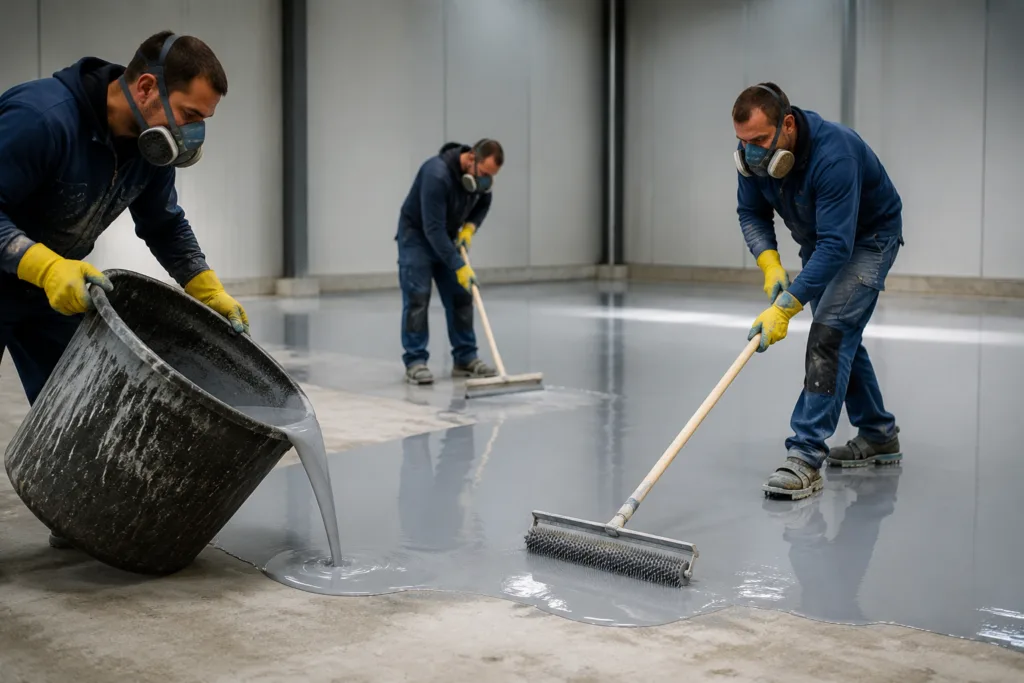
Installation conditions and sequencing
Installation windows matter as much as chemistry. Ambient temperature, slab temperature, humidity, airflow, and occupancy constraints all affect curing and finish quality.
- Confirm substrate temperature is above dew point margin requirements
- Avoid condensation risk during priming and topcoating
- Sequence trades so dust, welding residue, and water exposure do not contaminate curing layers
- Plan return-to-service separately for foot traffic, light wheels, heavy traffic, and chemical exposure
- Allow enough labor to place fast-reacting materials without overextending wet edges
Mid-build layers often determine the final floor thickness and leveling behavior. In systems that require build and load distribution, a material class similar to ZDS-3136AB epoxy mid coat for durable resin floors helps illustrate why buyers should evaluate body-coat mechanics rather than specifying only a primer and finish coat.
Quality control before handover
Quality control should be written into the project process, not treated as a final visual check. Good acceptance logic reduces disputes and makes performance expectations clear.
Useful checks during and after installation
- Surface profile confirmation before priming
- Mixing and batch recording by area
- Wet film or calculated coverage checks during application
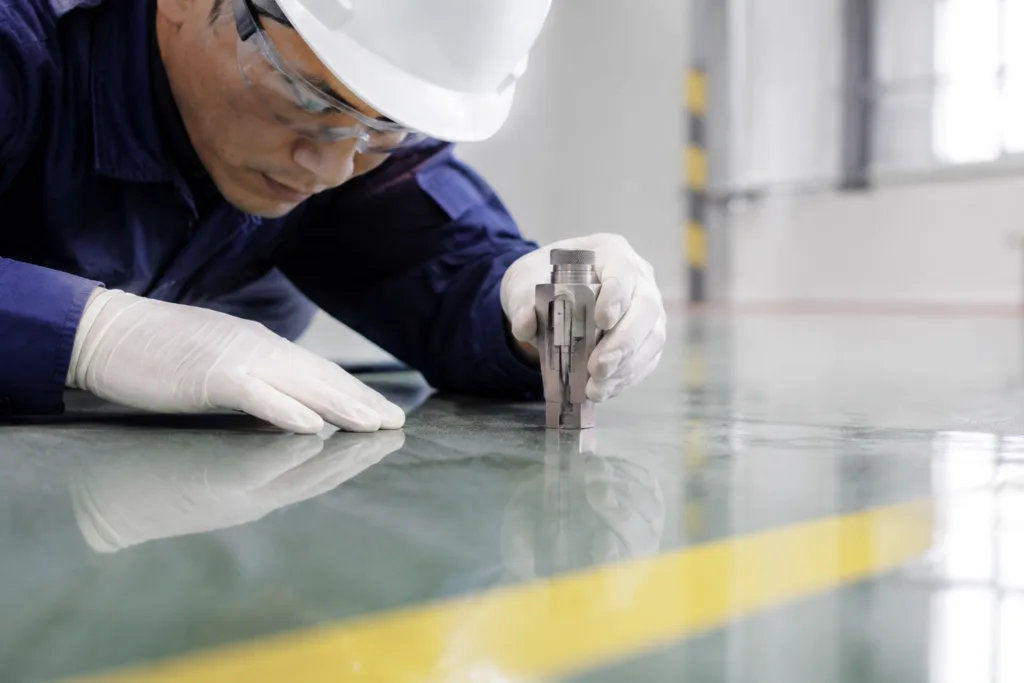
- Dry film thickness checks after cure where practical
- Adhesion testing, such as pull-off testing, on agreed sample areas
- Slip resistance checks suited to the end-use condition
- Chemical spot testing where exposure risk justifies it
- Visual inspection for pinholes, craters, color inconsistency, roller marks, and edge defects
Acceptance criteria should define what is cosmetic, what is functional, and what requires repair. This protects both buyer and contractor.
Common failure modes and how to prevent them
Most failures are predictable. The root causes are usually moisture, contamination, weak substrate, wrong system thickness, or poor environmental control.
Delamination
Often caused by inadequate preparation, hidden contamination, weak concrete paste, or moisture pressure. Prevention starts with profile control, substrate testing, and primer selection.
Pinholing and bubbling
Can result from porous concrete outgassing, over-rolling, or warming substrate conditions. Proper priming, timing, and viscosity control help reduce risk.
Fish eyes or crater defects
Usually linked to contamination such as oil, silicone, or cleaning residue. Surface history matters, especially in operating facilities.
Blush or surface haze
Often associated with humidity and cure conditions in some epoxy systems. Environmental control and correct recoat discipline are important.
Yellowing
Many epoxy systems will amber over time under UV exposure. If appearance stability matters, buyers should consider UV-stable top-layer options or different chemistry.
Cracking
May come from slab movement, reflective cracking, or a system that is too rigid for the application. Thickness alone does not solve structural movement.
Specification and procurement checklist
A strong procurement package usually answers three questions: what performance is needed, how it will be verified, and what happens if site conditions do not match assumptions.
| Specification item | Why it matters | What to define |
|---|---|---|
| System type | Avoids vague substitutions | Primer, body coat, aggregate, topcoat, nominal thickness |
| Substrate prep | Drives adhesion | Required mechanical prep and cleanliness standard |
| Moisture limits | Reduces bond failure risk | Testing method and allowable threshold |
| Chemical resistance | Matches actual exposure | Chemical list, concentration, temperature, contact duration |
| Slip resistance | Safety and usability | Target texture or testing approach |
| Return to service | Operational planning | Walk-on, wheel traffic, full chemical cure timing |
| Acceptance testing | Limits disputes | Adhesion, thickness, visual standard, repair protocol |
Buyers should also review documentation such as technical data sheets, safety data sheets, installation guides, storage requirements, and batch identification procedures. In industries with special compliance needs, project teams may also ask whether the selected system aligns with internal hygiene, emissions, food-area, or process-environment requirements.
How to evaluate a manufacturer or supplier
From a purchaser’s view, resinous flooring is not just a material purchase. It is a risk-management decision involving formulation quality, consistency, and support capacity.
- R&D capability to adjust viscosity, cure speed, flexibility, or chemical resistance when needed
- Reliable batch consistency and documented quality control
- Ability to support primers, build coats, and topcoats as a system rather than isolated items
- Clear technical documents and practical installation guidance
- Production capacity aligned with project schedule and repeat orders
- Mock-up support, sample panel support, and troubleshooting responsiveness
- Private label or OEM/ODM support if the buyer is building a distribution brand
At ZDSpoxy, we find that the most successful projects begin when the buyer shares service conditions early, including cleaning chemistry, thermal cycles, and downtime constraints. That gives the manufacturer room to recommend the right balance of hardness, flexibility, cure speed, and film build.
Commercial considerations and lifecycle thinking
Lowest upfront cost is often a poor decision metric for resinous flooring. A thin low-cost coating may require early rework if traffic, moisture, or chemical exposure exceed its design range. Conversely, a thicker high-build system can be unnecessarily expensive in a low-demand environment.
Lifecycle thinking should include:
- Expected service life under actual traffic and cleaning conditions
- Downtime cost for initial installation and future repair
- Ease of local patching or recoating
- Maintenance labor and cleaning chemical use
- Aesthetic retention and marking clarity over time
- Potential cost of failure, contamination, or operational interruption
For heavy-use industrial spaces, a finish layer such as ZDS-4220AB industrial epoxy floor topcoat for heavy-traffic areas reflects the type of wear-focused topcoat selection that can materially affect long-term maintenance frequency.
Matching systems to common project scenarios
| Project environment | Typical system direction | Main reason |
|---|---|---|
| Warehouse and logistics | Epoxy coating or self-leveling system | Abrasion resistance, dust control, traffic visibility |
| Food processing | Heavy-duty polyurethane or mortar-type system | Washdown, thermal stress, hygiene-focused finish |
| Pharmaceutical or clean production | Smooth self-leveling resinous floor | Seamless cleaning, controlled finish, low dust |
| Automotive workshop | Broadcast or high-build epoxy system | Chemical drips, tire wear, impact exposure |
| Chemical plant area | Chemical-resistant high-build system | Spill resistance matched to process chemicals |
| Retail back-of-house | Thin to medium build decorative epoxy system | Appearance, cleaning, moderate duty |
| Parking or service zones | Textured traffic-bearing system | Slip control, marking, weather-adjacent wear |
Short project examples and lessons
Distribution center aisle upgrade
A warehouse with forklift traffic and dust complaints may choose a medium-build epoxy system over bare concrete. The lesson is that abrasion resistance alone is not enough; line-marking visibility and maintenance shutdown planning also shape the specification.
Wet food prep room
A process room exposed to aggressive cleaning and regular water exposure may move away from a thin epoxy coating toward a heavier-duty system designed for thermal and moisture stress. The lesson is that washdown frequency and cleaning temperature should be discussed before product selection.
Commercial showroom with back-room operations
A decorative front-of-house area may use a smoother finish for appearance, while the service corridor behind it uses a more slip-resistant build. The lesson is that a single building can require more than one resinous flooring specification.
Practical installer tips that protect outcomes
- Pre-condition materials when ambient temperatures are outside the preferred range
- Mix full units correctly and observe induction time if required by the system
- Do not stretch coverage rates to save material; under-build often causes early wear
- Use spike rollers, gauge rakes, or squeegees only where suited to the system design
- Broadcast aggregate consistently to avoid patchy texture or inconsistent slip resistance
- Protect fresh floors from dust, insects, water, and trade traffic during cure
- Plan recoat windows carefully; a missed window may require sanding or re-preparation
Sample specification language buyers can adapt
The floor shall be a seamless resinous flooring system applied over mechanically prepared concrete substrate. Total nominal dry thickness, surface texture, primer type, body coat composition, and topcoat chemistry shall be defined in the project schedule. The contractor shall verify substrate soundness, moisture condition, and cleanliness before application. No application shall proceed over contaminated, weak, or condensation-prone surfaces.
Adhesion, appearance, and cure acceptance criteria shall be agreed before production work begins. A sample area or mock-up should be completed where appearance, texture, and cleaning expectations are critical. Repair procedures for pinholes, edge defects, or localized delamination should also be defined in advance.
Conclusion
Resinous flooring is not a single finish but a family of engineered floor systems designed to solve different commercial and industrial problems. The right selection depends on chemistry, build thickness, substrate condition, installation timing, and the real service environment after handover. Buyers who define measurable performance targets, require substrate testing, and evaluate manufacturer support as carefully as price usually reduce lifecycle cost and avoid preventable failures. When specified with realistic expectations and installed over properly prepared concrete, resinous flooring can deliver a durable, maintainable, and operationally efficient surface.
Frequently Asked Questions
How long does resinous flooring typically last?
Service life depends on system type, thickness, traffic, cleaning method, chemical exposure, and substrate quality. A light-duty coating in a commercial back room may have a very different life than a heavy-build industrial system, so buyers should ask for an expected maintenance cycle rather than a generic lifespan.
Can damaged resinous flooring be repaired without replacing the whole floor?
Yes, localized repairs are often possible if the damage is identified early and the surrounding floor remains well bonded. Repair success depends on matching chemistry, preparing the repair edges properly, and confirming that the original failure was not caused by slab moisture or substrate weakness.
Is resinous flooring suitable for wet and chemical-exposed areas?
It can be, but only if the system is selected for the actual exposure profile. Water, cleaning chemicals, acids, alkalis, oils, and temperature all affect system choice, so the specification should list likely contaminants, contact time, and cleaning routine before a chemistry is approved.
What substrate tests should be completed before installation?
At minimum, project teams should assess concrete soundness, surface contamination, and moisture condition. Depending on the site, this may include internal relative humidity or moisture vapor testing, visual inspection for laitance or curing compounds, and trial preparation to verify that the slab can achieve the required bond profile.
Does resinous flooring always need a primer?
Not always, but many systems perform better with a primer because it improves adhesion, reduces substrate porosity effects, and helps control outgassing. The decision should be based on the slab condition, system build, and manufacturer guidance rather than assuming every project can skip that layer.
What should buyers request from a resinous flooring manufacturer?
Buyers should request system data sheets, safety documentation, recommended substrate preparation, thickness guidance, cure and return-to-service timing, chemical resistance information, and clarification on batch consistency and technical support. For larger projects, a mock-up, sample panel, or pilot area is also a practical requirement.
Related Reading
- complete manufacturer’s guide to resin floor systems and uses
- decorative resin flooring options for commercial and light-industrial projects
- chemical-resistant resin flooring for spill-prone facilities
- ESD and anti-static epoxy flooring systems for electronics and cleanrooms
- real-world coating cure timetable: when it’s safe to walk on epoxy