
Marine environments expose adhesives, laminating systems, primers, fairing compounds, and clear coatings to a harsher mix of moisture, salt, impact, thermal cycling, and substrate movement than most land-based applications. That is why marine grade epoxy resin is not just standard epoxy with a different label. In practical specification work, it usually means a formulation designed for lower water uptake, stronger wet adhesion, better toughness through wet-dry cycles, and more predictable cure behavior under jobsite conditions that are often less controlled than factory production.
Explore epoxy systems for marine applications and boat repair if you are comparing laminating, bonding, coating, or repair materials and need to match resin behavior to the actual marine service environment.
This guide is written for boat builders, repair yards, OEM teams, spec writers, procurement managers, and engineers who need a practical decision framework. We will focus on what truly changes performance in service: water absorption, adhesion chemistry, cure kinetics, substrate compatibility, UV stability, viscosity selection, and quality-control expectations. From our manufacturing perspective, many marine failures do not begin with dramatic structural overload. They begin with smaller issues such as moisture diffusion, surface contamination, incomplete cure, wrong flexibility, or an epoxy chosen for dry indoor use rather than real marine exposure.
Quick answer: what makes a marine grade epoxy different?
At a high level, marine formulations are usually designed around a tighter balance of water resistance, wet adhesion, toughness, and cure reliability. Standard epoxy can perform well for many general bonding and coating jobs, but it may not be optimized for continuous humidity, intermittent immersion, saltwater splash, cyclic movement, or osmotic pressure. A true marine-focused system often uses lower-absorption resin chemistry, curing agents selected for hydrolytic stability, additives that improve wet-cycle durability, and viscosity control suited to laminating, sealing, fairing, or repair work on boats and marine structures.
That does not mean every boat repair needs the most chemically robust system available. It means the resin should be selected according to service conditions. A cabin interior trim repair above the waterline does not have the same requirements as a through-hull reinforcement, teak-to-GRP bond line, or below-waterline barrier coat build.
Marine grade epoxy resin vs standard epoxy at a glance

| Property | Marine-focused epoxy | Standard general-purpose epoxy |
|---|---|---|
| Water resistance | Typically lower water uptake and better wet-cycle durability | May be acceptable for dry or occasional damp exposure |
| Adhesion in wet service | Usually optimized for stronger bonding after moisture exposure | Can lose performance faster under immersion or splash cycles |
| Cure control | Often designed for workable pot life with controlled exotherm | May cure too fast, too brittle, or unevenly for marine repair needs |
| Toughness and peel resistance | Frequently improved with flexibilizing or toughening strategies | Can be harder but more brittle under impact and movement |
| UV and color stability | Clear systems may include anti-yellowing support, but often still need UV topcoat protection | Often yellows faster outdoors |
| Corrosion and osmosis support | May include barrier, anti-corrosion, or anti-blister design logic | Usually not formulated with marine barrier performance as a core target |
| Recommended substrates | Wood, GRP, fiberglass, steel, aluminum, composites, selected concrete | Depends heavily on dry-service conditions and simpler substrate demands |
What “marine grade” should mean in real specification work
The term itself is not always regulated in the market, so buyers should avoid relying on the phrase alone. In practice, a marine-grade claim should be supported by technical data, substrate guidance, immersion limits, and test evidence. Useful questions include whether the system is intended for immersion, splash zone, above-waterline coating, structural bonding, clear casting, or fairing. These are different applications with different formulation priorities.
A meaningful marine specification often looks for performance in several areas:
- Low water absorption or at least controlled water uptake under test conditions
- Durable adhesion after humidity, immersion, or salt exposure
- Resistance to osmotic blistering or moisture-driven interface failure where relevant
- Appropriate toughness for vibration, impact, and differential thermal movement
- Predictable cure at realistic ambient temperatures
- Reasonable resistance to amine blush, blooming, and surface inhibition
- Compatibility with intended substrates and overcoats
When buyers ask us to define marine suitability, we generally move the conversation away from labels and toward service profile. A resin used for deck sealing, for example, may need excellent wetting and UV-protected topcoating, while a potting resin in a marine instrument enclosure may prioritize low shrinkage, dielectric stability, and water resistance over abrasion performance.
Formulation differences that deliver marine performance
Hydrophobic chemistry and lower water absorption
Water enters cured epoxy primarily by diffusion. Even a well-cured network can absorb some moisture over time. The question is how much enters, how fast it enters, and what it does once inside the polymer network. Marine systems often aim to reduce free volume, improve crosslink structure, and use resin-hardener combinations that show better hydrolytic stability. Lower water uptake generally helps preserve modulus, adhesion, and dimensional stability over time.
Not all low-viscosity systems are equal in wet service. Some easier-flowing general epoxies wet surfaces well initially but absorb more moisture after cure or soften more under prolonged exposure. This is why buyers should request test data rather than assume flowability equals marine durability.
Amine selection, toughness, and peel resistance
The curing agent matters as much as the resin. Marine systems commonly rely on hardener choices that balance reactivity with toughness. If the network is too rigid, bond lines may crack under vibration or thermal cycling. If it is too soft, heat resistance and mechanical strength may drop too far. A well-designed marine formulation often targets peel resistance and crack-arrest behavior so small defects do not propagate quickly in wet service.
For boat repair teams working with timber, marine plywood, or mixed-material assemblies, a certain amount of flexibility can be an advantage. Wood and composites move differently with moisture and temperature. A brittle resin may show excellent dry lap-shear numbers yet fail prematurely in a real hull repair.
Fillers, barrier additives, and corrosion support
Marine coatings and repair compounds may include fillers or pigments that improve barrier properties, reduce permeability, control sag, or support anti-corrosion performance on metal substrates. In below-waterline or splash-zone uses, formulation choices can influence how well a coating resists blistering and how effectively it limits electrolyte access to steel or aluminum surfaces.
For timber restoration, penetrating primers also matter. Where decayed or porous wood is involved, a low-odor consolidating system such as ZDS-2060AB solvent-free wood rot primer for marine timber repair fits a very different need than a high-build adhesive paste. The first job is often to strengthen porous fibers and improve bonding conditions before gap filling or rebuilding geometry.
UV stabilizers and anti-yellowing support
Clear marine epoxies face a difficult challenge: epoxies are generally strong structural materials, but they are not naturally the most UV-stable clear polymers for long outdoor exposure. Formulators can improve clarity retention with stabilizers, cleaner curing chemistry, and lower-blush hardeners, but long-term sunlight still pushes oxidation and yellowing. That is why clear marine systems frequently need a UV-resistant topcoat when appearance matters.
Water resistance in practice
Diffusion, hydrolysis, and osmotic blistering
Water resistance is more than whether a cured sample gets wet. First, moisture diffuses into the network. Second, under harsh conditions, water may contribute to hydrolysis or weaken interfaces. Third, in coatings over porous laminates or imperfectly prepared hulls, osmotic effects can create blistering if soluble materials or permeation pathways exist. These are related but different mechanisms.
In the field, the critical distinction is service zone. A resin used in a dry cabin locker sees incidental moisture. A transom repair may see repeated wet-dry cycling and mechanical loads. A barrier coat or submerged bond line sees much harsher exposure. The same epoxy should not automatically be specified across all three scenarios without reviewing data.
Test methods worth requesting
Buyers comparing systems should ask for test methods that connect to marine exposure. ASTM D570 water absorption is a common starting point because it helps compare moisture uptake under defined conditions. It is not a full life predictor, but it is useful for screening. Salt spray can be relevant for coating systems on metal when interpreted carefully. Adhesion retention after water soak or humidity conditioning can be more informative than a dry adhesion number alone.
A more complete data request may include:
- Water absorption data such as ASTM D570
- Adhesion pull-off testing such as ASTM D4541 for coatings or bonded layers where applicable
- Tensile, compressive, or lap-shear data before and after water exposure
- Peel or fracture-related data for flexible assemblies
- Accelerated ageing under heat and humidity
- Salt exposure or corrosion-support testing for metal-protective systems
At ZDSpoxy, we typically encourage customers to compare both initial properties and retained properties after conditioning. A high dry number can be misleading if retention drops sharply after immersion or humidity cycling.
How to interpret lab data realistically
Lab tests are comparative tools, not exact field predictions. Short immersion data does not automatically represent years of warm seawater exposure. Likewise, a favorable water absorption result does not by itself prove good adhesion to aluminum, teak, or aged fiberglass. The practical value comes from reading test results as a set: uptake, adhesion retention, cure schedule, Tg or heat resistance, and substrate notes together.
Adhesion under marine conditions
Substrate-specific bonding strategy
Marine structures combine many substrates, and each behaves differently.
- Wood and marine plywood: require penetration, fiber wetting, and tolerance for some dimensional movement. Moisture content control is essential.
- GRP and fiberglass: depend heavily on sanding profile, contaminant removal, and bonding to a sound laminate rather than a weak gelcoat layer.
- Steel: needs corrosion control, aggressive prep, and coating-window discipline.
- Aluminum: is sensitive to oxide films and needs very careful preparation and primer compatibility.
- Composites: may need application-specific resin compatibility, especially when secondary bonding to cured laminates.
- Concrete in marine settings: requires moisture assessment, surface strength verification, and alkali compatibility.
For seam filling or rebuilding gaps in marine plywood assemblies, a thicker repair material such as ZDS-1240 epoxy wood gap filler for marine plywood seams can be more appropriate than a thin laminating resin, because geometry control, sag resistance, and gap-bridging behavior become part of the performance requirement.
Surface preparation essentials
Surface prep is still one of the biggest separators between a lasting marine bond and an early failure. Even a strong resin cannot compensate for wax, oil, oxidized metal, glossy gelcoat, rotten fibers, or trapped moisture. Good marine prep usually includes mechanical abrasion, dust removal, solvent or approved cleaner wipe where suitable, drying time, and respect for the open window before rebonding.
Practical preparation priorities include:
- Remove weak, chalky, rotten, or contaminated material fully
- Create a clean and consistent mechanical profile
- Control moisture before sealing or bonding
- Avoid polish residues, silicone contamination, and oily rags
- Confirm compatibility with primers, topcoats, and existing laminate chemistry
Bonding to damp substrates: know the limits
Some systems are marketed as tolerant of damp conditions, but damp-tolerant does not mean immersion-tolerant, and it does not mean tolerant of free water, hidden condensation, or saturated wood. When moisture is present, buyers should request specific manufacturer limits, not assume performance. In our formulation work, damp-substrate capability is always treated as a defined operating window, not a broad permission to skip drying and prep.
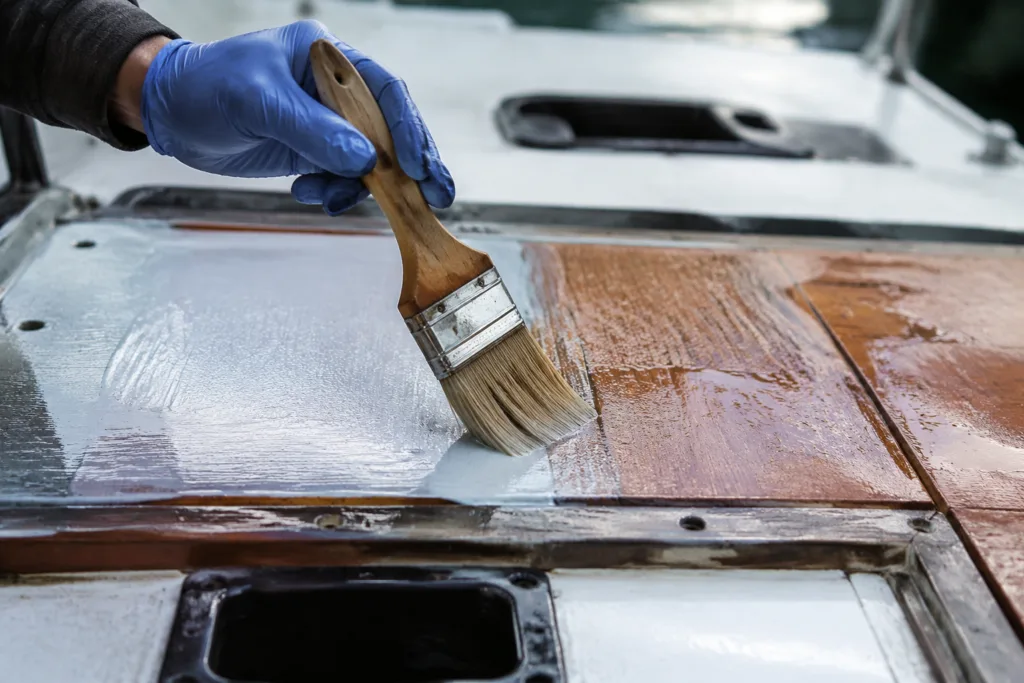
Cure control and on-boat realities
Pot life, gel time, and exotherm
Marine repairs often happen in warm engine compartments, direct sun, or enclosed spaces with limited ventilation. Pot life and gel time therefore matter as much as ultimate strength. A resin with excellent final properties can still fail operationally if it kicks too fast, overheats in the mixing cup, traps bubbles, or becomes too viscous before placement.
Thicker sections create higher exotherm because reaction heat builds faster than it can dissipate. That can cause yellowing, shrinkage, cracks, or incomplete wetting at the interface. For fillets, gap filling, or casting around marine hardware, it is safer to define maximum pour thickness and, if needed, build in layers.
Temperature and humidity effects
Low temperature slows reaction kinetics, raises viscosity, and can reduce wetting. High humidity can contribute to surface blush with some amine systems, affecting intercoat adhesion and finish quality. High temperature shortens working time and can increase peak exotherm. For marine yards and onboard teams, cure schedules should be written around real ambient conditions, not ideal lab conditions.
If a repair will be done in cool conditions, it may be more practical to use a low-temperature-curing system than to force a standard epoxy outside its intended window. However, that choice can involve trade-offs in heat resistance or cure speed. The correct answer depends on whether the part later sees elevated service temperatures, sunlight, engine heat, or secondary coating steps.
For broader project planning, our guide to marine epoxy selection and common boat repair uses provides a useful next layer of context for matching cure profile and application type.
Clear marine epoxy and long-term color stability
Clear systems are often requested for bright-finish wood, decorative laminates, encapsulation, or instrument-related castings. The challenge is that clarity loss can come from several mechanisms at once: oxidation during cure, UV exposure in service, excessive exotherm, contamination, and amine blush. Even a very clean initial cure can yellow over time outdoors.
To improve appearance retention, buyers should look for:
- Low-blush curing systems
- Controlled exotherm in thicker sections
- UV-protective topcoats when the epoxy is exposed to sunlight
- Application guidance that avoids overheating and contamination
- Clear distinction between “good initial clarity” and “long-term UV stability”
For truly appearance-critical projects, it is often better to use epoxy for structural or sealing value and then rely on a UV-stable protective topcoat for long-term visual preservation.
Selecting the right viscosity for marine application methods
Viscosity should match both substrate and process. A single resin cannot be ideal for every marine task.
| Application | Preferred consistency | Why it matters |
|---|---|---|
| Laminating wet-out | Low to medium viscosity | Helps fiber wetting and air release |
| Resin infusion | Low viscosity, controlled reactivity | Supports flow through reinforcement before gel |
| Filleting and fairing | Thixotropic paste | Prevents sag and holds shape |
| Gap filling and bonding | Medium to high viscosity | Maintains bond line and bridges irregular surfaces |
| Potting and encapsulation | Low viscosity or specialty casting grade | Improves void reduction and fill quality |
| Barrier coating | Coating-grade flow with film build control | Supports coverage and consistent protection |
Touch-up and cosmetic rebuild work can also call for a different material than structural bonding. A repair compound such as ZDS-189 wood repair putty for hull and interior touch-ups may be useful where shape retention, sanding ease, and localized defect filling matter more than deep penetration or laminate wet-out.
Practical application best practices for marine projects
A strong marine result depends on process discipline as much as resin choice. The most common field failures are still linked to ratio error, poor substrate prep, cold resin, over-thick application, moisture entrapment, or inadequate cure time before loading.
Recommended workflow
- Stabilize material and substrate temperature before mixing
- Measure mix ratio accurately by the specified method
- Mix thoroughly, scraping sides and bottom
- Transfer to a second container for critical work if needed to reduce unmixed zones
- Apply within pot life and avoid massing excess material in the cup
- Observe thickness limits to control heat and shrinkage
- Allow full cure or required post-cure before aggressive sanding, loading, or immersion
- Inspect for blush, tack, pinholes, voids, and dry spots before overcoating
Common mistakes to avoid
- Using a standard indoor epoxy for below-waterline or prolonged wet exposure
- Bonding over gloss, wax, oil, or weathered gelcoat
- Assuming “surface dry” means fully cured
- Applying thick pours in hot weather without exotherm planning
- Sealing damp wood and trapping moisture inside
- Choosing a resin by hardness alone instead of durability under wet cycling
Failure modes and troubleshooting in marine environments
Most visible failures point back to a limited set of root causes.
| Failure mode | Likely causes | Corrective direction |
|---|---|---|
| Delamination | Poor prep, weak substrate, contamination, low adhesion retention | Reassess prep profile, substrate integrity, and wet-condition adhesion data |
| Amine blush or blooming | Humidity, curing-agent chemistry, low temperature | Clean surface properly and review cure window |
| Blistering or osmosis | Permeation, soluble contaminants, trapped moisture, poor barrier build | Dry substrate, remove contamination, rebuild barrier system correctly |
| Yellowing | UV exposure, high exotherm, oxidation | Use UV-protective topcoat and control cure heat |
| Brittle cracking | Excessively rigid formulation, thermal stress, movement mismatch | Select tougher resin and redesign bond-line thickness if needed |
Specification checklist for buyers and engineering teams
When preparing a procurement or project specification, it helps to state minimum technical requirements instead of using generic wording. A good marine epoxy specification can include:
- Application type: laminating, bonding, fairing, coating, potting, or repair
- Service environment: interior, splash zone, intermittent immersion, continuous immersion, UV exposure
- Substrate list and required prep method
- Viscosity range or application consistency
- Pot life and cure window at target jobsite temperatures
- Water absorption test data request
- Adhesion retention or pull-off data where relevant
- Maximum recommended thickness or pour depth
- Storage condition and shelf-life requirement
- Batch traceability and quality-control expectations
- Overcoat compatibility and blush-management instructions
From a manufacturer perspective, this kind of specification discipline reduces mismatch far more effectively than simply asking for a “strong marine epoxy.” It makes technical review faster, cleaner, and more objective.
Manufacturer capabilities and OEM considerations
OEM and procurement teams often need more than an off-the-shelf answer. They may need a viscosity adjusted for automated dispensing, a slower hardener for large bonding areas, better flexibility for mixed substrates, or added anti-corrosion support for metal contact zones. Private label requirements can also bring packaging, color, mix ratio, labeling, and shelf-life constraints into the formulation decision.
In marine projects, the right manufacturing partner should be able to discuss trade-offs clearly: lower viscosity versus sag control, faster cure versus pot life, hardness versus peel resistance, clarity versus UV durability, or immersion resistance versus processing speed. That discussion is usually more valuable than broad marketing language because it helps teams specify a system that works in real service, not only in a catalogue description.
Short real-world examples
Bonding teak to GRP on a recreational yacht
This application benefits from strong surface prep, moisture control, and an adhesive with enough toughness to handle movement mismatch between wood and composite. A too-rigid standard epoxy can look acceptable at installation but become vulnerable over time as the substrate expands and contracts.
Fairing and through-hull reinforcement on a commercial vessel
Here, exotherm control, film build logic, and water resistance are more critical than decorative finish. Multi-step use of penetrating primer, structural bonding paste, and barrier coating may be more reliable than trying to solve everything with one general epoxy.
Clear casting on a marine instrument component
The priority may be optical quality, low bubble content, and controlled cure heat. Even then, the spec should still address yellowing risk and whether the component will be exposed to sunlight, enclosed heat, or cleaning chemicals.
Conclusion

Marine grade epoxy resin differs from standard epoxy in the ways that matter most once moisture, salt, movement, and real operating conditions enter the picture. Better marine performance usually comes from lower water uptake, stronger wet adhesion, tougher cure networks, better control of blush and exotherm, and more application-specific viscosity design. For buyers and engineers, the safest decision path is to define service conditions first, then compare technical data, substrate compatibility, cure schedule, and retained properties after conditioning. When the resin choice matches the real exposure profile, marine repairs and builds become more durable, more predictable, and easier to specify with confidence.
FAQs
Can I use standard epoxy for my boat repair?
Sometimes yes, but only when the repair is in a low-risk area with limited moisture exposure and modest mechanical demand. For below-waterline work, splash-zone exposure, structural bonding, or repairs involving wet-dry cycling, a marine-focused system is usually the safer choice because it is more likely to retain adhesion and toughness after exposure.
How do I choose a clear marine epoxy that will not yellow quickly?
No clear epoxy is completely immune to yellowing outdoors, so the practical goal is slower color change rather than zero change. Look for low-blush, clarity-oriented formulations, control exotherm during cure, and plan to use a UV-resistant topcoat if the surface will see sunlight for extended periods.
What pot life is suitable for onboard marine repairs?
The right pot life depends on repair size, ambient temperature, and application method. Small spot repairs can use a shorter working time, while laminating, bonding larger panels, or detailed assembly work usually benefits from a longer pot life to improve wetting, placement accuracy, and heat control.
Which tests should procurement teams request before approving a marine epoxy?
Useful starting points include water absorption data, adhesion or pull-off results where relevant, and mechanical property retention after water or humidity conditioning. For metal protection or severe marine exposure, teams may also request corrosion-related testing, ageing data, and clear instructions on cure schedule and substrate preparation.
Can marine epoxy bond to damp wood or wet fiberglass?
Some formulations tolerate slight dampness better than others, but that does not mean they can bond reliably to visibly wet or saturated substrates. Moisture limits should always be checked against manufacturer guidance, because trapped water can reduce adhesion, promote blistering, and shorten service life.
Why does epoxy fail in boats even when the product looked strong on paper?
Many failures come from the gap between laboratory values and field conditions. Common causes include poor surface preparation, wrong mix ratio, over-thick application, inadequate cure before service, hidden moisture, and selecting a resin for dry-service strength rather than long-term marine durability.
Related Reading
- diagnosing and fixing fish eyes and wetting failures in boat epoxy
- causes and prevention of epoxy delamination in boat repairs
- amine blush removal and prevention for marine epoxy
- osmosis barrier coat application guide for hull protection
- marine deck coating systems: epoxy primer plus durable topcoats