
What is resin flooring? In industrial terms, it is a site-applied floor system made from reactive resin binders, curing agents, fillers, and performance additives that form a continuous surface over a prepared substrate. Unlike loose-laid finishes or tiled systems with grout joints, resin floors are specified as integrated builds: primer, body coat, screed or self-leveling layer, and topcoat selected for traffic, chemicals, hygiene, slip resistance, and service temperature. For engineers, contractors, and procurement teams, understanding those system differences matters because two floors described simply as “epoxy flooring” can perform very differently in adhesion, thickness, cure speed, impact resistance, and lifecycle cost.
Explore resin flooring system options for industrial projects when you need to compare build-up logic, expected service conditions, and formulation direction before writing a specification or sending an RFQ.
What makes a resin floor a resin floor?
A resin floor is defined less by appearance and more by how it is built and cured. The binder starts as liquid or semi-liquid resin, reacts with a hardener or curative, and becomes a crosslinked polymer matrix bonded to the substrate. That gives the floor its seamless character, which can improve cleanability, reduce dirt traps, and simplify maintenance in many industrial settings.
From our manufacturing perspective, a true resin floor is not just a paint film. It is a designed system with target thickness, substrate profile, moisture tolerance, and performance criteria. Thin-film seal coats may be under 0.3 mm, self-leveling systems often range around 1 to 3 mm, and heavy-duty screed or mortar systems can be several millimeters thicker depending on mechanical and thermal demand.
How resin floor systems work
Base resins and curatives
Most resin flooring systems use epoxy, polyurethane, polyaspartic, or polyurea-modified chemistry. Epoxy systems are known for adhesion, hardness, and chemical resistance. Polyurethane systems add flexibility, abrasion tolerance, and better UV stability. Polyaspartic and related fast-cure technologies are chosen when rapid return to service is a project constraint.
The curative controls reaction speed, hardness development, pot life, and final balance between brittleness and flexibility. That is why nominally similar resin systems can behave differently during installation and in service.
Fillers and additives
Fillers such as graded silica or mineral extenders help control viscosity, film build, compressive behavior, and cost-performance balance. Additives can modify wetting, de-airing, anti-slip texture, pigment dispersion, chemical resistance, or UV behavior. In conductive floors, specialty conductive media are introduced to manage electrical performance.
System layers
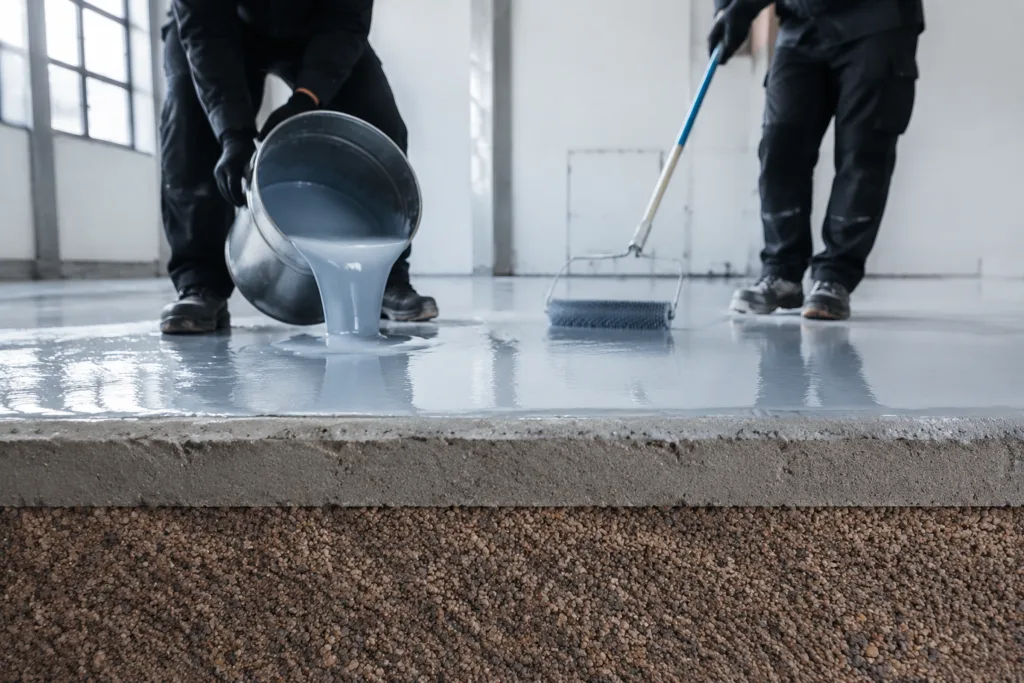
A common industrial system may include a primer for penetration and adhesion, an intermediate coat to build thickness and lock in broadcast aggregates, and a topcoat to deliver wear, stain resistance, and cleanability. For example, where substrate absorption and bond security are critical, a system may begin with a ZDS-1012AB epoxy primer for concrete and ceramic floors before body coats or self-leveling layers are installed.
Primary types of resin flooring
Epoxy resin floors
Epoxy flooring is often the reference point when people ask what is resin flooring, because epoxy remains one of the most widely specified industrial floor chemistries. Typical strengths include strong adhesion to properly prepared concrete, good compressive performance, broad chemical resistance, low shrinkage, and a smooth finish range from utility to decorative.
Its limitations should be understood just as clearly. Standard epoxy can yellow under UV exposure, become less forgiving on moving or cracked substrates, and may not be the right choice where thermal shock or large temperature swings are frequent. Common epoxy builds include primer plus roll coat, primer plus self-leveling body coat, broadcast quartz systems, and epoxy mortar or screed systems for repair and heavy load areas.
Where greater build and impact tolerance are needed, a mid-layer is often doing the real structural work rather than the topcoat alone. In that type of system, a product such as ZDS-3136AB epoxy mid-coat for durable industrial floors is used to create thickness, fill profile, and support wear performance before the final sealing layer.
Polyurethane resin floors
Polyurethane flooring generally offers better flexibility than epoxy, which can help with abrasion, impact, and some substrate movement. Aliphatic PU topcoats can also improve color and gloss retention where ambient light or intermittent sunlight is a concern. In some industrial plants, polyurethane is selected over epoxy because it tolerates mechanical wear and thermal cycling more effectively.
The tradeoff is that PU systems can be more application-sensitive, and some builds require tighter control over humidity, substrate condition, or mixing. They are common in high-traffic facilities, food production, and areas needing a more resilient walking surface.
Polyaspartic and polyurea-modified systems
These systems are chosen mainly for speed. They can provide fast tack-free times, short recoating intervals, and earlier return to service than conventional ambient-cure epoxy systems. That makes them useful for shutdown-limited projects, retail back-of-house areas, logistics sites, or repair windows where overnight completion is needed.
Fast cure, however, changes installation logic. Shorter working time means crew size, mixing sequence, and edge control matter more. For projects where reduced downtime is the deciding factor, a finish such as ZDS-1223AB polyaspartic clear topcoat for fast-cure floor systems may fit better than a conventional epoxy top layer, provided the substrate and environmental conditions are suitable.
Decorative resin floors
Decorative systems include metallic epoxy looks, flake floors, quartz broadcast finishes, and terrazzo-style resin floors. Even when aesthetics matter, the floor should still be specified as a performance system. Broadcast density, aggregate size, clear topcoat chemistry, slip texture, and cleanability all affect whether a decorative floor works in a commercial or light-industrial environment.
For clear finish depth and gloss in decorative applications, some projects use a sealing layer such as ZDS-400AB high-gloss clear epoxy topcoat for decorative resin floors, but specifiers should still check yellowing tolerance, wear expectations, and maintenance methods before selecting a purely visual finish.
Functional specialty systems
Specialty floors include anti-static or ESD systems, anti-slip broadcast floors, chemical-resistant systems, antimicrobial or hygiene-focused systems, moisture-tolerant primers, and high-temperature screeds. These should be chosen by actual service demands, not generic labels. For example, “chemical-resistant” only has meaning if the exposure list includes concentration, contact time, spill frequency, and cleaning regime.
Key performance metrics buyers should know
| Metric | Why it matters | Practical note |
|---|---|---|
| Pot life | Determines usable time after mixing | Short pot life increases placement risk in warm conditions |
| Tack-free time | Affects dust pickup and recoat timing | Useful for shutdown scheduling, but not the same as full cure |
| Time to foot traffic | Early access planning | Often much shorter than time to forklift or chemical service |
| Hardness | Indicates surface rigidity and wear behavior | Higher hardness is not always better if impact or movement is expected |
| Abrasion resistance | Important for wheels, dragging, and traffic | Compare test method and system thickness, not just one number |
| Tensile and elongation | Shows flexibility and crack-bridging potential | Useful when selecting between epoxy and PU families |
| Chemical resistance | Controls suitability for spills and washdown | Review chemical list by concentration and temperature |
| Slip resistance | Affects safety in wet or contaminated areas | Texture can improve grip but also affect cleaning |
| Thermal resistance | Important near ovens, hot wash, or steam exposure | Thermal shock tolerance is different from dry heat resistance |
| VOC profile | Affects indoor application constraints | Verify local compliance and ventilation needs |
We advise buyers to compare test data only when the test method, cure condition, and system build are aligned. A single property value without thickness, substrate, and curing context can be misleading.
Epoxy vs PU vs polyaspartic
| System type | Main strengths | Main limitations | Typical fit |
|---|---|---|---|
| Epoxy | Adhesion, hardness, chemical resistance, cost-performance | UV yellowing, lower flexibility, slower return to service | Warehouses, production halls, utility areas, chemical zones |
| Polyurethane | Flexibility, abrasion resistance, UV stability, comfort under traffic | Can be more application-sensitive, sometimes higher system cost | Food areas, high-traffic plants, mixed indoor-outdoor exposure |
| Polyaspartic | Fast cure, short shutdown windows, low-temperature application potential | Short working time, technique-sensitive installation | Rapid refurbishment, service corridors, time-critical projects |
If the question is resin flooring vs polished concrete, the main distinction is functional control. Polished concrete relies heavily on the slab itself, while resin floors let the specifier design chemical resistance, slip profile, color, electrostatic behavior, and repair strategy more directly.
How to choose a system by industry and scenario
Warehouses and logistics
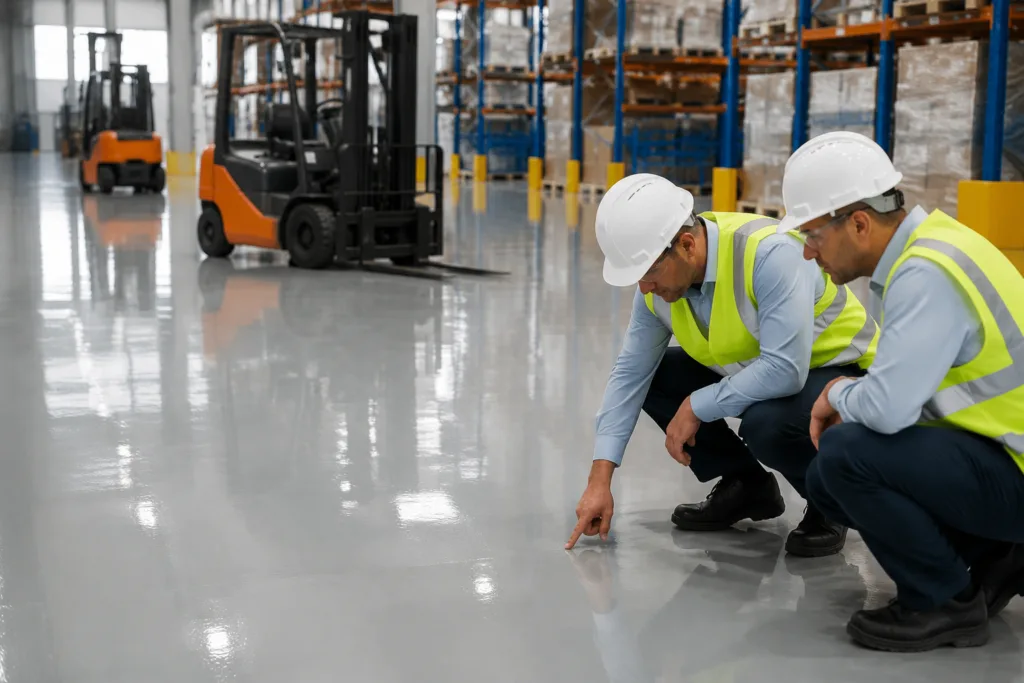
Forklift traffic usually means abrasion, tire marking, point loading, and impact at joints or turning areas. A thin decorative coating may look acceptable at handover but wear quickly under constant wheel traffic. Buyers should check slab flatness, joint condition, wheel type, and cleaning method before deciding between a thin-film epoxy, a self-leveling floor, or a thicker screed build.
Manufacturing and chemical plants
Start with the chemical list: acids, alkalis, solvents, oils, and process liquids. Then add concentration, temperature, exposure duration, and whether spills are intermittent or continuous. Secondary containment areas may need different chemistry from general production zones. At ZDSpoxy, we usually work backward from that exposure map rather than choosing a resin family first.
Food and beverage
Cleanability, anti-slip balance, thermal washdown, and coved detailing are often more important than gloss. Texture must match contamination risk: too smooth can become unsafe when wet, while too rough may trap residue and slow sanitation. Some zones benefit from more resilient PU-based systems where temperature cycling is frequent.
Pharmaceuticals and cleanrooms
Low porosity, easy cleaning, controlled particulate behavior, and consistent finish quality matter here. Buyers should also review odor and VOC constraints during installation, plus curing schedules that fit commissioning plans. Repairability is important because patch visibility and contamination control can affect qualification work.
Parking decks and exterior exposure
Exterior or semi-exposed floors are usually poor candidates for standard interior epoxy top layers. UV, thermal cycling, and water exposure increase the importance of flexible, weather-stable finishes. Slip resistance under wet conditions and crack movement tolerance should be specified explicitly.
Typical build-ups and thickness ranges
| Scenario | Typical build-up | Approximate thickness range |
|---|---|---|
| Light-duty utility room | Primer plus roll coat or seal coat | 0.2 to 0.5 mm |
| Warehouse aisle | Primer plus self-leveling epoxy plus topcoat | 1 to 3 mm |
| Heavy manufacturing | Primer plus mortar or screed plus topcoat | 3 to 6 mm or more |
| Decorative commercial floor | Primer plus pigmented body coat plus flakes or metallic layer plus clear topcoat | 0.5 to 3 mm |
| Fast-turnaround refurbishment | Rapid primer or repair layer plus polyaspartic top system | Varies by repair depth and finish target |
These are decision ranges, not guaranteed specifications. Final thickness should be based on substrate condition, service load, and accepted installation tolerance.
Surface preparation and installation best practices
Most floor failures begin below the coating. Concrete age, laitance, contamination, compressive quality, and moisture condition all matter. Mechanical surface preparation such as grinding or shot blasting should create the profile required by the selected system. Specifiers often refer to concrete surface profile targets, but the key point is matching the profile to the primer and body coat viscosity.
Moisture testing should never be skipped on slab-on-grade or uncertain substrates. If vapor drive is likely, use a system designed for that risk rather than forcing a standard build onto a wet slab. Also define ambient and substrate temperature limits, relative humidity limits, and dew point separation before installation starts.
Curing behavior and scheduling
A practical resin floor specification should distinguish between pot life, walk-on time, light service, full mechanical load, and chemical cure. A floor that can take foot traffic in several hours may still need much longer before pallet jacks, forklifts, or harsh cleaning chemicals are allowed.
Temperature strongly affects reaction speed. Warm conditions shorten working time and can increase roller marks or lap lines. Cold conditions extend cure and may reduce flow. Humidity can influence appearance or cure behavior in some systems. For shutdown planning, ask the manufacturer for a cure schedule by temperature band rather than one nominal value.
Quality assurance on project
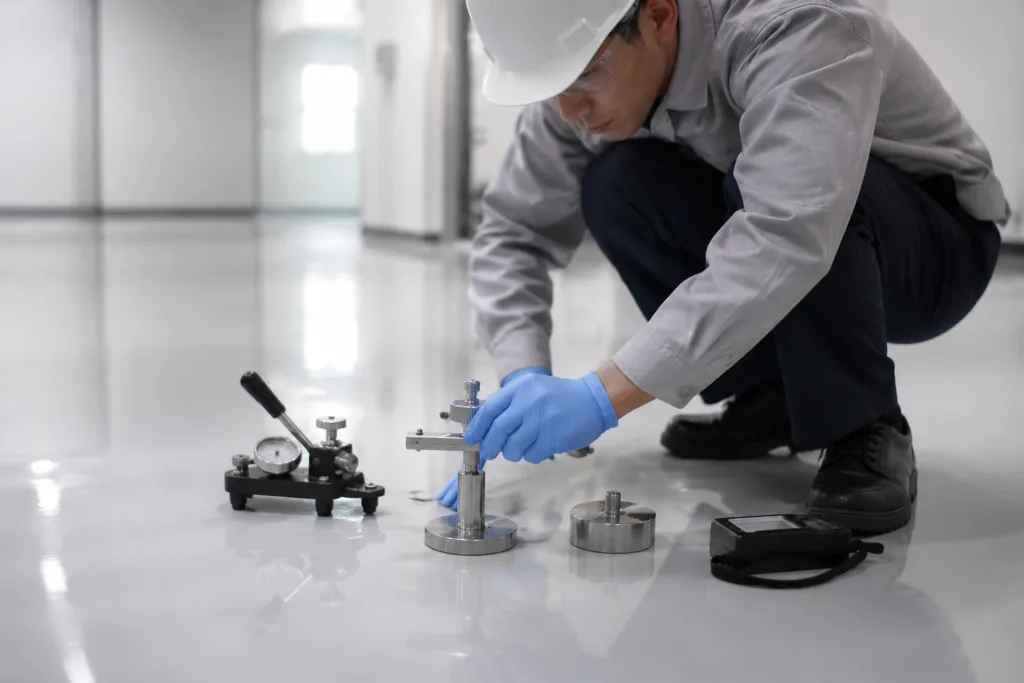
Useful project QA items include substrate moisture records, ambient logs, batch traceability, wet and dry film thickness checks where relevant, adhesion pull-off testing when specified, slip resistance confirmation for textured zones, and visual acceptance criteria for pinholes, roller lines, or color variation. Failure review should distinguish adhesive failure to substrate, cohesive failure within concrete, and intercoat failure, because each points to a different root cause.
Maintenance, repair, and lifecycle planning
Industrial buyers should evaluate resin floors on lifecycle cost, not only installed cost per square meter. A cheaper thin-film system may require earlier repair in traffic lanes, while a thicker build can reduce disruption and rework frequency. Cleaning chemistry also affects lifespan; aggressive cleaners can shorten topcoat life if they are incompatible with the system.
Repair planning should be part of the original specification. Define acceptable patch appearance, recoat windows, and whether future tie-ins require broadcast texture matching, anti-slip renewal, or conductive continuity checks.
Common problems and root-cause checks
Blistering or bubbling
Often linked to substrate moisture, outgassing, or excessive film build over porous concrete. Check primer penetration, slab temperature rise during application, and whether the surface was sealed too quickly.
Delamination
Usually caused by contamination, weak surface concrete, inadequate profile, missed recoat window, or moisture pressure. Pull-off testing and fracture pattern review are more useful than visual guessing.
Yellowing
Common with many aromatic epoxy finishes under UV exposure. If visual stability matters, specify a more UV-stable topcoat chemistry.
Cracking
Can reflect substrate movement, reflective cracking, brittle system choice, or structural slab issues. Resin flooring cannot compensate for all substrate movement without a compatible design.
Insufficient adhesion
Review substrate profile, dust control, primer compatibility, mixing accuracy, and environmental conditions during cure. Many adhesion failures are process problems, not simply product problems.
Health, safety, and environmental considerations
Flooring specifications should address PPE, ventilation, mixing safety, waste handling, and curing emissions alongside performance requirements. Solventless systems can reduce some site concerns, but no resin system should be treated casually during installation. Buyers should request TDS, SDS, storage guidance, and disposal recommendations early in the procurement cycle.
How to evaluate a resin flooring manufacturer or supplier
Ask for more than a brochure. Practical evaluation questions include:
- What substrate moisture limits apply, and what mitigation options are available?
- What are the pot life, tack-free time, and time to mechanical and chemical service at different temperatures?
- Which primer, body coat, and topcoat combinations are approved together?
- What test methods support abrasion, adhesion, slip, and chemical resistance claims?
- Can the supplier provide batch traceability and documented QC controls?
- What site acceptance criteria are recommended for thickness, appearance, and adhesion?
- What are the repair and recoating procedures after damage or wear?
We recommend requesting system data sheets, SDS documents, cure schedules, sample panels, and written clarification on exclusions before final award. That approach usually prevents specification gaps later.
Sample specification language and procurement checklist
Example specification snippet
Provide a seamless resin flooring system on mechanically prepared concrete substrate. System shall include compatible primer, intermediate build coat, and wear topcoat as recommended by the manufacturer for the stated service environment. Finished floor shall achieve the specified thickness range, chemical resistance appropriate to the exposure schedule, and slip resistance appropriate to wet and dry operating conditions. Installation shall follow documented substrate moisture limits, ambient application limits, and recoat windows.
Procurement checklist
- Define traffic type: pedestrian, pallet jack, forklift, steel wheel, or impact loading
- List chemicals by concentration, temperature, and contact duration
- Specify washdown or thermal cycling conditions
- Confirm substrate age, moisture condition, and repair scope
- State target thickness and finish texture
- Request cure schedule by temperature band
- Request TDS, SDS, and compatible system build document
- Define acceptance criteria for appearance, thickness, and adhesion
- Clarify maintenance method and recoat strategy
Conclusion
For industrial buyers asking what is resin flooring, the most useful answer is this: it is not one material but a family of engineered floor systems built around resin chemistry, substrate condition, and service demand. The right specification depends on matching the resin family and layer build to traffic, chemicals, moisture, temperature, downtime limits, and maintenance strategy. If you compare systems by complete build-up, cure schedule, and project conditions rather than by generic labels alone, you will make better sourcing and performance decisions.
Frequently Asked Questions
How long does resin flooring last?
Service life depends on system thickness, traffic, chemicals, substrate quality, and maintenance, but thicker industrial systems generally outlast thin decorative coatings in demanding environments.
Is resin flooring the same as epoxy flooring?
No, epoxy is one major type of resin flooring, but polyurethane, polyaspartic, and other specialty chemistries are also used depending on cure speed, UV exposure, flexibility, and service conditions.
How thick should an industrial resin floor be?
Light-duty coatings may be under 0.5 mm, many self-leveling industrial systems are about 1 to 3 mm, and heavy-duty screed or mortar builds are often 3 mm or thicker.
Can resin flooring be applied over damp concrete?
Sometimes, but only with systems designed for moisture tolerance or vapor mitigation; standard builds can fail if slab moisture or vapor drive is not properly evaluated first.
Is resin flooring slip resistant?
It can be, but slip resistance depends on the aggregate texture, topcoat profile, and whether the floor is used dry, wet, oily, or under frequent washdown conditions.
How fast can a resin floor return to service?
Return-to-service time varies by chemistry and temperature, with fast-cure systems often reopening sooner than standard epoxy, but full chemical and heavy mechanical service usually takes longer than walk-on cure.