
What is epoxy grout? Epoxy grout is a two- or three-component resin-based jointing and anchoring material made from epoxy resin, a curing agent, and selected fillers or pigments. Unlike cement grout, it cures by chemical reaction rather than water evaporation or cement hydration, which gives it strong adhesion, low water absorption, high stain resistance, and better performance in wet, chemical, hygienic, or heavy-duty environments. This guide is written for specifiers, contractors, engineers, procurement teams, and industrial buyers who need to decide when epoxy grout is worth the extra cost and installation control.
For projects where grout must resist moisture, cleaning chemicals, food acids, oils, or industrial washdown, it is useful to explore epoxy grout solutions for chemical resistance and waterproofing before finalizing a specification.
What Epoxy Grout Is Made Of
Most epoxy grout systems are built from three functional groups of ingredients: the epoxy resin, the curing agent, and the filler package. The resin provides adhesion, toughness, and chemical resistance. The curing agent, commonly amine-based in many construction grouts, reacts with the resin to form a crosslinked polymer network. Fillers such as graded silica, mineral powders, or specialty aggregates control viscosity, sag resistance, compressive strength, abrasion behavior, and shrinkage.
Pigments and additives are added for color consistency, workability, thixotropy, wetting, defoaming, anti-sag behavior, and cure control. From our manufacturing perspective, a grout is not simply “strong” or “waterproof” in isolation; its performance depends on how resin chemistry, filler loading, particle size, and cure speed are balanced for the jobsite conditions.
| Component | Main Function | Specification Impact |
|---|---|---|
| Epoxy resin | Bonding, durability, chemical resistance | Affects adhesion, hardness, flexibility, yellowing tendency, and service life |
| Curing agent | Controls chemical cure | Affects pot life, cure speed, temperature sensitivity, and chemical resistance |
| Fillers and aggregates | Build body and strength | Affects viscosity, joint packing, compressive strength, abrasion resistance, and shrinkage |
| Pigments and additives | Color and processing control | Affects appearance, workability, flow, cleanup, and storage stability |
Common Types of Epoxy Grout Formulations
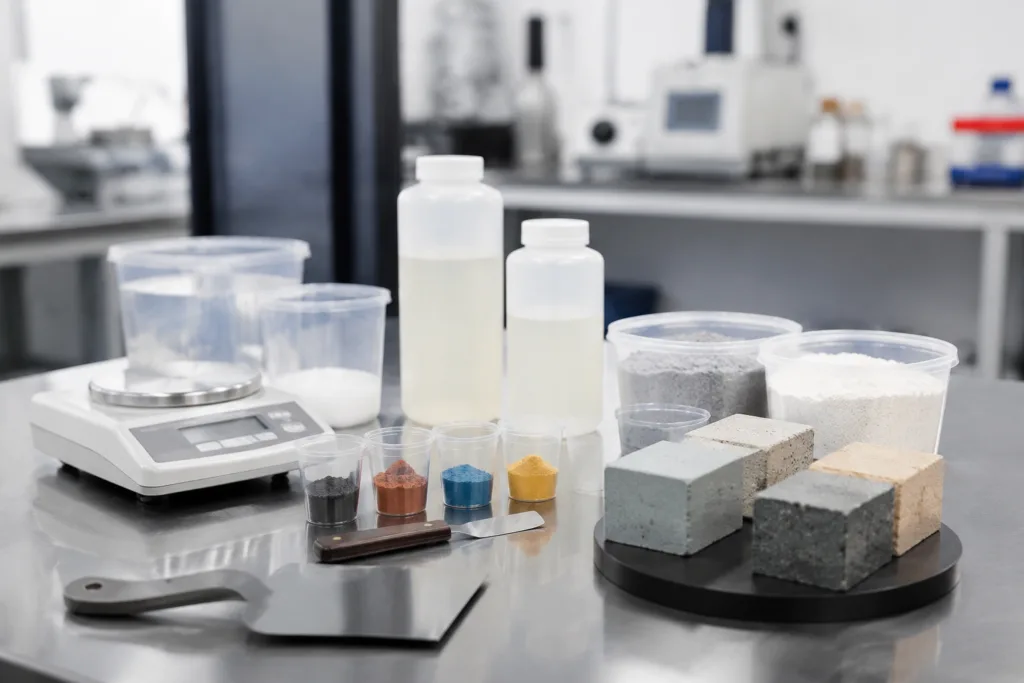
Epoxy grout is not one universal material. The correct formulation depends on joint width, exposure, substrate, cure schedule, and whether the grout is used for tile joints, machinery bases, underwater repair, or industrial crack filling.
100% Solids Epoxy Grout
These systems contain little to no solvent and are often selected where low shrinkage, high chemical resistance, and dense cured structure are required. They are common in food processing, commercial kitchens, laboratories, pools, cleanable industrial floors, and chemical service areas. Many premium tile grouts and machinery grouts fall into this category.
Epoxy-Cement and Modified Hybrid Grouts
Hybrid systems combine resin modification with cementitious behavior. They may be easier to apply than full epoxy grout and can reduce material cost, but they usually do not match the chemical resistance, stain resistance, or water absorption profile of a true epoxy system. They can be suitable where moderate performance improvement is needed without specifying a fully resinous grout.
High-Strength and Machinery Grouts
When grout is used under equipment bases, crushers, pumps, rails, or structural bearing plates, compressive strength, creep resistance, vibration tolerance, and load transfer become more important than decorative finish. For this type of specification, contractors may compare tile-grade epoxy grout with products such as ZDS-4130AB high-compressive epoxy grout for heavy machinery bases, where the performance target is mechanical support rather than only joint sealing.
Underwater, Wet-Area, and Fast-Curing Variants
Some formulations are designed to tolerate damp substrates, standing water, or underwater placement. Others prioritize rapid return to service, which can be useful in retail, food service, or plant maintenance shutdowns. Faster systems usually reduce open time, so installers need tighter batching, smaller mix volumes, and a trained crew.
Epoxy Grout Compared With Cementitious Grout
Cement grout remains useful for many residential and light commercial applications because it is economical, familiar, and forgiving. Epoxy grout is chosen when the performance requirement is higher than what cement grout can reliably deliver. The main difference is that cement grout is porous and mineral-based, while epoxy grout cures into a dense polymer matrix with low water absorption.
| Performance Factor | Epoxy Grout | Cementitious Grout |
|---|---|---|
| Water absorption | Typically very low when properly cured | Higher unless sealed and maintained |
| Chemical resistance | Strong against many cleaners, food acids, oils, and mild industrial chemicals; confirm chemical list | Limited, especially against acids and aggressive cleaners |
| Stain resistance | High because the surface is dense and non-porous | Moderate to low without sealing |
| Compressive strength | Often higher, especially in filled industrial grades | Varies by cement type and water ratio |
| Shrinkage | Low with 100% solids systems | Can shrink or crack if mixed too wet |
| Installation difficulty | Higher; strict ratio, pot life, and cleanup control | Lower; more forgiving for general installers |
| UV and yellowing | Can discolor outdoors unless stabilized or protected | Generally less resin-yellowing concern, though staining can occur |
Where Epoxy Grout Performs Best
Epoxy grout is most valuable where grout failure creates hygiene risk, downtime, water intrusion, chemical attack, or repeated maintenance. In commercial kitchens, it helps resist grease, food acids, detergents, and hot washdown. In laboratories, it supports easier cleaning and improved resistance to spills when the chemical exposure is within the grout’s tested limits. In food processing, it reduces water absorption and supports sanitary maintenance around tiles, trenches, drains, and production zones.
Swimming pools, spas, shower rooms, and exterior wet environments benefit from low water absorption and strong adhesion. For submerged or constantly wet service, a wet-tolerant formulation matters; ordinary epoxy grout may not bond well if the substrate is saturated or if water interrupts the cure. In these cases, a system such as ZDS-1417AB high-strength underwater epoxy grout for wet environments illustrates the type of formulation logic specifiers should look for.
In industrial floors and service corridors, epoxy grout can reduce joint erosion caused by forklifts, carts, chemical drips, and repeated cleaning. The key is to match grout hardness and toughness to the movement and impact profile of the floor system rather than assuming the hardest formulation is always the most durable.
Limitations and Trade-Offs
Epoxy grout is not automatically the correct answer for every project. It costs more per unit than cement grout and often requires more skilled labor. Cleanup must be done during the correct window; if resin haze cures on tile, removal can be difficult. Pot life may range from less than 20 minutes for fast systems to 45 minutes or more for slower systems, depending on formulation, batch size, and temperature.
Temperature strongly affects working time. Warm conditions accelerate cure and shorten pot life, while cool conditions slow cure and can delay return to service. Substrate moisture also matters. Some systems tolerate damp surfaces, while others require dry, clean substrates. Always verify the technical data sheet rather than relying on a generic epoxy assumption.
- Cost: Higher material cost, but often lower maintenance cost in aggressive environments.
- Skill: Requires accurate mixing, timing, tooling, and cleanup discipline.
- Repairability: Spot repair can be more difficult because cured epoxy bonds strongly and may not color-match perfectly.
- UV exposure: Some epoxy systems yellow or chalk under sunlight unless modified or protected.
- Movement: Epoxy grout is not a substitute for movement joints, expansion joints, or flexible sealants.
Installation Fundamentals for Contractors
Successful epoxy grout installation begins before mixing. Substrates and tile edges must be clean, sound, and free from dust, oil, laitance, release agents, standing water, or loose cement residue. Joint depth and width must match the grout’s recommended range. Many tile-joint epoxy grouts are designed for narrow to moderate joints, while industrial grouts may be formulated for deeper voids, anchoring pockets, or larger bearing areas.
For tight joints, fine seams, and low-clearance voids, viscosity becomes a critical selection factor. A low-viscosity material can penetrate narrow spaces better than a heavily filled paste, but it may need controlled placement to prevent runout. This is where a product category like ZDS-4131AB low-viscosity epoxy grout for tight joints and fine seams helps clarify why flow behavior should be specified, not assumed.
Practical Installation Checklist
- Confirm substrate dryness or wet-tolerance requirements before mobilization.
- Check the approved joint width, joint depth, and tile compatibility.
- Condition materials to the recommended temperature range before mixing.
- Use the full resin-to-hardener ratio; do not split kits unless weighing is controlled.
- Mix mechanically at low speed to avoid air entrapment and unmixed streaks.
- Work in small batches when ambient temperature is high.
- Tool the joint before the grout begins to gel.
- Complete initial wash and final cleanup within the manufacturer’s recommended window.
- Protect the work from water, traffic, chemicals, and cleaning until the stated cure time is reached.
Typical light foot traffic windows may be around 12 to 24 hours for many systems under normal conditions, while full chemical resistance may require several days. These values vary by formulation, film mass, temperature, and cure chemistry, so the project specification should state the required return-to-service schedule.
Cleaning, Maintenance, and Long-Term Care
Properly cured epoxy grout is easier to keep clean than cement grout because it absorbs less water and staining liquid. Neutral or mildly alkaline cleaners are commonly used for routine maintenance, followed by clean water rinsing where residues could accumulate. Avoid unverified strong solvents, aggressive paint removers, or highly concentrated chemicals unless the grout supplier confirms compatibility.
Maintenance teams should inspect for cracked tiles, loose edges, failed movement joints, impact damage, or chemical attack patterns. If grout discoloration appears only near a drain, tank, or process line, the issue may be chemical concentration, heat, or cleaning residue rather than ordinary staining. In submerged or aggressive service, the grout may be part of a broader resin system that includes coating, repair mortar, or lining materials; for those environments, engineers may also evaluate a ZDS-2186AB chemical-resistant epoxy option for submerged and aggressive conditions as part of the surrounding protection strategy.
Common Mistakes and Troubleshooting
Most epoxy grout failures trace back to selection mismatch, surface preparation, mixing control, or cure conditions. Poor ratio control can leave soft, tacky, or brittle areas. Incomplete mixing can cause color streaks and weak spots. Applying over dusty, wet, oily, or contaminated surfaces can reduce adhesion even when the epoxy itself is high strength.

| Problem | Likely Cause | Corrective Action |
|---|---|---|
| Sticky or soft grout | Wrong mix ratio, poor mixing, low temperature, expired material | Remove uncured material, verify batch condition, reapply with controlled mixing |
| Pinholes or voids | Air entrainment, poor packing, fast tooling, low grout volume | Use correct mixing speed, pack joints fully, rework before gel |
| Discoloration | Improper cleanup, chemical exposure, UV, contaminated water | Identify exposure source, test cleaning method, consider UV-stable or protected system |
| Cracking at joints | Movement joint omitted, substrate movement, impact, thermal cycling | Use flexible movement joints and repair damaged substrate before regrouting |
| Poor bond | Dust, oil, moisture mismatch, weak substrate | Prepare surface, confirm moisture tolerance, prime if specified |
Specification Checklist for Professionals
A good epoxy grout specification defines the service environment rather than only naming a generic material. We usually start by asking what the grout must survive: cleaning chemicals, acids, oils, salts, hot water, immersion, forklift traffic, impact, vibration, thermal cycling, UV exposure, or hygienic washdown. The answer determines resin chemistry, filler package, viscosity, pot life, cure schedule, and test requirements.
- Chemical exposure: List the actual chemicals, concentrations, temperatures, and contact duration.
- Mechanical loading: Define traffic, vibration, compressive load, abrasion, and impact risk.
- Joint geometry: State joint width, depth, void size, and whether the grout must flow or remain non-sag.
- Substrate: Identify tile, concrete, steel, stone, masonry, or existing resin surface.
- Moisture condition: Confirm dry, damp, wet, submerged, or intermittent immersion.
- Return to service: Define foot traffic, washdown, chemical exposure, and full load timing.
- Appearance: Confirm color tolerance, staining risk, UV exposure, and cleaning method.
- Documentation: Request TDS, SDS, batch identification, test data, and installation instructions.
When a standard product does not match the exposure profile, a manufacturer can adjust viscosity, cure speed, filler loading, color, or chemical resistance targets. In our epoxy resin formulation work at ZDSpoxy, this evaluation is based on the application environment first, then the processing window the contractor can realistically manage.
Epoxy Grout vs Cement Grout vs Urethane or Polymer Grouts
The right grout is the one that fits the risk profile. Cement grout can be suitable for lower-risk areas where cost and ease of installation matter most. Urethane and other polymer grouts may offer flexibility and stain resistance in certain decorative or residential applications, but chemical resistance and high-temperature tolerance must be verified. Epoxy grout is typically selected when durability, hygiene, water resistance, and chemical resistance are primary drivers.
| Project Scenario | Likely Grout Choice | Reason |
|---|---|---|
| Residential dry wall tile | Cement or polymer grout | Lower exposure and easier installation |
| Commercial kitchen floor | Epoxy grout | Grease, food acids, hot washdown, and hygiene requirements |
| Laboratory splash area | Epoxy grout | Better resistance to many spills and easier cleaning |
| Decorative area with minor movement | Polymer or flexible system | Movement and appearance may be more important than chemical resistance |
| Swimming pool or wet room | Wet-area epoxy grout | Low water absorption and improved stain resistance |
| Machinery base or crusher support | Industrial epoxy grout | Compressive strength, load transfer, and vibration resistance |
Testing, Standards, and Documentation to Request
Professional specifications should ask for test data that matches the project risk. Useful references may include ASTM methods for compressive strength, bond strength, water absorption, chemical resistance, abrasion, and dimensional change where applicable. Exact standards depend on the grout type and use case, so the project engineer should align requested tests with tile, concrete, coating, or machinery-grouting requirements.
For food, beverage, pharmaceutical, healthcare, or cleanroom areas, also ask how the grout will support sanitation, cleanability, and chemical washdown procedures. Avoid assuming that “epoxy” automatically means food-safe or compliant; compliance depends on the complete formulation, cure state, installation environment, and applicable local requirements.
Cost and Life-Cycle Considerations
Epoxy grout usually has higher material and labor cost than cement grout. However, in wet, chemical, or high-traffic areas, the life-cycle cost can be lower if it reduces regrouting, staining, water ingress, shutdowns, odor, mold-supporting residue, and cleaning labor. The return is strongest when grout failure would interrupt operations or create sanitation issues.
A practical rule is to compare not only the grout price but the cost of access, surface preparation, downtime, rework, cleaning, and production disruption. A low-cost grout can become expensive if it fails in a plant corridor, commercial kitchen, pool deck, or process room that is difficult to shut down.
Manufacturer Evaluation Points
When choosing an epoxy grout supplier, ask for more than a product name. Request the technical data sheet, safety data sheet, installation guide, batch consistency process, color tolerance information, storage conditions, and chemical resistance chart. For demanding projects, ask whether the supplier can review the chemical list, temperature range, substrate condition, and return-to-service requirement before the material is approved.
Useful manufacturer support may include formulation adjustment, private label options, sample panels, cure schedule guidance, color development, and jobsite troubleshooting. The most important point is alignment: the grout must match the exposure, and the installation method must match the grout’s working time.
Typical Product Attributes to Specify
Exact values vary by formulation, but a professional epoxy grout specification often defines target properties rather than relying on a generic product description. Typical attributes may include pot life, initial set time, full cure window, compressive strength, bond strength, viscosity or consistency, service temperature range, water absorption, chemical resistance list, color tolerance, and recommended joint width.
- Pot life: Often around 20 to 60 minutes, shorter in hot conditions and larger batches.
- Return to light foot traffic: Often around 12 to 24 hours, depending on cure speed and temperature.
- Full chemical exposure: Commonly delayed for several days until full cure is achieved.
- Joint width: Must follow the product data sheet; fine-seam and industrial void systems are formulated differently.
- Service temperature: Must be verified for hot washdown, steam, exterior exposure, or process heat.
- Chemical resistance: Should be checked against actual chemicals, concentration, temperature, and contact duration.
Short Application Examples
Food Processing Line
A production floor with tile joints exposed to fats, organic acids, detergents, and frequent washdown would typically justify epoxy grout. Key specification points include low water absorption, resistance to cleaning chemicals, strong bond to tile edges, and a cure schedule that fits shutdown planning.
Indoor Swimming Pool
A pool or spa area needs grout that resists continuous moisture, cleaning chemicals, staining, and edge erosion. The specification should confirm immersion suitability, substrate moisture condition, color stability expectations, and cure time before filling or reopening the pool.
Chemical Plant Service Corridor
A service corridor exposed to spills, carts, and periodic cleaning may need an epoxy grout with chemical resistance, abrasion resistance, and impact tolerance. If spills are concentrated acids, solvents, or high-temperature chemicals, the chemical resistance chart should be reviewed before approval.
Conclusion
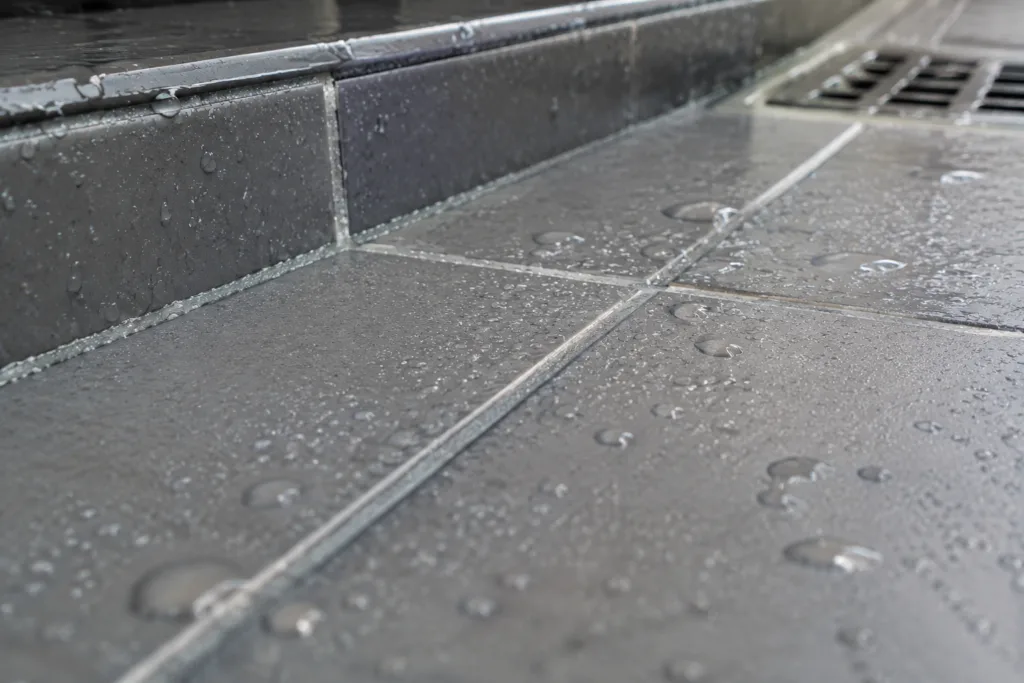
Epoxy grout is a resin-based grout system chosen for low water absorption, strong adhesion, stain resistance, chemical resistance, and durability in demanding environments. It is most useful where cement grout would absorb contaminants, erode under cleaning, stain easily, or require frequent maintenance. The trade-off is that epoxy grout requires better specification, tighter installation control, and a clear understanding of pot life, cure time, substrate condition, and exposure limits.
For specifiers and contractors, the practical next step is to define the environment first: chemicals, moisture, traffic, joint geometry, temperature, cleaning method, and return-to-service window. Once those are clear, the epoxy grout formulation can be selected with much less guesswork.
FAQ
Is epoxy grout waterproof?
Epoxy grout has very low water absorption and is often used in wet areas, but the complete assembly is only as waterproof as the substrate, tile, movement joints, and installation quality. It should be specified as a water-resistant grout, not as a substitute for a waterproofing membrane.
Can epoxy grout be used outdoors?
Yes, epoxy grout can be used outdoors when the formulation is suitable for UV exposure, temperature cycling, moisture, and the tile system. Some epoxy systems may yellow or chalk under sunlight, so exterior projects should confirm UV stability or use a protected system.
How long before walking on epoxy grout?
Many epoxy grouts allow light foot traffic after about 12 to 24 hours under normal conditions, but full cure and chemical resistance may take several days. Always follow the technical data sheet because cure speed changes with temperature, batch size, and formulation.
Is epoxy grout better than cement grout?
Epoxy grout is better for wet, chemical, stain-prone, hygienic, or high-traffic environments, while cement grout may be more economical and easier to install in lower-risk areas. The better choice depends on exposure, maintenance expectations, installer skill, and life-cycle cost.
Can epoxy grout be color matched?
Epoxy grout can be pigmented and color matched within practical manufacturing tolerances, but exact matching to existing aged grout or tile can be difficult. For visible projects, request cured samples or mockups before full installation.
What is the biggest mistake when installing epoxy grout?
The most common mistake is poor mixing or ignoring pot life, which can cause soft spots, color streaks, weak adhesion, or difficult cleanup. Contractors should mix complete kits accurately, work in manageable batches, and clean residue before the grout cures.