
Waterproof epoxy grout is often treated as a simple yes-or-no material choice, but in practice the answer depends on chemistry, installation quality, joint design, exposure conditions, and how the full wet-area system is specified. From our manufacturing perspective, epoxy grout can deliver very low water absorption, strong chemical resistance, and much better stain resistance than cementitious grout, but that does not mean every epoxy grout installation automatically becomes a waterproof barrier under every jobsite condition.
Explore epoxy grout system options for waterproof installations when you are comparing joint fillers, substrate conditions, and exposure classes for showers, food areas, pools, and other wet environments.
Executive summary: is epoxy grout really waterproof?
The short answer is that epoxy grout is generally highly water-resistant and very low in porosity, and in many tile and industrial joint applications it performs far better than cement-based grout in resisting water penetration, staining, and chemical attack. However, specifiers should avoid assuming that grout alone replaces the need for proper waterproof membranes, movement joints, crack control, or substrate preparation.
In wet-area work, epoxy grout can usually be relied on when the following conditions are met:
- The formulation is designed for the intended exposure, including chemical load, immersion time, and cleaning regime.
- The joint dimensions match the product viscosity and filler system.
- Mix ratio and pot life are respected.
- The substrate is properly prepared and dry enough for the selected system, or a compatible damp-tolerant primer is used.
- Movement joints, penetrations, drains, corners, and transitions are handled with the correct companion materials.
- Field quality checks confirm cure and water-tightness at the system level, not only at the grout line.
For procurement teams and engineers, the practical specification question is not only “Is epoxy grout waterproof?” but rather “Is this epoxy grout system sufficiently water-resistant for this exact service condition, and what other layers are needed to make the assembly reliable?” That distinction prevents costly failures.
What epoxy grout is and how it differs from cement grout
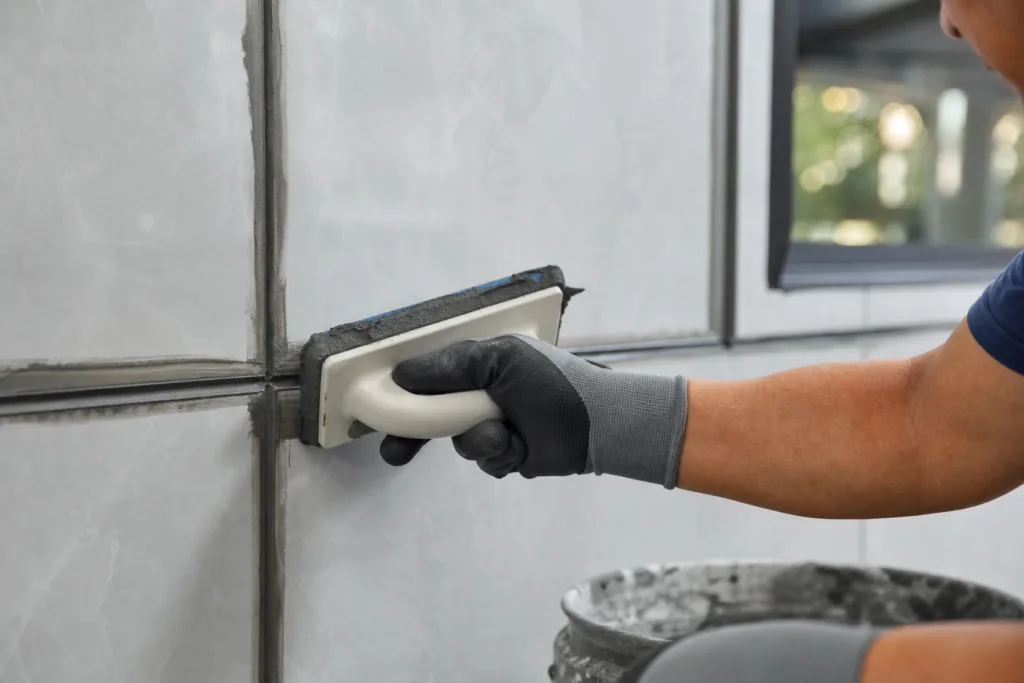
Epoxy grout is typically a reactive system built around a resin component and a hardener component, often combined with graded fillers, pigments, and performance additives. After mixing, the resin and hardener crosslink into a dense polymer matrix that binds the fillers and forms the cured joint material.
Cementitious grout behaves differently. It hardens through hydration, remains more porous, and often depends on sealers or maintenance cycles to reduce staining and moisture ingress. Epoxy grout, by contrast, is designed to cure into a denser, less absorbent structure. That is one reason it is widely considered for showers, commercial kitchens, laboratories, pool surrounds, and industrial washdown areas.
Typical epoxy grout ingredients include:
- Epoxy resin for bonding and network formation
- Amine or modified hardener for cure reaction
- Silica or mineral fillers for body, strength, and shrinkage control
- Pigments for color consistency
- Flow modifiers, defoamers, and wetting aids for workability
- Special additives for chemical resistance, flexibility, or cleaning behavior
The exact balance matters. A grout optimized for narrow decorative tile joints may not perform the same way as a heavy-duty industrial joint compound intended for aggressive cleaning chemicals or intermittent immersion. In our formulation work, that is where product selection becomes more important than generic material labels.
How waterproof epoxy grout achieves water resistance
The water resistance of epoxy grout comes from its crosslinked polymer network and its relatively low porosity after cure. When resin and hardener are mixed correctly, they form a tight three-dimensional structure that does not absorb water the way cement-rich materials do. Fillers further reduce shrinkage and help control dimensional stability, while pigments and additives can influence cleanability and long-term surface behavior.
That said, “waterproof” in a marketing sense can be misleading. Water resistance depends on several connected factors:
- Degree of cure and crosslink density
- Void content caused by mixing or tooling defects
- Bond quality to tile edges or joint walls
- Joint continuity at corners and transitions
- Crack movement beyond the grout’s strain capacity
- Long-term exposure to heat, chemicals, or UV
If the grout is under-mixed, mixed off-ratio, applied after pot life, or forced into contaminated joints, the cured network may be incomplete or poorly bonded. In that case, even a normally high-performance epoxy system can allow leakage pathways around the interface rather than straight through the bulk material.
Measurable performance and how buyers should read test data
For wet-area decisions, buyers should ask for measurable indicators rather than broad claims. Common performance categories include water absorption, permeability, compressive strength, bond performance, chemical resistance, and cure development under defined temperature conditions.
Depending on market and application, manufacturers may reference ASTM, ISO, EN, or internal test protocols. The exact standard cited can vary by product type and region, so the key is to verify what was tested, how it was tested, and whether that test condition matches your service condition.
| Performance factor | Why it matters in wet areas | What to ask the manufacturer |
|---|---|---|
| Water absorption | Lower absorption usually means less moisture uptake and staining risk | Ask for test method, cure time before test, and numeric result |
| Permeability or water resistance | Helps indicate resistance to water migration through the cured material | Ask whether results reflect bulk material only or installed system behavior |
| Chemical resistance | Critical for pools, kitchens, food plants, and cleaning-intensive areas | Request resistance table by chemical, concentration, temperature, and dwell time |
| Bond or adhesion | Leakage often occurs at the interface, not through the grout body | Ask about substrate compatibility and surface preparation requirements |
| Compressive strength | Supports durability under traffic and cleaning equipment | Check whether higher hardness reduces flexibility too much for the joint design |
| Cure schedule | Cold conditions can delay network formation and reduce early resistance | Request application temperature range and immersion waiting time |
One common mistake in procurement is comparing only a single number, such as compressive strength, while ignoring water uptake, cure schedule, and joint movement. A very hard system may be excellent in a static chemical plant floor yet too rigid for a wet tiled assembly with thermal cycling.
In some permanently wet or submerged conditions, specifiers may need a more specialized material class than general tile grout. For example, projects involving full immersion may require a system closer to a ZDS-1417AB high-strength underwater epoxy grout for submerged applications, where bond stability and cure behavior under wet exposure are more critical than decorative finish alone.
Chemical resistance in real service conditions
Epoxy grout is often chosen not just for moisture resistance but for its ability to tolerate detergents, food acids, alkalis, disinfectants, and in some cases chlorine-bearing environments. This is a major reason it is specified in commercial kitchens, food processing areas, washdown zones, and some pool-adjacent installations.
However, chemical resistance is not universal. Different epoxy chemistries can behave very differently when exposed to oxidizers, concentrated acids, hot alkalis, solvents, or long-term immersion. A standard bisphenol-A based system may be suitable for many architectural wet areas, while a novolac-type or specially modified system may be preferable where stronger chemicals or higher temperature cleaning cycles are expected.
As a practical guide:
- Chlorinated water: often acceptable for many epoxy grouts, but concentration, temperature, and exposure duration still matter.
- Common detergents: usually well tolerated if the grout is fully cured.
- Food acids: often better resisted than by cement grout, but resistance still varies by acid type and concentration.
- Alkalis: many epoxy systems perform well, though hot caustic cleaning can be more demanding.
- Solvents: resistance ranges widely; some solvents can soften or swell certain systems.
- Steam and heat with chemicals: far more severe than room-temperature splash exposure.
Always ask for a chemical resistance chart with concentration and temperature limits. Without those details, a “chemical resistant” label is too broad to specify responsibly.
Installation dependency is what usually decides waterproof performance
Even a strong formulation can fail if field variables are not controlled. In our experience, the biggest gap between lab performance and jobsite performance comes from installation dependency. Epoxy grout is less forgiving than simple cement grout because cure chemistry, interface cleanliness, and timing all directly affect the finished joint.
Mix ratio and mixing quality
Resin-rich mixes may stay soft, stain more easily, or develop lower chemical resistance. Hardener-rich mixes can become brittle or cure unpredictably. Incomplete mixing leaves streaks and weak zones. Premeasured kits reduce risk, but crews still need to mix thoroughly, including container sides and bottom.
Pot life and working time
As the reaction advances, viscosity rises. Once material begins to thicken beyond its intended working window, it becomes harder to compact into the joint and wet the sidewalls. That can create microvoids and poor bond lines. Do not stretch pot life to avoid waste; the hidden cost is often rework.
Temperature and humidity
Cold environments slow cure, increase viscosity, and can delay water resistance development. Very warm conditions shorten working time and may trap more air if installers rush. Substrate temperature is as important as room temperature because cold tile or concrete can locally change flow and cure.
Substrate condition and priming
Moisture, laitance, soap residues, dust, and old sealers can all interfere with adhesion. When concrete is damp or intermittently wet, a compatible primer may be necessary. In such cases, a system such as ZDS-2870AB epoxy primer for adhesion on damp or wet concrete can be relevant because adhesion at the interface is often the first control point for reliable moisture performance.
Joint width, depth, and geometry
Narrow joints require the right flow behavior. Wide joints may need a different filler loading or application technique to avoid slump, air pockets, or incomplete packing. Deep joints may need staged filling or specific tooling to prevent hidden voids.
Tooling and final cleaning
Tooling affects compaction and the continuity of the exposed surface. Cleaning too early can pull material out of the joint. Cleaning too late can leave residue film. Excess water or incompatible cleaning liquids during installation can also affect surface cure or appearance.
Common mistakes that compromise waterproofing
Most epoxy grout leakage complaints trace back to a small number of avoidable issues. The following failure patterns are especially common:
- Off-ratio mixing: reduces cure quality and long-term resistance.
- Applying after pot life: causes weak wetting and poor compaction.
- Cold cure: slows crosslinking and can leave the joint vulnerable before full development.
- Poor surface prep: contamination blocks adhesion.
- Incorrect joint geometry: shallow or inconsistent fill can create capillary paths.
- Overaggressive cleanup: washes out fresh material at the surface.
- Ignoring movement areas: rigid grout is forced to bridge dynamic joints and later cracks.
Prevention is mostly procedural. Use batch-controlled material, verify substrate readiness, follow the cure schedule, and require sample panels when the project is high consequence or unusually wet.
Where waterproof epoxy grout is suitable and where caution is needed
Not all wet areas expose grout in the same way. Intermittent splash, routine washdown, standing water, and permanent immersion are different service classes and should be treated that way in specifications.
| Wet-area type | Typical suitability | Main specification note |
|---|---|---|
| Residential showers | Usually suitable | Still pair with a proper waterproof membrane behind the tile assembly |
| Bathrooms | Usually suitable | Pay attention to corners, drains, and movement joints |
| Commercial kitchens | Often highly suitable | Check detergent, grease, heat, and thermal shock exposure |
| Food processing washdown zones | Conditionally suitable | Demand a chemical chart and verify sanitation chemical compatibility |
| Steam rooms | Conditionally suitable | Heat, vapor pressure, and substrate waterproofing become critical |
| Pool coping and splash zones | Often suitable | Review chlorine, UV, and cleaning exposure |
| Permanently submerged joints | Specialized systems needed | Do not assume general-purpose tile epoxy grout is enough |
| Exterior wet facades | Conditionally suitable | Consider UV stability, movement, and freeze-thaw exposure |
For fine joints and tight seam filling, flow behavior becomes a key selection factor. A material such as ZDS-4131AB low-viscosity epoxy grout for tight joints and fine seams illustrates why viscosity class matters: if the material is too stiff for the joint design, complete wetting and void-free filling become much harder.
When epoxy grout alone is not enough
Epoxy grout should not be treated as a universal substitute for a complete waterproofing strategy. It is one layer in a system. Several conditions require companion materials or a different assembly design:
- Movement joints and expansion zones
- Structural cracks or active shrinkage cracks
- Tile-to-drain, wall-to-floor, and dissimilar material transitions
- Below-grade moisture pressure
- Permanent submersion or underwater repair
- Areas where the substrate itself is deteriorated or porous
If concrete already has active leakage or a wet crack network, grouting the surface joint will not solve the underlying path of water migration. In those cases, repair and sealing may need injection materials first. Where wet concrete repair is involved, a product class such as ZDS-2013AB underwater injectable epoxy for wet concrete repair reflects a different problem-solving approach than surface grout alone.
For broad system selection questions involving formulation, substrate condition, and industrial exposure, ZDSpoxy approaches the specification process by separating decorative tile-joint needs from structural, submerged, or chemical-service demands. That distinction helps buyers avoid under-specifying a project simply because every product contains epoxy.
Selecting the right formulation for wet-area performance
The right epoxy grout is not always the hardest or the fastest curing one. Material selection should reflect exposure severity, installation window, and movement tolerance.
Viscosity and flow
Lower viscosity helps with narrow joints and wetting of tight interfaces, but too much flow can create slump in wider joints. Higher-bodied systems may tool better in vertical areas but require more compaction effort.
Cure speed
Fast cure reduces downtime, but it also narrows the installation window and increases sensitivity to mixing delays. Slow cure may improve working time but can delay flood testing or return to service.
Hardness versus flexibility
Higher hardness often supports abrasion resistance and compressive performance. More flexibility can help absorb limited movement or thermal cycling. The wrong balance can cause either brittle cracking or reduced surface durability.
Chemical-grade resin choice
Standard systems can perform well in ordinary wet areas. More severe service may justify modified hardeners, novolac-based chemistry, or tailored filler packages for stronger resistance to chemicals or heat.
Color stability and UV exposure
Exterior wet areas and sunlit pool surrounds may need better yellowing resistance than interior bathrooms. Epoxy chemistry can discolor over time, especially under UV and chemical exposure, so color retention should be addressed early if appearance matters.
Performance trade-offs that should be written into the specification
Wet-area performance is rarely improved by maximizing every property at once. Real systems involve trade-offs:
- Long pot life versus fast return to service: one usually reduces the other.
- High hardness versus crack accommodation: rigid systems resist wear but tolerate less movement.
- Low VOC goals versus solvent tolerance: formulation direction can affect both process and resistance profile.
- Easy cleanup versus aggressive chemical resistance: some heavily crosslinked systems are less installer-friendly.
- Decorative finish versus industrial durability: visual requirements may limit certain filler choices.
Good specifications make those priorities explicit. That is especially useful for procurement teams evaluating multiple quotations that appear similar on paper but are built around different resin and hardener packages.
Onsite testing and QA protocol for wet-area projects
Field verification matters because waterproof performance is system-dependent. A practical QA process should include:
Before installation
- Confirm substrate dryness or approved damp tolerance
- Check joint dimensions and cleanliness
- Verify batch numbers and shelf life
- Review ambient and substrate temperature range
- Prepare a sample panel when appearance or chemical exposure is critical
During installation
- Use complete kit mixing, not partial hand estimation unless the product allows it
- Record start time to control pot life
- Inspect compaction and joint fill depth
- Confirm cleaning method matches the product instructions
After installation
- Allow full cure before exposure to water or chemicals
- Inspect for pinholes, edge gaps, color inconsistency, or washout
- Perform flood or water-retention testing where the assembly design requires it
- Verify adjacent movement joints are treated with the correct flexible sealant system
One important point: a flood test evaluates the assembly, not just the grout body. If the membrane, drain transition, or corner detail is weak, the test can fail even when the epoxy grout itself is sound.
Maintenance, long-term durability, and expected service life
Well-installed epoxy grout usually offers easier cleaning and lower stain pickup than cementitious alternatives. Its non-porous character also tends to reduce dirt retention and support more hygienic maintenance routines. Even so, long-term durability depends on matching cleaning chemistry to the cured material and avoiding unnecessary abuse.
For maintenance planning, we generally recommend:
- Use routine cleaners that are known to be compatible with cured epoxy surfaces.
- Avoid prolonged contact with harsh solvents unless the system was specified for that exposure.
- Rinse away strong cleaning concentrates rather than allowing them to dwell indefinitely.
- Inspect corners, transitions, and movement areas periodically because those usually age before the field joints.
- Address hairline defects early before moisture reaches the substrate interface.
In normal bathroom or kitchen service, lifecycle performance can be very good when the system is properly installed. In hot chemical washdown service, the maintenance interval will depend far more on cleaning severity and substrate movement than on the generic label “epoxy grout.”
Troubleshooting and repair logic
When an epoxy grout joint fails, diagnosis should start with the failure mode rather than appearance alone.
Delamination from joint sidewalls
Usually linked to contamination, moisture interference, incomplete wetting, or expired pot life. Repair often requires removing the affected material back to sound bonded surfaces, cleaning thoroughly, and reinstalling under controlled conditions.
Hairline cracking
Often points to joint movement, excessive rigidity, substrate stress, or poor joint design rather than simple loss of waterproofness through the bulk material. Regrouting without addressing movement can repeat the failure.
Discoloration or surface dullness
May result from aggressive cleaning chemicals, UV exposure, improper cleanup during installation, or incomplete cure. Verify the exposure history before assuming the chemistry is wrong.
Soft or tacky sections
Common causes include off-ratio mixing, cold cure, or incomplete blending. Localized replacement is often needed because under-cured epoxy typically does not self-correct once installed.
A sound repair workflow is: identify the root cause, isolate affected zones, remove defective grout, restore the substrate or interface if needed, reinstall with the correct material, and verify cure before reopening the area.
Specification language and procurement checklist
For buyers and specifiers, the most useful procurement documents translate broad performance goals into verifiable requirements. A practical checklist can include:
- Required application type: intermittent splash, routine washdown, or full immersion
- Approved substrate conditions and moisture limits
- Joint width and depth range
- Minimum cure temperature and maximum installation temperature
- Water exposure waiting time after installation
- Chemical resistance data for the actual cleaners or process liquids
- Mixing instructions and whether partial kits are allowed
- Batch traceability and shelf-life labeling
- Repair procedure for defects found during inspection
- QA requirements such as sample panel approval or flood testing
For more complex projects, request technical data sheets, safety documentation, chemical resistance charts, and written guidance on substrate preparation and service limits. If the wet area includes unusual temperatures, submerged exposure, or strict hygiene protocols, a custom formulation discussion may be justified.
Conclusion

Epoxy grout can be genuinely reliable in wet areas because it is dense, low in porosity, and often far more resistant to water and chemicals than cement-based grout. But the accurate answer is not that epoxy grout is automatically waterproof in every situation. It is dependable when the formulation matches the exposure, the installation is controlled, the assembly includes the right membranes and movement details, and QA confirms the finished system performs as intended.
For contractors and specifiers, the safest next steps are straightforward: verify the chemical and water exposure class, match viscosity and cure profile to the joint design, require proper substrate preparation, review the manufacturer data sheet carefully, and use a sample panel or flood test when failure risk is high. That approach turns waterproof epoxy grout from a marketing phrase into a defendable specification decision.
FAQs
Is epoxy grout completely waterproof?
Epoxy grout is usually highly water-resistant and much less porous than cement grout, but complete waterproof performance depends on the full installation system, including membranes, joint detailing, substrate condition, and cure quality.
Can epoxy grout replace a waterproof membrane in a shower?
No, epoxy grout should not normally replace a dedicated waterproof membrane in a shower because water can still move through corners, penetrations, transitions, or substrate defects even if the grout itself has very low absorption.
Does epoxy grout resist pool chemicals and chlorine?
Many epoxy grouts handle chlorinated environments better than cementitious grout, but resistance still depends on chemical concentration, exposure duration, temperature, and whether the product is intended for splash zones or permanent immersion.
Why does epoxy grout sometimes leak even when the material is low-porosity?
Leaks often occur at the interface around the grout rather than through the cured grout body, usually because of poor surface preparation, voids, off-ratio mixing, movement cracks, or weak transitions at drains and corners.
What is the most important installation factor for waterproof epoxy grout?
The most important factor is consistent installation control, especially correct mixing, working within pot life, proper joint filling and compaction, and allowing full cure before exposing the area to water or cleaning chemicals.
When should a project use a specialized underwater epoxy system instead of standard epoxy grout?
A specialized underwater or submerged-service epoxy system is the safer choice when joints will remain permanently underwater, when the substrate is actively wet or leaking, or when the repair involves structural bonding beyond normal tile or surface grouting.
Related Reading
- epoxy grout for swimming pools — selection, installation, and chemical resistance
- best epoxy grout for shower floors and wet areas — installer guide
- epoxy grout for bathroom tiles: waterproofing and mold resistance tips
- underwater grouting for marine structures and submerged joints
- epoxy grout applications: where waterproof grout is appropriate