
Choosing grout is not only a finish decision. For contractors, specifiers, and procurement teams, the right epoxy grout affects joint performance, cleaning resistance, cure timing, and long-term maintenance. The wrong system can slow installation, create finish defects, or fail early under moisture, chemicals, or movement.
If you need to compare epoxy grout system options for your project requirements, start with the environment and joint geometry before you compare color charts or pack sizes. That approach usually produces a more reliable specification and a lower-risk install.
Quick answer: what makes the best epoxy grout for a project?
The best epoxy grout is the one that matches the site conditions, not the one with the broadest marketing claim. A grout that performs well in a dry commercial lobby may be the wrong choice for a chemical processing area, a wet room, or a heavy-duty baseplate installation.
- Narrow, precise joints: choose a finer-flow system that can fill the joint cleanly without excessive voids.
- Heavy traffic or machinery: prioritize compressive strength, abrasion resistance, and stable cure.
- Wet or submerged service: look for moisture tolerance and chemical resistance at the actual exposure level.
- Fast-track projects: balance working time with the installer’s ability to place and finish the material properly.
- Appearance-critical areas: focus on color stability, stain resistance, and consistency from batch to batch.
From our manufacturing perspective, the right answer always starts with four questions: what is the substrate, what is the exposure, how wide are the joints, and how much installation time is available. Once those are clear, the product family becomes much easier to narrow down.
What epoxy grout is and why the chemistry matters

Epoxy grout is a reactive system that typically combines resin, hardener, and filler. Once mixed, the components cure into a dense, low-porosity material that is used where cementitious grout may absorb stains, soften, or wear too quickly. The filler package, resin balance, and cure profile all influence how the grout flows, packs into the joint, and performs after cure.
That is why epoxy grout selection is not just about whether the floor is indoors or outdoors. The details matter: joint depth, movement, cleaning chemistry, temperature, and the installer’s working pace all change the result. In practical terms, the same surface can need different grout families depending on whether it sits in a dry retail corridor, a food-preparation room, or a production area with washdown.
At ZDSpoxy, we look at epoxy grout as a system decision rather than a single product decision. Viscosity, filler size, cure speed, and exposure resistance all have to work together, otherwise a product that looks right on paper may still be difficult to install or maintain in the field.
Two-part systems
Two-part epoxy grout is mixed on site, which gives the installer and specifier more control over cure behavior and placement. Because the resin and hardener are separated until use, the system can be formulated for a specific pot life, a specific working time, and a specific performance target. For demanding projects, that flexibility is often valuable.
Premixed systems
Premixed epoxy grout is generally selected for convenience, smaller job sizes, or repeatable installation workflows. It can reduce mixing errors and simplify crew handling, but the trade-off is usually less flexibility in cure timing and sometimes a narrower performance envelope. For the right project, that trade-off is acceptable; for a critical industrial floor, it may not be.
Key performance attributes to evaluate
When buyers ask what separates a good grout from a poor one, the answer is usually a combination of performance attributes rather than one single number. The table below summarizes the most useful criteria to compare before you approve a product family.
| Attribute | Why it matters | What to ask the supplier |
|---|---|---|
| Adhesion and bond | Helps the grout stay locked into the joint under traffic and cleaning | Which substrate conditions were used in testing? |
| Compressive strength | Important for floors, machinery bases, and load-bearing service | Request lab data and the test method used |
| Flexural strength | Supports crack resistance where vibration or slight movement exists | Ask how the grout behaves under repeated loading |
| Chemical resistance | Critical for plants, kitchens, wash areas, and maintenance chemicals | List the exact chemicals or cleaners in service |
| Stain resistance | Controls appearance and cleaning effort over time | Confirm whether the pigment package affects stain pickup |
| UV and yellowing resistance | Important for exterior or light-exposed installations | Ask for guidance on color stability in sunlight |
| Thermal tolerance | Helps in hot-water cleaning, process heat, or temperature swings | Confirm cure and service temperature ranges |
| Cure time | Affects downtime and how soon the space can return to service | Check re-entry timing and full cure expectations |
Specifiers often focus on compressive strength first, but in practice the wrong pot life or poor chemical resistance can create a more expensive failure than a slightly lower strength number. The best epoxy grout is the one that performs where the site is most exposed.
Two-part epoxy grout explained
Two-part systems are usually the default choice when the project has a defined performance target and an installer who can follow a controlled mix and placement process. They are common in commercial flooring, industrial maintenance, and applications where the grout must withstand cleaning, traffic, and repeated service cycles.
One advantage is formulation flexibility. A manufacturer can tune the resin package and filler size to target tighter seams, deeper joints, or higher load resistance. For example, a low-viscosity family such as ZDS-4131AB low-viscosity grout for tight joints and fine-seam filling is more relevant when the grout must move into narrow spaces cleanly without trapping air or leaving voids.
The limitation is that two-part systems require more process discipline. The ratio must be correct, the parts must be mixed thoroughly, and the crew must stay within the working window. If the site temperature changes significantly, the result can shift as well. That is why two-part products are often better for teams with experience and a controlled installation plan.
Where two-part systems usually fit best
- Industrial floors and production spaces
- Commercial kitchens and washdown areas
- Machine bases and load-bearing grout lines
- Areas that require stronger chemical or stain resistance
- Projects where the spec demands documented performance data
Premixed epoxy grout explained
Premixed grout can be useful when speed, convenience, and consistency matter more than customization. It reduces field mixing steps, which can help smaller crews, short shifts, and jobs where the installation window is narrow. In the right situation, that simplicity lowers the risk of operator error.
The trade-off is that premixed materials often provide less adjustment at the point of use. If the project has unusual joint geometry, aggressive chemicals, or a difficult substrate, the product may not be as forgiving as a tailored two-part system. Shelf life, storage conditions, and re-sealing discipline also become more important because the material is already in a ready-to-use state.
As a buyer, it helps to ask whether the project values convenience or performance margin more. On a low-risk interior renovation, premixed can be practical. On a critical industrial installation, we usually recommend evaluating a more specific two-part formulation first.
Sanded, unsanded, and micro-fill options
Filler size changes how epoxy grout behaves in the joint. Sanded systems typically provide better body and support for slightly wider joints, while unsanded or fine-fill systems can move into narrow joints more cleanly and leave a smoother finish. Micro-fill systems sit between those extremes and can be useful where the appearance must stay uniform while the joints remain relatively tight.
| Grout family | Typical fit | Selection note |
|---|---|---|
| Unsanded or fine-fill | Tight joints, fine tile work, narrow seams | Helps achieve smooth placement and cleaner finish lines |
| Micro-fill | Mid-range joints where appearance still matters | Useful when you want balance between flow and body |
| Sanded | Wider joints and more demanding floor service | Better body, but confirm surface finish and scratch risk |
Joint size is not the only factor. Depth-to-width ratio, tile edge profile, and movement expectations also matter. A wider joint that is too shallow may need a different approach than a narrow but deep seam. In our formulation work, we try to match particle size and flow behavior to the actual geometry rather than assuming one filler package can handle every job.
Selecting by joint size and geometry
Joint width should be one of the first selection filters because it affects flow, packing, and final appearance. If the grout is too stiff for a narrow seam, it will bridge and leave voids. If it is too fluid for a wider joint, it may sag or lose uniformity. That is why the product data sheet should always be read alongside the tile layout and substrate details.
For fine seams and precision work, a system designed for narrow joints is often the safer choice. For example, a product family such as ZDS-4130AB high-compressive epoxy grout for heavy machinery bases is more relevant when load transfer, density, and long-term stability matter more than decorative finish alone. The point is not the name itself; it is the underlying performance target.
General selection logic by geometry usually looks like this:
- Very narrow joints: prioritize flow, fine filler, and clean tooling behavior.
- Moderate joints: balance body, workability, and finish quality.
- Deeper joints: confirm slump control and whether the grout is intended for that depth.
- Movement-prone assemblies: review substrate stability before choosing a rigid grout.
Project environment and exposure conditions
Environmental exposure often decides the grout family faster than aesthetics. Wet areas, food-processing spaces, chemical zones, and outdoor installations each create different failure modes. A grout that survives cleaning water may still discolor in UV light or soften under a specific chemical rinse.
When the installation is exposed to constant moisture, hydrostatic pressure, or submerged service, the chemistry must be selected carefully. A system like ZDS-1417AB underwater high-strength epoxy grout for wet environments illustrates the kind of product logic that matters here: the grout is chosen for service conditions first, and appearance second.
Use the following exposure lens when comparing systems:
- Wet rooms and washdown areas: focus on moisture resistance, cleaning chemistry, and joint sealing quality.
- Heavy traffic floors: focus on abrasion resistance and compressive strength.
- Chemical plants: confirm the exact chemical list and contact duration.
- Outdoor or UV exposure: check yellowing, fading, and color stability.
- High-temperature zones: verify thermal tolerance and post-cure behavior.
Installation constraints that affect choice
Even a strong product can fail if the installation window is wrong. Temperature, humidity, and crew pace affect viscosity, pot life, and final cure. Low temperatures usually slow cure and extend the working window, while higher temperatures shorten pot life and can make the grout harder to tool. Humidity may also influence surface finish and cleanup behavior.
Procurement teams should ask for three timing points: working time, re-entry time, and full cure time. Those values affect not only the grouting crew, but also adjacent trades and operations planning. If a space must return to service quickly, a more predictable system is often worth more than a slightly lower material price.
- Confirm the recommended substrate and ambient temperature range.
- Check whether the product needs pre-conditioning before use.
- Verify the maximum batch size that can be mixed safely.
- Plan the crew flow so tooling happens before the material begins to gel.
- Protect the area from water, dust, and traffic until the manufacturer’s cure window is reached.
How application method changes the product choice
Two-part and premixed systems are not installed in the same way, and that affects the decision. Two-part products demand accurate ratio control, thorough mixing, and a disciplined cleanup sequence. Premixed products reduce mixing errors but still require substrate preparation, correct tooling, and a clean finish schedule.
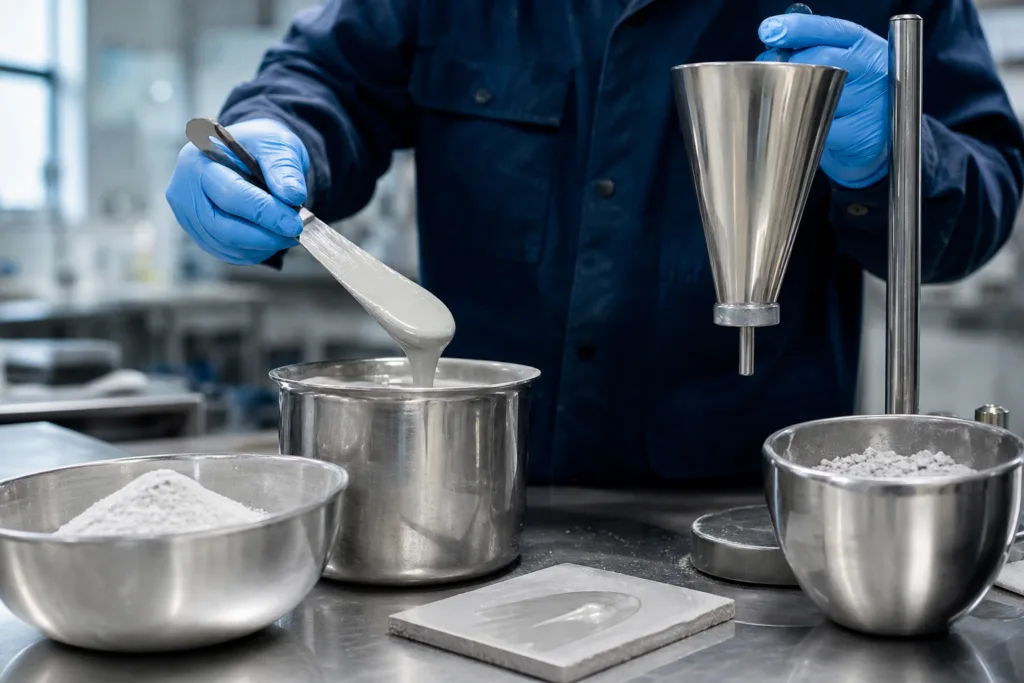
Good surface preparation is non-negotiable. The joint must be clean, dry when required, and free from dust, sealers, oils, or contamination that can weaken the bond. If the project uses porcelain, glass, or mosaic tile, the installer also needs to watch for surface scratching and edge chipping during cleanup. The practical difference between a successful project and a frustrating one is often found in these small details.
For teams that want to review grout use cases by application type, it helps to align the material choice with the end use rather than with a generic product category. That is the same logic we apply when we classify epoxy grout applications during formulation and support.
Common mistakes and how the right choice reduces risk
Many grout problems are not caused by the grout alone. They are caused by mismatch. The product was too stiff, too fast, too soft, or too generic for the actual site conditions. Choosing the right family early reduces the chance of rework later.
- Incorrect mix ratio: solved by choosing a system with clear mix instructions and crew training.
- Insufficient substrate prep: solved by making prep part of the specification, not a field assumption.
- Low-temperature cure issues: solved by confirming cure behavior at the site’s real temperature.
- Excessive joint movement: solved by checking whether a rigid grout is appropriate at all.
- Color inconsistency: solved by requesting batch traceability and sample approval before bulk use.
When a project has high risk, it is usually better to narrow the selection to fewer, more specific candidates. That reduces installation errors, simplifies acceptance checks, and makes troubleshooting far easier if the project changes midstream.
Specification checklist and procurement language
A clear specification should do more than name an epoxy grout. It should describe the service environment, the joint geometry, the timing constraints, and the required evidence from the supplier. Below is practical wording that can be adapted to a project sheet or purchase requirement.
Suggested spec language: Provide epoxy grout suitable for the stated joint width, substrate type, ambient conditions, and exposure level. Product shall be supplied with manufacturer data for compressive strength, adhesion or bond performance, chemical resistance, abrasion resistance, hardness, cure schedule, and pot life. Supplier shall confirm mixing ratio, recommended application temperature, cleanup method, and full cure timeline before shipment.
Procurement checklist:
- Joint width and depth-to-width ratio
- Substrate type and surface preparation method
- Exposure to moisture, chemicals, heat, or UV
- Required working time and re-entry time
- Need for color matching or batch consistency
- Testing documents and batch traceability
- Storage conditions and shelf-life limits
Decision matrix: choosing the right epoxy grout family
If you want a fast way to narrow the selection, use the matrix below as a decision aid rather than a final specification. It is meant to guide the shortlist before you request samples or technical data.
| If your project has… | Start with… | Why |
|---|---|---|
| Tight, clean joints | Low-viscosity or fine-fill two-part grout | Better flow and reduced void risk |
| Heavy machinery or load transfer | High-compressive two-part grout | More suitable for structural service |
| Constant moisture or underwater exposure | Moisture-tolerant specialty grout | Designed for wet service conditions |
| Short labor window and simple handling | Premixed grout | Reduces mixing complexity |
| Critical chemical exposure | Application-specific industrial formulation | Exposure profile matters more than convenience |
In practical buying terms, the best epoxy grout is often the one that removes the most risk from the project, not the one with the widest generic promise.
Troubleshooting common grout problems
If a project develops discoloration, soft spots, poor adhesion, or a rough finish, the first step is to identify whether the issue is product choice, mixing, substrate condition, or cure environment. Most failures can be traced to one of those four areas.
- Discoloration: often linked to contamination, inconsistent cure, or exposure mismatch.
- Soft spots: usually indicate mix ratio errors or incomplete mixing.
- Poor adhesion: often points to substrate contamination or insufficient preparation.
- Efflorescence-like marks: may indicate moisture movement through the assembly.
- Blush or surface haze: can result from cure conditions or cleanup timing.
If remediation is needed, verify the cause before selecting a repair method. A cleanup issue does not call for the same fix as a chemical exposure mismatch. In critical areas, small site samples and controlled trials are better than guessing.
Safety, storage, and handling
Epoxy grout is a construction material, but it still needs disciplined handling. Review the safety data, use the recommended PPE, and store the product within the stated temperature range. Keeping resin and hardener sealed, dry, and properly labeled helps preserve shelf life and prevents avoidable waste.
Crews should also manage pot life carefully. Once the material starts to react, the working window cannot be reset. Mixing smaller batches is often better than overfilling a bucket and rushing the placement. Waste disposal should follow local rules and the supplier’s instructions for uncured and cured material.
When to call the manufacturer
You should involve the manufacturer when the project falls outside a standard use case. That includes unusual joint geometry, a demanding chemical profile, a submerged application, a strict launch schedule, or a requirement for custom color control. It is also useful when an OEM or distributor needs private label packaging, repeatable batch quality, or documentation for internal approval.
In our own support work, the best results come when the project team shares the substrate details, the exposure conditions, the expected traffic, and any constraints on working time. With that information, we can usually narrow the system faster and reduce the risk of a mismatch.
Example project scenarios
Residential bathroom: prioritize moisture resistance, ease of cleaning, and a finish that handles everyday cleaners. A simple system may be enough if joint width and movement are controlled.
Commercial kitchen: focus on chemical resistance, stain resistance, and cleaning durability. Surface prep and cure timing matter because the space often has downtime constraints.
Industrial chemical plant: require a product that matches the actual chemical list and thermal exposure. This is usually where a custom or highly specific industrial formulation makes sense.
Marine deck or wet service area: choose a grout system designed for constant moisture and verify the installation sequence carefully. In these spaces, a general-purpose floor grout is rarely enough.
Each scenario leads to a different decision path, which is why a single label rarely defines the best epoxy grout for every job.
Conclusion

The right epoxy grout is a project decision, not a shopping decision. Start with the environment, joint geometry, cure window, and exposure profile, then compare the products that fit those conditions. If the job is simple, convenience may matter most. If the job is demanding, the best choice is usually the one with the narrowest fit to the real service conditions.
For procurement teams and specifiers, the most reliable approach is to request technical data, check the installation constraints, and validate the shortlist against the actual site. That is the clearest path to a grout system that performs after the crew leaves the jobsite.
FAQs
What makes the best epoxy grout for a commercial project?
The best epoxy grout is the system that matches joint width, exposure, cure window, and cleaning chemistry. For commercial work, we usually rank chemical resistance, installation tolerance, and service-life risk ahead of color or price.
Is two-part epoxy grout better than premixed grout?
Two-part grout usually gives tighter control over cure, strength, and chemical resistance, while premixed grout can reduce mixing errors and speed work on smaller jobs. The better choice depends on labor skill, batch size, and whether the project can tolerate a shorter or longer working window.
How do I choose epoxy grout for wide or narrow joints?
Narrow joints usually favor finer filler packages and lower-viscosity systems, while wider joints need better body, slump control, and filler stability. Always check the manufacturer’s joint-width range and confirm the depth-to-width ratio before specifying.
Can epoxy grout be used in wet areas or submerged service?
Yes, but only if the system is formulated for constant moisture, cleaning exposure, and any hydrostatic or submerged load the site may create. Wet areas need a grout choice based on the exact exposure, not a generic interior floor product.
What test data should I request from a grout supplier?
Ask for compressive strength, adhesion or bond data, chemical resistance, abrasion resistance, hardness, cure schedule, pot life, and batch traceability. If the project is critical, request the test method used and a sample for site validation.
When should I ask for a custom epoxy grout formulation?
Ask for a custom formulation when the project has unusual joint geometry, strong chemicals, high heat, underwater service, unusual color targets, or a production schedule that standard products cannot meet. A custom system can reduce risk when the site is outside normal use cases.