
Clear marine epoxy resin is often specified for appearance-driven marine work, but transparency alone does not make a system suitable for long-term service. In practice, buyers and applicators need to balance clarity with UV exposure, layer thickness, substrate condition, cure profile, abrasion risk, and maintenance expectations. From our manufacturing perspective, the right choice depends on whether the project truly needs a clear visual effect or simply needs moisture protection, structural bonding, or surface sealing in a marine environment.
Explore marine epoxy resin options for boatbuilding and repairs if your project involves hull work, timber components, laminating, sealing, or restoration where water resistance and processing behavior matter as much as appearance.
This guide is written for contractors, boatbuilders, furniture makers, OEM teams, engineers, and procurement managers who need decision support rather than broad marketing claims. The central question is simple: when does transparency add value, and when does it create cost, maintenance, or durability compromises that are better solved with another epoxy system or a protected clear build-up.
When clear marine epoxy resin makes sense
The strongest case for clear marine epoxy resin is when the substrate itself is part of the finished visual design. Common examples include varnished wood interiors on yachts, bright-finish trim, decorative fiberglass encapsulation where the weave or underlying wood grain should remain visible, clear-pour marine-adjacent furniture, and some instrument or component potting applications where visual inspection is helpful.
In these situations, buyers usually care about four linked outcomes:
- High initial transparency with low haze
- Controlled ambering during cure and service life
- Smooth leveling without trapped bubbles
- Good adhesion to the selected substrate and subsequent topcoat system
However, specifying a clear system is justified only if the project team also accepts the maintenance strategy. Pure epoxy, even high-quality material, is not the final answer for long-term UV stability in exposed exterior marine service. That is where many specifications become unrealistic.
Who this guide helps and what decisions it supports
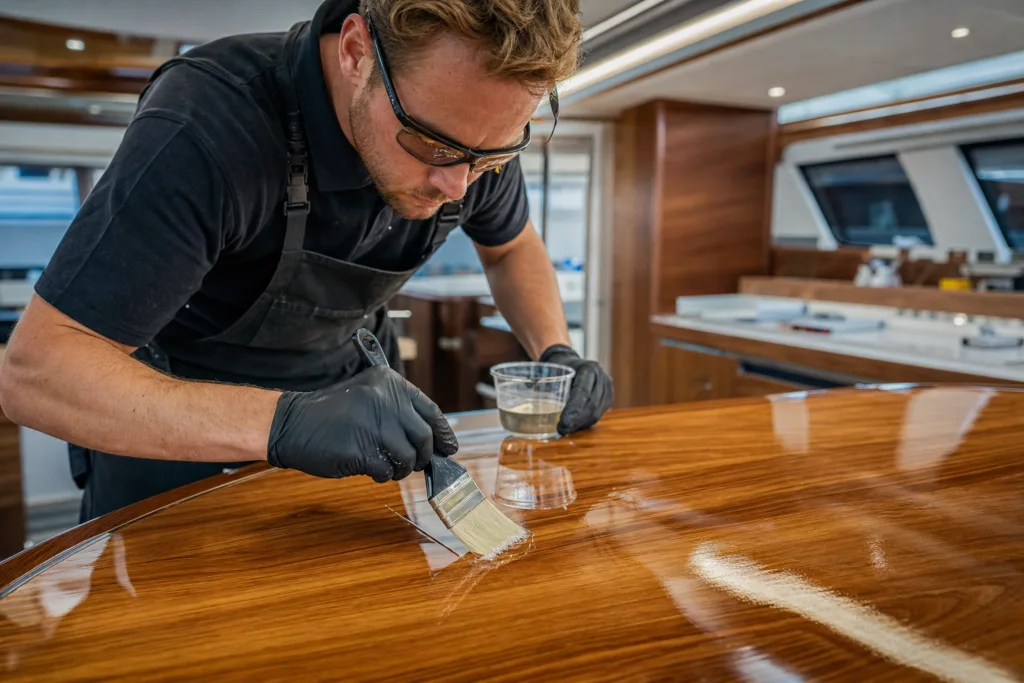
This article supports several decision points. A boatyard may be deciding whether to clear-coat an interior table or use a pigmented protective coating. A furniture OEM may need a resin that preserves wood depth without excessive yellowing. A procurement team may be comparing technical data sheets and asking which clarity metrics actually matter. A contractor may need to know whether a deep single pour is acceptable or whether multiple seal and build coats are safer.
At ZDSpoxy, we usually see the best results when the buyer defines appearance expectations in concrete terms: clear for visual depth, clear enough for sealing, or clear only during short-term indoor service. That distinction affects hardener selection, viscosity, stabilizer package, recommended film build, and whether a UV-resistant topcoat is mandatory.
What clear marine epoxy resin really means
The phrase often implies more than one property. Buyers may use it to mean water-resistant epoxy, optically clear epoxy, low-yellowing epoxy, or a clear coating suitable for boats. Those are related but not identical requirements.
A truly useful marine clear system should be evaluated across three groups of properties.
Optical performance
This includes initial transparency, low color, low haze, and acceptable color retention over time. If the resin starts clear but quickly ambers, it may still be functional as a sealer, but it is no longer a good decorative finish.
Marine service performance
This includes moisture resistance, adhesion to wood or fiberglass, dimensional stability under temperature change, and a cure profile appropriate for field application. A decorative resin that looks excellent in a controlled shop but blushes, clouds, or softens in humid dockside conditions may not fit marine use.
Process performance
Viscosity, pot life, exotherm behavior, de-gassing, and recoat window all influence the final visual outcome. Even a well-formulated resin can lose clarity if it is mixed aggressively, poured too thick, or applied over damp substrate.
What controls clarity in practice
Initial transparency is only the starting point. Clear systems are influenced by the refractive relationship between resin, hardener, additives, and the substrate below. If those optical relationships are disrupted, the surface can look cloudy, milky, or uneven even when the chemistry has cured correctly.
| Property | Why it matters | Common field impact |
|---|---|---|
| Initial color | Sets starting appearance | A slight amber tint can warm wood but distort pale surfaces |
| Haze | Measures loss of visual clarity | Higher haze reduces depth and makes coatings look dull |
| Yellowing resistance | Affects appearance retention | Exterior exposure can quickly shift clear to amber |
| Gloss retention | Supports premium finish look | Surface erosion or micro-scratching lowers visual sharpness |
| Bubble release | Controls optical defects | Trapped micro-bubbles reduce transparency and perceived quality |
Clear finishes on wood bring another issue: the substrate is not optically neutral. Grain density, moisture content, tannins, and prior contamination all affect how “clear” the final surface appears. In some hardwoods, the resin may magnify color variation rather than simply coat it.
Why clarity changes over time
Many users assume yellowing is a sign of poor manufacturing. In reality, all epoxy systems have limits under UV and oxidative exposure. The real question is not whether change will happen, but how fast and under what service conditions.
Main causes of clarity loss include:
- UV degradation that breaks down surface chemistry and drives ambering
- Oxidation during long-term heat and air exposure
- Excessive exotherm from thick pours, which can darken the cured mass
- Moisture contamination causing blush, haze, or intercoat defects
- Incompatible fillers, pigments, or additives that scatter light
- Secondary reactions from incorrect mix ratio or incomplete mixing
Even indoor applications can amber gradually if they see sunlight through windows, elevated ambient temperatures, or repeated thermal cycling. For that reason, “marine grade” should never be interpreted as “immune to yellowing.” It is more accurate to ask how the resin behaves within a known exposure profile.
Formulation variables that affect transparency
Resin chemistry is only one part of the story. Hardener type is often decisive. Some curing agents offer better color stability and lower blush risk, while others deliver faster cure or stronger early mechanical properties at the expense of long-term appearance.
Reactive diluents can reduce viscosity and help wetting, but excessive or poorly matched diluent content may affect hardness, heat build-up, and long-term appearance. UV stabilizers and absorbers may slow visible degradation, but they do not convert epoxy into a fully UV-stable exterior clear finish. In specification work, that distinction matters.
Fillers also deserve caution. If clarity is the target, inert fillers used for gap filling, sag control, or strength modification can reduce transparency. That is why systems intended for sealing and visual depth differ from systems intended for fairing, crack filling, or structural bedding.
Where substrate preparation is part of the visual result, a penetrating sealer can help reduce uneven absorption. For degraded wood or porous repair areas, a low-odor primer such as ZDS-2060AB wood primer for rot repair and sealing can improve consolidation before decorative clear coats are built, provided the overall system is matched for compatibility and final appearance.
Use cases where transparency adds real value
Wood sealing and bright-finish interiors
Clear epoxy is often valuable on interior yacht tables, cabinet faces, trim pieces, and other wood surfaces where the grain is intended to remain visible. In these cases, clarity supports aesthetics and also helps moisture sealing. The specification should focus on low blush, good wetting, and a finish schedule that can be topcoated for wear and UV protection if needed.
Clear fiberglass encapsulation
Some builders want the fiberglass weave or substrate below to remain visible for a technical or decorative effect. Clear laminating or sealing coats can work if thickness is controlled and air release is managed carefully. Excess build without proper venting usually creates trapped bubbles that are more visible in transparent systems than in pigmented ones.
Decorative marine-adjacent furniture and signage
River tables, branded inlays, display panels, and custom furniture used in marina, hospitality, or yacht-interior settings often prioritize visual depth. Here, optical quality may matter as much as water resistance. Still, if the piece will sit in sun-exposed spaces, a separate UV-protective surface strategy is needed.
Inspection-friendly potting or encapsulation
In some non-structural encapsulation work, a clear system allows visual inspection of embedded components. But clarity should not override temperature resistance, dielectric performance, or shrinkage requirements if the application is technical rather than decorative.
Use cases where transparency is unnecessary or a poor choice
There are many marine projects where specifying clear epoxy adds cost or future maintenance without improving service life.
- Exterior decks and coamings with constant UV exposure
- Anti-slip walking surfaces where texture and wear resistance matter more than clarity
- Concealed sealing layers below paint or topcoat systems
- Structural bonding, filling, or bedding compounds
- Repair zones where color mismatch is already unavoidable
For high-traffic or sun-exposed areas, a pigmented or otherwise protected system is often more practical. If the final layer will be painted, using a fully clear resin simply for appearance can be an unnecessary cost. In many cases, transparent epoxy becomes counterproductive because every micro-bubble, sanding mark, dust nib, and future ambering effect remains visible.
Similarly, if gaps or voids must be rebuilt before finishing, a repair compound such as ZDS-1240 epoxy wood gap filler for sealing and repair may be the more functional step before deciding whether a decorative clear top system is still realistic for the final surface.
Layering, thickness, and exotherm rules
One of the fastest ways to lose clarity is to pour too much material in one pass. Thick sections generate more heat, and excess exotherm can darken the resin, increase shrinkage stress, trap bubbles, or create internal haze. Maximum single-layer thickness should always come from the manufacturer for the exact formulation, because not all clear marine systems behave the same way.
As a practical rule, thin sealing coats are easier to keep clear than deep single pours. Wet-on-wet schedules can improve intercoat bonding and reduce sanding labor, but they require careful timing. If the recoat window is missed, sanding and cleaning become necessary to avoid adhesion loss and visible layer lines.
For contractors, the safest process logic is usually:
- Seal porous substrate first
- Allow controlled de-gassing from the substrate
- Build thickness in staged coats rather than aggressive single pours
- Monitor mix volume and ambient temperature to control exotherm
- Use sand-and-recoat when visual consistency is more important than speed
Deep decorative encapsulation projects should not be specified by appearance alone. Ask for laboratory and field guidance on pour depth, pot life versus mass, and heat generation under expected shop temperatures.
Surface and substrate compatibility
Wood
Wood is a common target for clear marine coatings, but it is also one of the most variable substrates. Moisture content, oiliness, tannin bleed, porosity, and sanding quality all affect the final look. Marine plywood can absorb resin unevenly, especially at edges and end grain. For teams working with panels, our recommendation is to review substrate sealing logic carefully, especially where repeated wet-dry cycling is expected. A useful reference is this article on epoxy resin for marine plywood: sealing and moisture protection guide.
Fiberglass and gelcoat
Existing fiberglass or gelcoat must be clean, fully abraded where required, and free from wax, polish, amine contamination, or moisture. Clear systems show contamination more brutally than pigmented coatings. If fisheyes or local haze occur, the surface preparation is often the first place to investigate.
Metals
Some metals can be coated with clear epoxy for sealing or appearance, but corrosion risk, thermal expansion mismatch, and adhesion sensitivity make testing essential. Where long-term corrosion protection matters, a dedicated primer or non-clear protective system may be more appropriate.
Plastics
Plastic compatibility varies widely. Some plastics release plasticizers, while others have low surface energy that limits adhesion. Small-scale trials are important before committing to production use, especially if the part is decorative and any loss of clarity will be immediately visible.
Application practices that preserve clarity
Good formulation can be undermined by poor handling. Most clarity failures are a combination of chemistry and process. From our manufacturing experience, the following controls have the strongest effect on real-world visual outcomes.
- Measure mix ratio accurately and mix long enough to eliminate streaking
- Avoid whipping air into the blend during mixing
- Use clean containers and clean tools to prevent contamination
- Condition materials to a stable application temperature before use
- Apply on dry substrate and avoid high-humidity windows where blush is likely
- Use suitable rollers, squeegees, or spreaders that do not shed fibers
- Allow bubbles to rise before film sets too quickly
Temperature control is especially important. Resin that is too cold may hold bubbles and level poorly. Resin that is too warm may shorten working time and increase heat build-up in the pot. On porous wood, pre-sealing often helps reduce outgassing that would otherwise produce pinholes and foam-like micro-bubbles in later coats.
UV topcoat limits and realistic alternatives
A common specification mistake is asking epoxy alone to provide both deep clarity and long-term exterior UV durability. In most cases, that is not realistic. Even systems with stabilizers benefit from a protective clear topcoat when used outdoors or in high-sunlight environments.
Where appearance retention matters, buyers should evaluate anti-yellowing topcoats to protect clear epoxy from UV and compare the full build system rather than the epoxy layer alone. A UV-resistant varnish or polyurethane topcoat often extends visual life more effectively than trying to rely only on additives within the epoxy.
| Approach | Strength | Limitation |
|---|---|---|
| Clear epoxy only | Strong depth and adhesion | Weak long-term UV appearance retention outdoors |
| Clear epoxy plus UV topcoat | Better color retention and serviceability | More process steps and periodic recoating |
| Pigmented marine coating | Often better exterior durability | Hides substrate appearance |
| Alternative decorative system | Can reduce maintenance burden | May sacrifice epoxy depth effect |
The practical choice depends on whether the project values visible wood grain, expected exposure life, repairability, or lower maintenance intervals.
Testing and acceptance criteria for clarity
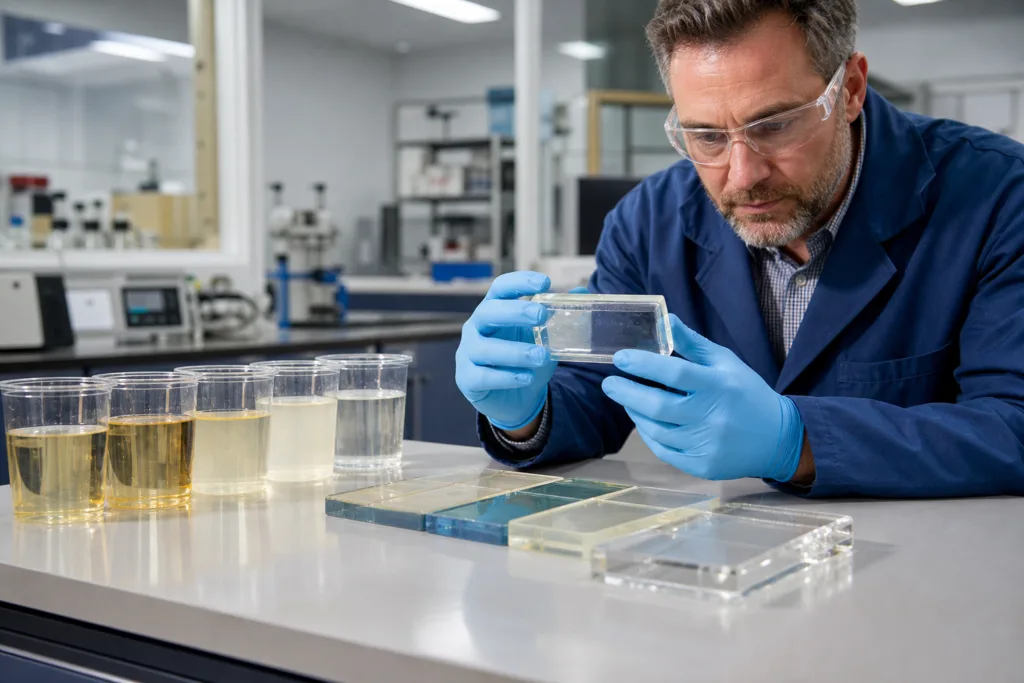
Decision-makers should not rely on general words like crystal clear or non-yellowing. Ask for measurable criteria. For decorative or OEM applications, useful evaluation points include haze, gloss, color shift, adhesion after environmental exposure, hardness development, and cure schedule consistency.
Recommended testing discussions may include:
- Accelerated weathering such as QUV exposure for comparative screening
- Color change tracking using Delta E or yellowing index
- Haze measurement for optical clarity
- Gloss retention after exposure or abrasion
- Adhesion testing on the actual substrate system
- Hardness development and post-cure response where relevant
These tests do not guarantee exact field life, but they help filter out unsuitable options and create a more defensible specification. For procurement teams, the key is consistency: the same test setup, same film build, and same exposure assumptions across all candidate systems.
Troubleshooting common clarity failures
Yellowing or amber shift
This usually relates to UV exposure, oxidation, excessive cure heat, or hardener chemistry. The corrective path may involve lower mass pours, improved topcoat protection, or a different resin-hardener package.
Cloudiness or milky appearance
Often caused by moisture, blush, substrate contamination, or incompatible additives. On wood, residual dampness and outgassing are frequent causes. On recoats, insufficient cleaning between layers is a common contributor.
Micro-bubbles
These can come from aggressive mixing, porous substrate, low temperature, or trapped air in corners and grain structure. A sealing pass, controlled material temperature, and lower-viscosity first coat can help.
Blistering
Blistering may be linked to moisture vapor, heat, contamination, or coating over poorly bonded prior layers. This is especially important in marine service where cyclic wetting and heating can magnify trapped defects.
Surface bloom or amine blush
This surface film can reduce gloss and disrupt clarity of later coats. The fix is usually process-related: manage humidity, select lower-blush chemistry where possible, and clean the surface before recoating.
What to include in a specification or data review
For technical buyers, a useful specification should go beyond generic terms such as marine clear epoxy. Ask suppliers to define the following clearly:
- Initial appearance and any stated color range
- Viscosity and recommended application temperature
- Pot life and working time at stated conditions
- Maximum single-layer thickness or pour depth
- Recommended cure schedule and recoat window
- Expected topcoat compatibility
- Yellowing or weathering test approach, if available
- Hardness, adhesion, and moisture resistance data relevant to the application
- Storage stability and batch traceability
A specification becomes much more useful when it also states what is acceptable visually. For example, define whether minor warm tint is acceptable, whether outdoor exposure is expected, and whether periodic recoating is part of the lifecycle plan.
When to request a custom formulation
A standard clear marine grade may be enough for interior sealing, modest decorative use, or protected service. A custom approach becomes more valuable when several difficult requirements must coexist, such as low color, slower exotherm, specific viscosity, longer working time, better UV stability support, or unusual substrate wetting.
In our formulation work, we ask buyers to brief five items clearly: target look, substrate type, exposure environment, expected lifetime, and required validation tests. That information is often more useful than a request for the clearest possible resin, because “clearest” without service context can lead to the wrong chemistry.
A practical decision matrix is simple. If the application is interior, low UV, moderate film build, and appearance-driven, standard clear systems may be suitable. If the application is exterior, high UV, high gloss expectation, and low tolerance for color shift, then a custom resin plus a specified protective topcoat system is usually the more realistic route.
Maintenance, repair, and lifecycle expectations
Clear epoxy finishes should be specified with maintenance in mind. Surface cleaning should avoid harsh solvents that dull the finish or weaken the topcoat. Exterior or sunlit surfaces may need periodic recoating before visible failure becomes severe. Once a clear epoxy has significantly yellowed or degraded, repair often means sanding back and rebuilding rather than simply adding another clear coat over the problem.
This matters in procurement decisions because a cheaper clear system with frequent maintenance may not be the lower-cost option over the life of the asset. For decorative marine components, appearance retention and repairability usually matter as much as initial material price.
Final decision guide
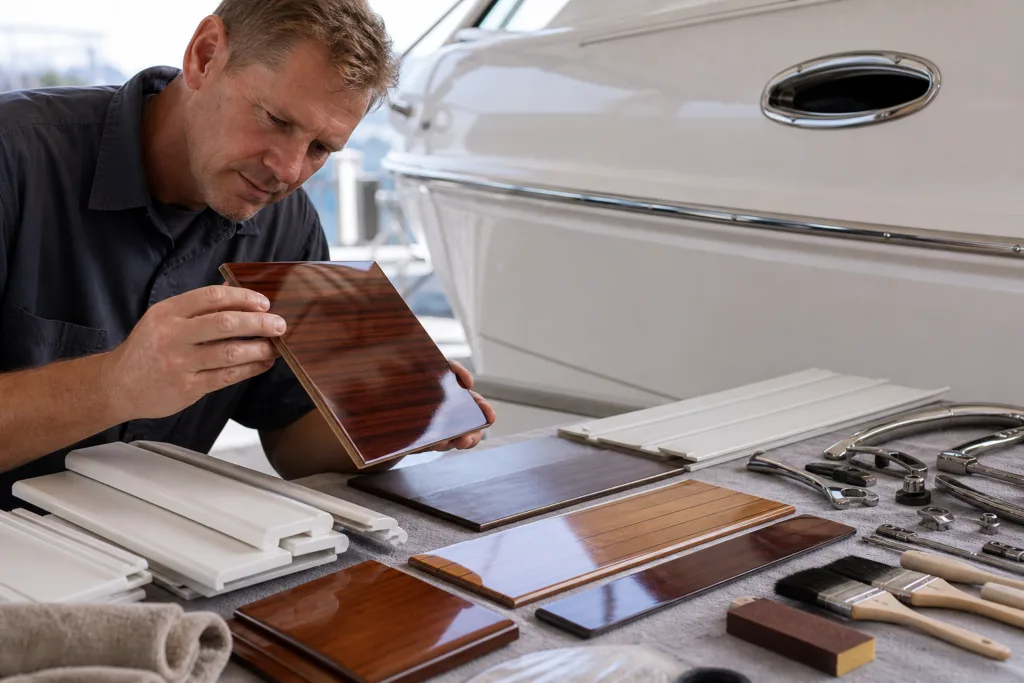
If transparency is a core part of the design, specify clear marine epoxy resin only after checking exposure, film thickness, substrate condition, and topcoat strategy. If transparency is only a preference and the area is exposed, walked on, painted over, or structurally loaded, another system may perform better with fewer visual defects and less maintenance.
The most practical selection priorities are usually:
- UV exposure level
- Required visual clarity and tolerance for ambering
- Maximum coating or pour thickness
- Substrate porosity and moisture risk
- Abrasion and traffic exposure
- Need for topcoat protection and future recoating
- Budget versus lifecycle appearance expectations
From a manufacturer standpoint, clear systems succeed when expectations are written precisely. The more accurately the buyer describes service conditions and appearance targets, the easier it is to recommend a resin system that performs honestly rather than attractively only in the first few weeks.
FAQs
Is clear marine epoxy resin suitable for exterior boat surfaces?
It can be used on exterior boat surfaces, but it should not usually be left unprotected if long-term appearance matters. UV exposure will gradually amber and degrade most epoxy surfaces, so a compatible UV-resistant topcoat is typically needed for better color retention and easier maintenance.
How thick can I apply clear marine epoxy resin in one layer?
The safe thickness depends on the exact formulation, ambient temperature, and total mixed mass. Clear systems can overheat if applied too thick, which may cause yellowing, bubbles, shrinkage stress, or haze, so the manufacturer’s maximum layer recommendation should always be followed and validated with a trial if appearance is critical.
Why did my clear epoxy turn cloudy after curing?
Cloudiness is commonly caused by moisture, substrate contamination, amine blush, trapped air, or incorrect mixing. On wood, dampness and outgassing are especially common causes, while on previously coated surfaces the issue is often poor cleaning or incompatibility between layers.
Does a low-yellowing epoxy mean it will stay water-clear permanently?
No. Low-yellowing means the formulation is designed to slow visible color shift compared with less stable systems, but it does not eliminate aging from UV, oxidation, or heat. Buyers should treat low-yellowing claims as a relative performance feature, not a promise of permanent optical clarity.
What should procurement teams ask a supplier before specifying a clear epoxy?
They should ask for clarity-related metrics, cure schedule, viscosity, pot life, maximum single-layer thickness, recoat window, substrate compatibility, and the supplier’s recommended testing for yellowing, haze, adhesion, and gloss retention. It is also useful to confirm batch traceability and whether custom formulation support is available.
When is a pigmented or protected system better than a clear one?
A pigmented or topcoat-protected system is usually better when the surface has high UV exposure, heavy wear, anti-slip requirements, concealed service, or no real design benefit from transparency. In those cases, durability and lower maintenance often matter more than preserving a clear look.
Related Reading
- marine grade epoxy resin: how it differs and when to choose it
- 2-part marine epoxy resin: mix ratios, pot life and cure basics
- epoxy delamination causes: avoid coating failure on boats
- low VOC marine epoxy: supplier questions for safe indoor repairs
- epoxy resin for wood: sealing, bonding and finishing solutions