
When buyers compare resin flooring vs epoxy flooring, the first thing to clarify is that these terms are not equal. Resin flooring is the broad category. Epoxy flooring is one system within that category, alongside polyurethane, polyaspartic, and other resin-based finishes. From a manufacturer perspective, this distinction matters because many project problems start with a specification that asks for “resin flooring” when the real need is a system with defined chemical resistance, UV stability, cure speed, or flexibility.
Compare flooring resin system options for commercial and industrial projects before finalizing a floor build-up, especially when substrate condition, downtime limits, or exposure risks vary across the site.
This guide is written for engineers, contractors, project managers, maintenance teams, and procurement staff who need a practical way to decide whether epoxy is the right answer or whether another resin system will perform better. We will compare chemistry, installation behavior, typical performance ranges, lifecycle cost logic, and the specification details that should appear in tenders and technical approvals.
Why resin flooring is the umbrella term
Resin flooring refers to seamless or near-seamless floor systems based on reactive polymer binders. The resin is combined with hardeners, pigments, fillers, aggregates, and functional additives to create a floor with targeted properties. Depending on formulation and layer design, the same floor family can be tuned for self-leveling, anti-slip, decorative, chemical-resistant, impact-resistant, or fast-return-to-service use.
Common chemistry families include:
- Epoxy for strong adhesion, hardness, and broad chemical resistance.
- Polyurethane for flexibility, abrasion resistance, and better tolerance of movement or thermal cycling.
- Polyaspartic for rapid cure, lower downtime, and improved application speed.
- Decorative resin blends using metallic pigments, quartz broadcast, flakes, or terrazzo-style aggregate systems.
In practice, many finished floors are not a single chemistry from bottom to top. A system may use an epoxy primer for concrete adhesion, an epoxy or mortar mid-layer for build thickness, and a polyurethane or polyaspartic topcoat for UV or wear performance. That is why precise system selection matters more than relying on one label.
How to use this comparison guide
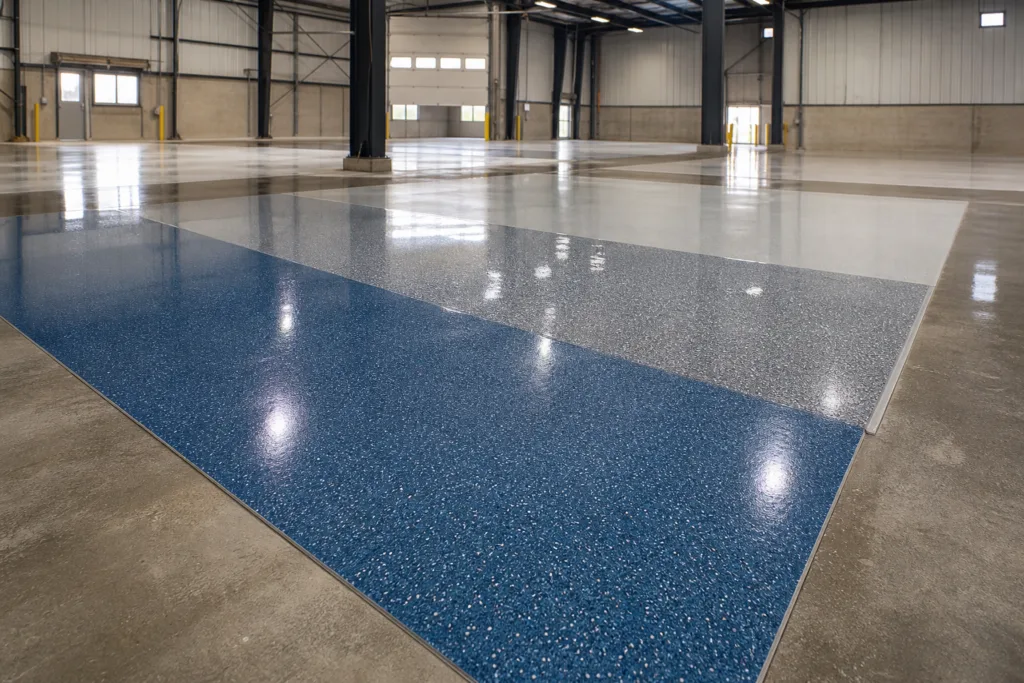
For design teams, the key question is performance fit. For contractors, it is application fit and recoat control. For procurement, it is total installed cost versus lifecycle value. We recommend using this guide in the same order that we use in formulation and technical review work:
- Define exposure conditions first.
- Confirm substrate moisture and strength.
- Set downtime limits and installation window.
- Decide required finish, slip profile, and cleanability.
- Review chemical, UV, and thermal demands.
- Check whether the system must be rigid, semi-flexible, or impact tolerant.
If one of these factors is ignored, the floor may still look acceptable at handover but fail early in service.
What is resin flooring made of?
A resin floor is more than resin alone. The base chemistry provides the binding matrix, but performance depends heavily on the full formulation. Typical components include curing agents, mineral fillers, silica or quartz, pigments, defoamers, flow modifiers, flexibilizers, adhesion promoters, UV stabilizers, and sometimes conductive or antimicrobial additives.
From our manufacturing perspective, additives often determine whether a flooring resin behaves well in the field. Two products may both be described as epoxy, yet one may have much better flow, lower blush tendency, or improved impact resistance because of formulation choices. That is why datasheet review should go beyond generic system names.
Common resin flooring systems at a glance
| System | Main strengths | Main limitations | Typical use cases |
|---|---|---|---|
| Epoxy | High bond strength, good hardness, good chemical resistance, economical build layers | Can yellow under UV, less flexible, slower cure than fast systems | Warehouses, factories, garages, labs, self-leveling interiors |
| Polyurethane | Flexible, abrasion resistant, better UV and impact tolerance | Usually higher cost, some systems are more application-sensitive | Food areas, light industrial, traffic lanes, thermal movement zones |
| Polyaspartic | Very fast cure, good return-to-service profile, clear topcoats | Short pot life, requires skilled application timing | Fast-track projects, overnight renovations, retail, parking-related areas |
| Decorative resin blends | Strong visual finish, broadcast texture options, customized appearance | Specification complexity and finish dependence on installer control | Showrooms, retail, hospitality, premium commercial interiors |
What is epoxy flooring?
Epoxy flooring is a resinous floor system based on epoxy resin and a compatible curing agent, usually supplied as a two-component system. When mixed correctly, the resin and hardener react to form a crosslinked polymer network. This network gives epoxy its characteristic hardness, adhesion, compressive strength, and resistance to many oils, fuels, and chemicals.
Most industrial floor epoxies are 2K systems. In flooring, that usually means Part A resin and Part B hardener. The chemistry can be modified for different results: lower viscosity for penetration, higher build for self-leveling, solvent-free formulations for indoor use, or aggregate-filled versions for trowel-applied repair and slope correction.
Common epoxy flooring layers include primer, scratch coat, mid-coat, body coat, broadcast layer, seal coat, and topcoat. For example, a project needing build thickness and leveling may use a dedicated ZDS-3136AB epoxy mid-coat for industrial and commercial floors where adhesion, thickness control, and filler acceptance are more important than UV stability.
How epoxy differs from polyurethane and polyaspartic
Curing mechanism and working time
Epoxy generally cures through reaction between epoxy groups and amine or related hardeners. This can provide useful pot life and a manageable working window, but cure speed often slows in cold conditions. Polyaspartic systems cure much faster, which helps compress project schedules but increases the risk of roller marks, lap lines, and wasted mixed material if crews are not organized.
Crosslink density and hardness
Well-formulated epoxy floors usually develop a rigid, high-strength matrix. This supports good compressive performance and heavy-duty service on sound concrete. Polyurethane systems are typically less rigid and more forgiving under vibration, impact, or substrate movement. That flexibility can improve durability where epoxy might crack or chip.
Adhesion behavior
Epoxy is often preferred as the direct-to-concrete bond layer because it wets prepared concrete well and can be formulated for strong mechanical and chemical anchoring. Polyurethane topcoats are frequently placed over epoxy build layers rather than directly replacing them, especially when the design wants both strong substrate bond and a more resilient surface.
Resin flooring vs epoxy flooring performance comparison
Because epoxy is part of the resin flooring family, the real comparison is epoxy versus other resin chemistries used in floor systems. Typical performance trends are shown below. Actual values depend on formulation, filler loading, film thickness, cure schedule, and test method, so project teams should verify product-specific data rather than rely on broad assumptions.
| Metric | Epoxy | Polyurethane | Polyaspartic |
|---|---|---|---|
| Hardness | Generally high; rigid surface | Moderate to high; usually less rigid | High surface hardness possible |
| Abrasion resistance | Good | Very good in many traffic applications | Good to very good |
| Chemical resistance | Broad and strong for many industrial exposures | Good, often selected where combined wear and chemical demand exist | Good, but check chemical list carefully |
| Impact resistance | Moderate; can chip if overly rigid | Better flexibility and impact tolerance | Moderate to good depending on build |
| Elongation | Lower | Higher | Moderate |
| UV stability | Often limited; ambering or chalking possible | Better color retention | Generally better than standard epoxy |
| Thermal shock tolerance | Moderate | Better in movement-prone zones | Moderate |
| Moisture tolerance during install | Usually needs tighter control | System-specific | System-specific and often timing-sensitive |
| Return to service | Standard cure | Moderate | Fast |
For surface appearance, clear epoxy can produce depth and gloss, especially in decorative interiors. Where the design prioritizes visual clarity and a polished finish, a ZDS-400AB high-gloss clear epoxy topcoat for decorative floors may be appropriate, but only if UV exposure and long-term color stability are acceptable for the space.
Installation differences that change project outcomes
Substrate preparation
All resin floors depend on preparation. Concrete should be structurally sound, clean, and properly profiled. Oil contamination, laitance, curing compounds, and weak surface paste must be removed. A strong resin cannot compensate for a weak concrete surface. In failure reviews, delamination often traces back to preparation rather than to resin chemistry itself.
Moisture and primer selection
Epoxy systems are often sensitive to rising moisture vapor if the slab was not designed with a functioning vapor barrier or if the slab remains too wet. Moisture testing should be part of the pre-installation sequence. In some cases, a moisture-tolerant primer or a different system strategy is required. Skipping this step can lead to blistering, osmotic pressure, or bond loss.
Layer thickness and recoat windows
Epoxy build systems can range from thin film coatings to self-leveling layers and mortar floors with significant thickness. The thicker the build, the more important exotherm control, aggregate loading, and cure timing become. Recoat windows also matter. If the next layer is applied too early, the surface may distort or trap solvent or amine byproducts. If applied too late without adequate abrading, intercoat adhesion may drop.
Ambient conditions
Temperature and humidity affect viscosity, pot life, wetting, leveling, and final cure. Cooler conditions typically thicken epoxy and slow cure. Hot weather shortens working time. Polyaspartic systems are even more timing-sensitive, which is why they are selected for speed only when the installation team is equipped to manage rapid mix-and-apply cycles.
Cure time and downtime implications
One of the biggest decision points between epoxy and other resin systems is allowable downtime. Standard epoxy can be ideal when the project allows staged cure and the owner wants good mechanical performance at a controlled material cost. But where a facility can shut down only overnight or over a weekend, fast-curing alternatives may offer better total value despite higher material cost.
At ZDSpoxy, we often see this trade-off clearly in retrofit work. A slower system may be cheaper per kilogram, yet the total project cost rises if access restrictions, labor waiting time, or production shutdowns dominate the budget.
For fast-track schedules, a ZDS-1223AB polyaspartic clear topcoat for fast-curing floor systems can reduce return-to-service time, but applicators need to account for short pot life, faster edge setting, and tighter batch planning.
Aesthetics and decorative finish choices
Epoxy remains a strong choice for decorative seamless floors because it can provide depth, clarity, pigment acceptance, and self-leveling appearance. Metallic epoxy, quartz broadcast floors, and pigmented smooth systems often use epoxy somewhere in the layer structure. However, decorative success depends on more than visual preference.
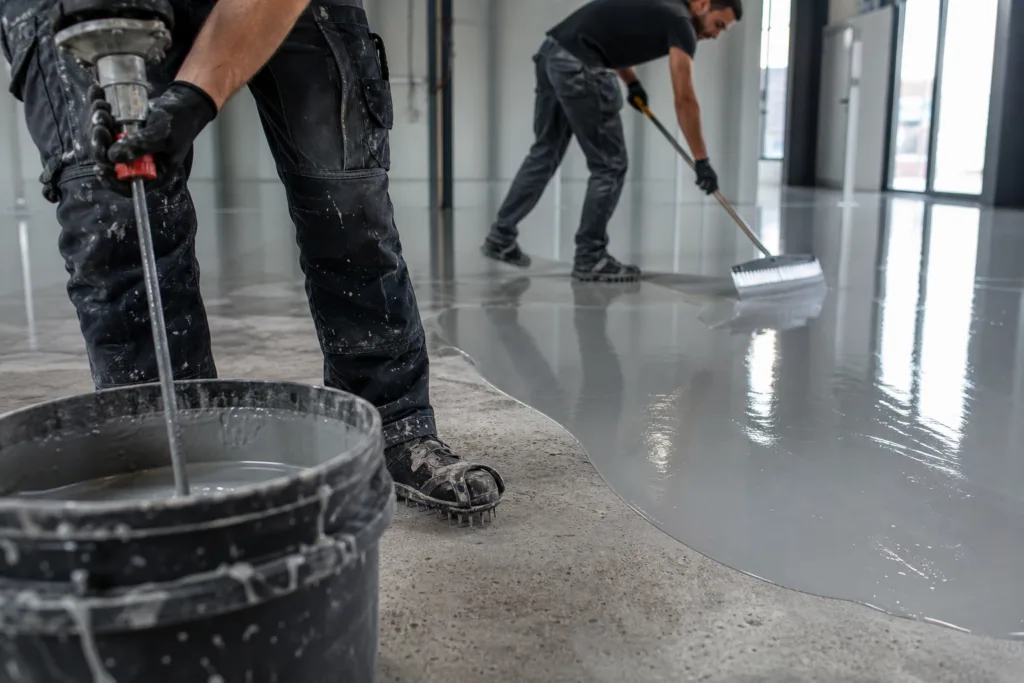
- Choose epoxy when interior gloss, depth, and leveling are priorities.
- Choose polyurethane or polyaspartic top protection when sunlight, color retention, or scratch visibility is a concern.
- Choose broadcast systems when slip resistance and texture control matter more than mirror-like smoothness.
- Choose terrazzo-style resin systems when design life and premium appearance justify thicker and more complex installation.
Outdoor decorative decks, balconies, and sunlit entrances are common areas where epoxy alone is often the wrong final surface, even if it is useful as an underlying binder layer.
Environmental and occupied-space considerations
For occupied buildings, odor, VOC strategy, and cure profile matter almost as much as long-term performance. Solvent-free or low-odor systems are often preferred for indoor applications, but project teams should also check ventilation requirements, curing emissions during installation, and re-entry timing. Some floor systems that perform well in heavy industry may not be ideal for schools, retail interiors, or healthcare-adjacent spaces if application conditions are constrained.
Cold-weather cure limits are another practical issue. A resin system that looks acceptable on paper may fail to reach proper cure in low substrate temperatures. That can affect hardness, chemical resistance development, and time to service. Procurement should request the recommended installation temperature range and minimum substrate condition data, not just final cured properties.
Application-match scenarios and suitable system choices
| Environment | Common priority | Often suitable choice | Key caution |
|---|---|---|---|
| Warehouse | Abrasion, forklift traffic, dust control | Epoxy build system | Check impact points and joint design |
| Food plant | Cleanability, chemical washdown, thermal cycling | PU or hybrid system | Confirm thermal and cleaning chemical exposure |
| Laboratory | Chemical resistance, seamless finish | Epoxy with resistant topcoat | Match exact reagent list |
| Retail renovation | Appearance and fast reopening | Decorative epoxy with fast topcoat or polyaspartic | Watch odor and cure schedule |
| Garage | Oil resistance, appearance, tire traffic | Epoxy base with protective topcoat | UV at entry points may yellow epoxy |
| Outdoor deck | UV and weather resistance | UV-stable resin system | Epoxy alone may discolor |
| Marine service area | Moisture, salt, maintenance practicality | System-specific hybrid approach | Substrate prep and moisture control are critical |
Where chemical splash and long-term wear combine, a tougher surface layer may be preferred over straight epoxy alone. In those cases, a ZDS-8300AB 2K polyurethane clear topcoat for chemical-resistant flooring may make more sense as the exposed finish over an epoxy build layer.
Installed cost versus lifecycle economics
Material price alone can be misleading. A lower-cost system may become expensive if it requires early replacement, repeated shutdowns for repair, or high maintenance effort. Total cost should consider:
- Surface preparation intensity
- Primer and moisture mitigation needs
- Layer count and thickness
- Cure time and labor staging
- Facility downtime cost
- Expected wear rate
- Repairability and patch blending
- Cleaning and maintenance frequency
Epoxy often performs well on cost-performance ratio for interior industrial floors with controlled sunlight and manageable downtime. Polyaspartic can justify higher installed cost where speed is the main economic driver. Polyurethane can justify its cost where movement, abrasion, and UV or impact tolerance would otherwise shorten the life of a more rigid system.
Common failure modes and how to prevent them
Delamination
Usually linked to poor preparation, contamination, weak concrete, or moisture pressure. Prevent it with proper profiling, cleanliness checks, pull-off testing where needed, and moisture evaluation before priming.
Yellowing or chalking
Common with standard epoxy under UV exposure. Prevent it by using UV-stable finish layers where sunlight is present or by accepting that epoxy is better suited to interior areas without sustained UV load.
Blisters and pinholes
Often caused by outgassing concrete, high substrate temperature during application, or trapped air in porous slabs. Priming strategy and temperature timing are critical.
Cracking
Can result from substrate movement, reflective cracking, or choosing a floor that is too rigid for the service condition. A more flexible or reinforced system may be needed around movement-prone areas.
Uneven wear patterns
Usually reflect traffic concentration, insufficient thickness, poor aggregate selection, or the wrong topcoat hardness. Wear mapping before specification helps avoid this mistake.
Specification checklist for procurement and tender review
Procurement documents should ask for more than generic statements such as “industrial epoxy floor.” A useful flooring specification should request:
- Resin chemistry and full layer build-up
- Primer, body coat, aggregate, and topcoat description
- Nominal dry film thickness or system thickness
- Pot life, working time, and recoat window
- Recommended substrate moisture limits and test method
- Surface preparation profile requirements
- Mechanical properties such as hardness, adhesion, compressive or tensile data where relevant
- Chemical resistance list tied to actual exposure media
- UV stability statement where sunlight is present
- Slip resistance target where required
- Installation temperature and humidity limits
- Batch traceability and quality control documentation
If standards are referenced, examples may include ASTM or ISO methods for adhesion, abrasion, hardness, and chemical resistance. The important point is not to request a long list for appearance alone, but to request test methods that relate to actual service conditions.
A practical decision flow for selecting the right floor system
When teams are stuck between broad options, we recommend this decision sequence:
- Is there UV exposure? If yes, do not assume standard epoxy should be the final wear layer.
- Is downtime limited? If yes, evaluate faster curing systems.
- Will the floor see thermal shock or movement? If yes, rigid epoxy may need reinforcement or an alternative top layer.
- What chemicals will contact the floor? Match against actual spills, concentrations, and contact duration.
- What traffic type is expected? Forklifts, steel wheels, pallet jacks, and foot traffic wear floors differently.
- Is appearance a primary requirement? If yes, define gloss, color stability, and texture expectations clearly.
- What is the budget logic? Compare not only installed cost, but also downtime, maintenance, and service life.
This is the practical meaning behind resin flooring vs epoxy flooring: epoxy is often the answer, but only when the exposure profile supports it.
What to expect from a manufacturer partnership
A capable manufacturer should help buyers move from broad product category to application-fit system. That includes technical data sheets, sample support, formulation logic, compatibility guidance, and realistic discussion of trade-offs. It should also include batch traceability and clear guidance on storage, mixing ratio, induction time if required, and expected cure development.
From our side, early technical review usually prevents more problems than late-stage troubleshooting. If a project has uncertain concrete moisture, extreme cleaning chemicals, narrow installation windows, or unusual aesthetic expectations, those factors should be discussed before tender award rather than after material arrives on site.
Example selection scenarios
Warehouse distribution floor
A contractor needs a durable seamless floor over sound interior concrete with forklift traffic and no sunlight. An epoxy primer and build system is often a practical choice because adhesion, hardness, and cost-performance align well with the use case.
Retail renovation with overnight installation
The owner wants a decorative floor and minimal downtime. A standard epoxy-only system may create scheduling pressure because cure time delays reopening. A decorative build with a faster-curing finish layer can improve project economics even if material cost is higher.
Food-processing support area
The floor sees repeated cleaning, occasional chemical splash, and some thermal movement. A more resilient system or hybrid build may be safer than a rigid epoxy-only specification, especially near drains, washdown zones, and door thresholds.
Conclusion

The clearest way to understand resin flooring vs epoxy flooring is this: resin flooring is the category, while epoxy flooring is one important option within it. Epoxy offers excellent adhesion, mechanical strength, and value for many interior industrial floors, but it is not automatically the right finish for every UV, thermal, impact, or fast-track project. Better outcomes come from matching the chemistry, layer structure, cure behavior, and topcoat function to the real service environment. For engineers, contractors, and procurement teams, the most reliable approach is to specify performance first and resin family second.
FAQs
Is epoxy flooring the same as resin flooring?
No. Resin flooring is the broader category, and epoxy flooring is one type within that category. Other resin floor systems include polyurethane and polyaspartic systems, which may be better choices when a project needs more flexibility, faster cure, or better UV stability.
When should I choose epoxy instead of another resin floor system?
Epoxy is often a strong choice for interior concrete floors that need good adhesion, hardness, chemical resistance, and cost-performance. It is especially practical in warehouses, production areas, garages, and laboratories where UV exposure is limited and the project can allow normal cure time.
Why does epoxy flooring sometimes fail outdoors?
Standard epoxy can yellow, chalk, or lose appearance under sustained sunlight, and some outdoor environments also add thermal movement and moisture stress. That does not always mean epoxy has no role outdoors, but it usually should not be assumed to be the final exposed wear layer without a UV-stable system design.
How important is concrete moisture when selecting a resin floor?
Concrete moisture is critical because excessive moisture vapor can cause blistering, bond loss, or osmotic issues under many floor systems. Before specifying or installing a resin floor, teams should test the slab and confirm whether a standard primer, moisture-tolerant primer, or another mitigation strategy is needed.
Is a faster-curing floor system always better for commercial projects?
Not always. Fast-curing systems reduce downtime, but they can also shorten pot life and make application timing less forgiving. They are valuable when reopening speed has high economic value, but for some projects a standard epoxy system provides a better balance of application control, finish quality, and total cost.
What should procurement request from a flooring resin manufacturer?
Procurement should request the full layer specification, technical data sheets, cure and recoat guidance, installation condition limits, substrate preparation requirements, chemical resistance information, and batch traceability details. These documents help confirm that the proposed system fits the project instead of relying on a generic product description.