
Choosing a 2 part marine epoxy resin is rarely just about bond strength on a datasheet. In real marine work, the system has to match the substrate, the repair geometry, the working temperature, the installer’s mixing method, and the cure window available before launch or further fabrication. Boat builders, repair teams, OEM buyers, and engineers usually need the same practical answers: what the resin and hardener each do, why the stated ratio matters, whether a 5:1 system is appropriate, how much working time is realistic, and what process controls prevent soft cures, delamination, or runaway heat.
Explore marine epoxy resin solutions and specifications when you need a clearer view of resin families, hardener options, and application fit before selecting a system for bonding, lamination, sealing, or structural repair.
From our manufacturing perspective, marine epoxy selection works best when readers separate three decisions that are often mixed together: chemistry choice, ratio discipline, and cure control. A strong formulation can still fail if the batch is measured by volume when the product is specified by weight, if the repair is applied over damp laminate, or if a large mixed mass overheats in a container. This guide focuses on those decision points so buyers and applicators can compare systems more confidently and set practical installation tolerances.
Why two-part systems are standard in marine applications
Marine environments are demanding because materials face water exposure, thermal cycling, vibration, occasional fuel or cleaner contact, and mechanical stress concentrated around joints, fasteners, corners, and repaired laminate. Two-part epoxy systems are widely used because they create a crosslinked network after resin and hardener are combined. That cured network usually offers stronger adhesion, lower shrinkage, better moisture resistance, and better gap-filling behavior than many one-component alternatives.
In practical terms, this means a properly selected marine epoxy can serve several roles within the same vessel or repair workflow:
- Bonding wood, fiberglass, metal inserts, and composite components
- Sealing porous substrates before laminating or coating
- Filling voids and rebuilding damaged sections with suitable fillers
- Wet-out of glass fabrics during lamination or patch reinforcement
- Bedding hardware where controlled adhesion and water exclusion are required
The reason two-part products remain standard is not only strength. They also allow formulation flexibility. By changing resin backbone, hardener type, viscosity, and additive package, manufacturers can tune working time, cure speed, toughness, water resistance, and heat tolerance for very different marine tasks.
Resin and hardener explained in practical terms
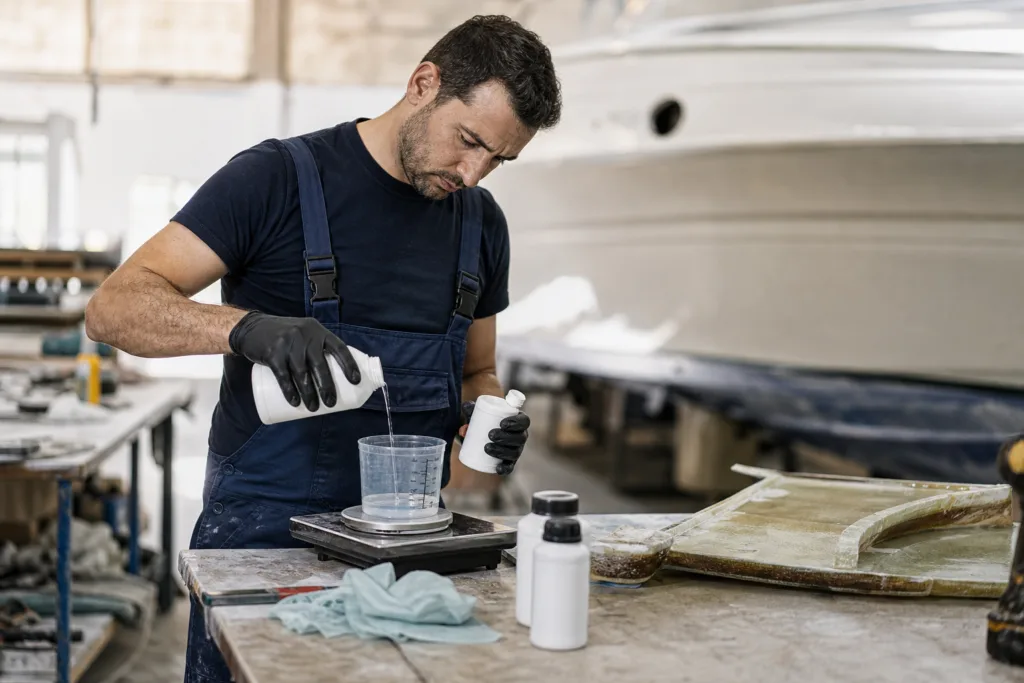
The resin side contains epoxy-functional molecules. The hardener side contains active hydrogen groups, commonly amines or modified amines, that react with those epoxy groups and build the cured network. The ratio is not arbitrary. It reflects the stoichiometric relationship needed to convert enough reactive groups into a stable crosslinked structure.
Technical teams often refer to epoxy equivalent weight and active hydrogen equivalent. These terms sound abstract, but the decision logic is simple: the formulator calculates how much hardener is required to react with a given amount of epoxy resin. Once the formulation is optimized, the product is sold with a defined mix ratio by weight, by volume, or both.
If too little hardener is used, the system may remain under-cured, softer than expected, and more vulnerable to moisture uptake or chemical attack. If too much hardener is used, the result is not “extra curing power.” Excess hardener can remain unreacted, reduce final properties, increase surface issues, and lower long-term durability. In other words, the cure balance matters in both directions.
Common marine epoxy chemistries and hardener trade-offs
Not all marine epoxies behave the same because the base resin and hardener type strongly influence viscosity, toughness, heat resistance, and cure profile.
Typical resin families
- Bisphenol-A epoxy resins: common general-purpose backbone with a balanced property profile for bonding, coating, and lamination.
- Bisphenol-F epoxy resins: often lower in viscosity than comparable bisphenol-A systems and useful where wet-out, penetration, or reduced filler demand matters.
- Novolac epoxy resins: higher functionality systems that can support improved chemical and heat resistance, though they may be less forgiving and more brittle if not properly modified.
- Flexible or toughened epoxies: modified to absorb impact and tolerate movement better in joints that see vibration, substrate mismatch, or peel stress.
Typical hardener families
- Polyamines: reactive and useful for ambient cure, but cure speed and surface behavior must be managed carefully.
- Amine adducts: often chosen for more controlled handling, improved blush resistance, or better film formation in practical conditions.
- Cycloaliphatic amines: can support improved appearance, chemical resistance, or heat performance, depending on the system.
- Modified fast hardeners: intended for quick turnaround at lower temperatures, but they can shorten pot life and raise exotherm risk.
The right chemistry depends on the job. Laminating large glass areas may favor lower viscosity and a moderate working time. Bonding a highly loaded insert may require higher toughness and better gap-fill capability. Fairing compounds can prioritize sandability over structural strength. That is why buyers should compare systems by use case, not by a single headline property.
For many specifiers, it also helps to review how marine-grade epoxy resin differs and why it matters for boat repairs, especially when comparing products that look similar on packaging but are built for different service conditions.
Understanding mix ratios, including 5:1 systems
Mix ratio notation can be one of the biggest sources of field error. A product may be stated as 5:1 by volume, 100:27 by weight, or another equivalent depending on component density and formulation design. Installers should never assume that a common ratio from one brand transfers to another.
A 5:1 system exists because it reflects the chemistry and density balance selected by the formulator. In marine products, 5:1 ratios are often associated with laminating, sealing, or adhesive systems designed to offer a workable balance of viscosity, cure speed, and field convenience. That does not make every 5:1 epoxy interchangeable. Two different 5:1 products may have very different viscosity, toughness, blush behavior, and cured heat resistance.
| Ratio topic | What it means | Why it matters in marine work |
|---|---|---|
| By volume | Measured using graduated pots or metering pumps | Convenient in the field, but only valid if the manufacturer specifically approves volume measurement |
| By weight | Measured using scales | Usually more precise for specification work, QA control, and small batches |
| 5:1 notation | Five parts resin to one part hardener by the stated basis | Must not be assumed to apply by both weight and volume unless confirmed |
| Filled mixtures | Base mix plus powders or fibers | Fillers change application viscosity and batch behavior, but they do not change the required base resin-to-hardener ratio |
From our formulation work, one of the most common errors is treating ratio as flexible because the mix “looks close enough.” Marine epoxy is more tolerant than some chemistries, but not tolerant enough to make casual measuring a reliable process standard.
Why ratio accuracy directly affects cure and durability
Ratio errors change the crosslink density of the cured material. That influences hardness, toughness, glass transition temperature, water resistance, adhesion retention, and chemical resistance. On a boat, these changes may not appear immediately. A repair can feel hard on the surface but still be poorly cured internally or weaker than expected after water exposure and heat cycling.
Typical signs of ratio-related problems include:
- Persistent tackiness or a greasy surface after the expected cure window
- Unusually soft sanding behavior or gum formation
- Brittle cracking in a joint that should have some toughness
- Lower than expected heat resistance in sun-exposed areas
- Reduced adhesion at edges or around fasteners over time
Where specifications matter, weigh components instead of estimating. For shop production, calibrated metering equipment, verified densities, and batch records improve repeatability. For field repairs, pre-marked containers and digital scales are often the simplest control measure.
Pot life fundamentals and what really changes working time
Pot life is the usable time of a mixed batch in a container before viscosity rises enough to limit application. It is not the same as open time on a substrate and not the same as full cure time. In marine repair work, pot life is strongly affected by temperature, batch mass, container shape, and the starting viscosity of the system.
As a rule, warmer conditions shorten pot life. Larger mixed masses also shorten pot life because the curing reaction generates heat, and that heat accelerates the reaction further. A batch that remains workable for 25 to 30 minutes in a shallow tray may become too hot and gel in much less time inside a deep cup.
Practical working-time controls include:
- Mix smaller batches more often
- Transfer mixed epoxy into a shallow roller tray or broad pan quickly
- Keep components at a controlled room temperature before use
- Select a slower hardener if the repair area is large or complex
- Avoid leaving mixed material in mass while preparing the substrate
For deeper repairs, cast sections, or high-volume fill zones, teams should pay special attention to controlling exotherm in thick epoxy pours for marine repairs because batch geometry can change cure behavior dramatically even when the chemistry is correct.
Exotherm risk and safe batch sizing
Exotherm is the heat generated during cure. In marine applications, the highest risk appears when low-viscosity epoxy is mixed in large quantity, left in a deep container, or poured into a confined cavity. Heat buildup can shorten working time, distort cured properties, cause smoke or discoloration, crack the mass, or damage nearby substrate.
There is no universal safe maximum batch size because exotherm depends on formulation, ambient temperature, container dimensions, and filler loading. However, practical safeguards are consistent:
- Run a small-site trial before mixing large production batches
- Use wider, shallower containers to release heat
- Stage the work in sequential batches instead of one large mix
- Increase filler loading only if the formulation and application allow it
- Do not leave mixed epoxy unattended in a pot when temperatures are high
Warning signs of runaway cure include rapid warming of the container, sharp viscosity increase, visible fuming, yellowing, and sudden gelation. If these appear, the remaining batch should not be forced into the repair because internal cure quality may already be compromised.
Mixing and metering best practices for consistent results
Good chemistry can only perform if the mixing process is controlled. For specification-driven marine work, we generally recommend choosing one measuring basis and training the team around it. If the technical data sheet specifies weight ratio, use scales. If a pump set is supplied for a volume ratio, verify the pump output periodically rather than assuming permanent accuracy.
Useful shop and field practices include:
- Pre-condition both components to a stable temperature before measuring
- Pre-weigh containers when small batches require precision
- Mix for the full recommended time, scraping walls and bottom
- Transfer to a second container and mix again for critical work if needed
- Avoid whipping motions that entrain unnecessary air
- Use static mixers only when the dispensing system is designed for the product viscosity and ratio
Small wood and joinery repairs often fail because the substrate absorbs resin unevenly or the cavity is filled with a mix that is too dry or poorly blended. In those cases, a penetrating primer such as ZDS-2060AB solvent-free wood rot primer for marine applications can help stabilize degraded wood before rebuilding with a structural or gap-filling system.
Surface preparation for wood, fiberglass, metals, and composites
Surface preparation remains one of the largest performance variables in marine bonding. Even a well-formulated 2 part marine epoxy resin cannot bond reliably over oil, wax, oxidation, salt residue, weak paint, or free moisture.
Wood
Wood should be dry, structurally sound, and free from loose fibers, oils, and old contamination. Porous end grain may benefit from a wet-out coat before adhesive filling. Severely degraded areas may need consolidation before structural filling.
Fiberglass and composites
Remove gloss, contamination, release residues, and weak layers. A clean abraded profile improves mechanical keying. Grinding dust should be removed thoroughly before bonding or laminating.

Metals
Fresh abrasion, degreasing, and prompt application are usually important because surface oxidation can reform quickly. Aluminum, steel, and stainless each require slightly different preparation discipline, especially in humid yards.
Compatibility checks
Not every old laminate, paint film, sealant residue, or previous repair material is compatible with epoxy. When uncertainty exists, perform an adhesion test on a controlled area before committing to full production.
In custom material selection work at ZDSpoxy, substrate condition often matters more than the nominal substrate type. Sound fiberglass and contaminated fiberglass are effectively two different bonding surfaces from a process standpoint.
Cure control strategies in marine environments
Cure control means selecting process conditions that allow the epoxy to reach target properties predictably. Temperature is the main variable. Low temperatures slow cure, extend tack time, and may reduce early strength development. High temperatures shorten working time and can raise exotherm risk but may also help final conversion if managed correctly.
Ways to accelerate cure include using a faster hardener, warming the components before mixing, or applying moderate post-cure heat after the initial set. Ways to slow the process include selecting a less reactive hardener and reducing batch size. Reactive diluents and other modifiers may alter flow and cure profile, but they should be evaluated as part of the full formulation rather than added casually in the field.
Common cure checkpoints are:
- Tack-free: surface no longer feels wet or transfers material
- Handle strength: part can be moved or lightly machined with care
- Service cure: bond or patch is ready for expected duty
- Post-cured state: improved heat resistance and property stability after controlled heating where applicable
For qualification work, simple field observations are useful but not enough. Shore hardness trends, differential scanning calorimetry for Tg, and bond tests such as lap shear give a more dependable picture when approving a system for repeated production.
How fillers and additives change application behavior
Marine repairs frequently require more than neat resin and hardener. Thixotropic agents can prevent sagging on vertical surfaces. Microballoons can make fairing compounds lighter and easier to sand. Milled fibers can reinforce adhesive mixes. Mineral fillers can improve body and gap-filling behavior.
What changes with fillers is not the base ratio of resin to hardener. The resin and hardener must still be mixed correctly first unless the manufacturer specifically provides a pre-adjusted process. Fillers then change apparent viscosity, heat buildup, wetting behavior, and cured mechanical profile.
| Filler type | Main purpose | Typical effect on process | Trade-off to watch |
|---|---|---|---|
| Silica or thixotrope | Anti-sag, filleting | Raises viscosity and helps gap hold | Can trap air if mixed aggressively |
| Microballoons | Fairing, low density filling | Improves sanding and reduces weight | Not suitable for high structural load |
| Milled fibers | Structural reinforcement | Improves toughness and load transfer | Harder to spread smoothly |
| Mineral fillers | Body, dimensional control | Can reduce shrink perception and increase bulk | May shorten practical working time in mass |
For gap-filling work in joinery or wood detail zones, a pre-designed product such as ZDS-1240 epoxy wood gap filler for marine joinery repairs can be easier to control than building the rheology from loose fillers on site.
Practical marine repair scenarios and recommended process logic
| Scenario | Preferred mix approach | Pot life priority | Gap-fill expectation | Cure checkpoint |
|---|---|---|---|---|
| Small bonding repair | Weighed small batch or verified cartridge system | Moderate; enough time for alignment | Thin bondline preferred unless substrate is irregular | Tack-free then confirm hardness before load |
| Fillet joint | Base mix first, then add thixotrope | Moderate to short to reduce sag | High body required | Check shape retention and through-cure at thickest section |
| Fiberglass lamination | Low-viscosity system, measured precisely | Longer working time for wet-out | Minimal bulk; focus on fabric saturation | No dry spots, no blush before secondary bonding |
| Fairing and patching | Base mix plus lightweight filler | Moderate | Buildable and sandable | Sand only after full through-cure |
| Through-bolt bedding | Controlled mix with moisture-clean surfaces | Enough open time for assembly | Void filling around penetrations | Verify squeeze-out cure before final service exposure |
These are process patterns, not universal formulas. The right combination depends on substrate temperature, section thickness, expected mechanical load, and whether the repair is cosmetic, semi-structural, or structural.
Troubleshooting common marine epoxy problems
Sticky or under-cured surfaces
Usually linked to wrong ratio, poor mixing, low temperature, or contamination. Verify the measuring basis first, then review actual component temperature and mixing practice.
Amine blush or surface film
This can occur under certain humidity and cure conditions. The fix is usually removal and cleaning before recoating rather than simply applying another layer over it.
Brittle cured epoxy
Can result from unsuitable chemistry for the joint, over-post-curing, or an unbalanced formulation relative to movement and peel stress. Structural joints with vibration may require a tougher system.
Delamination
Common root causes include poor substrate preparation, bonding over blush, interlaminar contamination, or curing outside the acceptable recoat window.
Microbubbles
Often caused by air entrainment during mixing, outgassing from porous substrate, or applying under warming conditions that drive air outward.
Yellowing
Epoxy can yellow with UV exposure even when the underlying bond remains sound. For exposed appearance-sensitive areas, plan suitable topcoat protection.
Most failures trace back to a small group of process issues: ratio, mixing completeness, temperature mismatch, moisture, or contamination. When those variables are recorded, root-cause analysis becomes much easier.
Quality checks, procurement questions, and when to involve the manufacturer
Marine buyers should request more than a generic statement of strength. A reliable specification package usually includes exact mix ratio by weight and volume if both are approved, viscosity range, pot life at defined temperatures, cure schedule, expected hardness development, Tg or post-cure capability where relevant, and appropriate bond or shear data for the intended use.
A practical procurement checklist should ask for:
- Resin and hardener chemistry type
- Exact resin-to-hardener ratio and measurement basis
- Pot life at multiple temperatures
- Viscosity and recommended application range
- Substrate compatibility guidance
- Bond, tensile, or shear data relevant to the use case
- Water, chemical, and heat resistance expectations
- Storage conditions and shelf-life limits
- Whether fillers, pigments, or accelerators are approved
- Custom formulation or private-label support if production needs differ from stock products
Ask the manufacturer early when the project includes unusual substrates, confined thick sections, low-temperature cure demands, production line speed targets, or branded OEM packaging needs. Those are common cases where a standard formulation may be close, but not fully optimized.
Safety, storage, and shelf-life discipline
Marine epoxy components should be handled with appropriate gloves, eye protection, and ventilation suited to the work area. Even low-odor systems still require safe process control. Storage temperature matters because cold components become harder to meter accurately, while excessive heat can reduce storage stability.
Keep containers sealed when not in use, protect them from moisture ingress, and rotate inventory by batch age. Older material may still appear usable but can show viscosity drift, crystallization, slower response, or inconsistent mixing behavior. Shelf-life is not just a warehouse issue; it directly affects process predictability on the job.
A simple decision flow for selecting and using a two-part marine epoxy
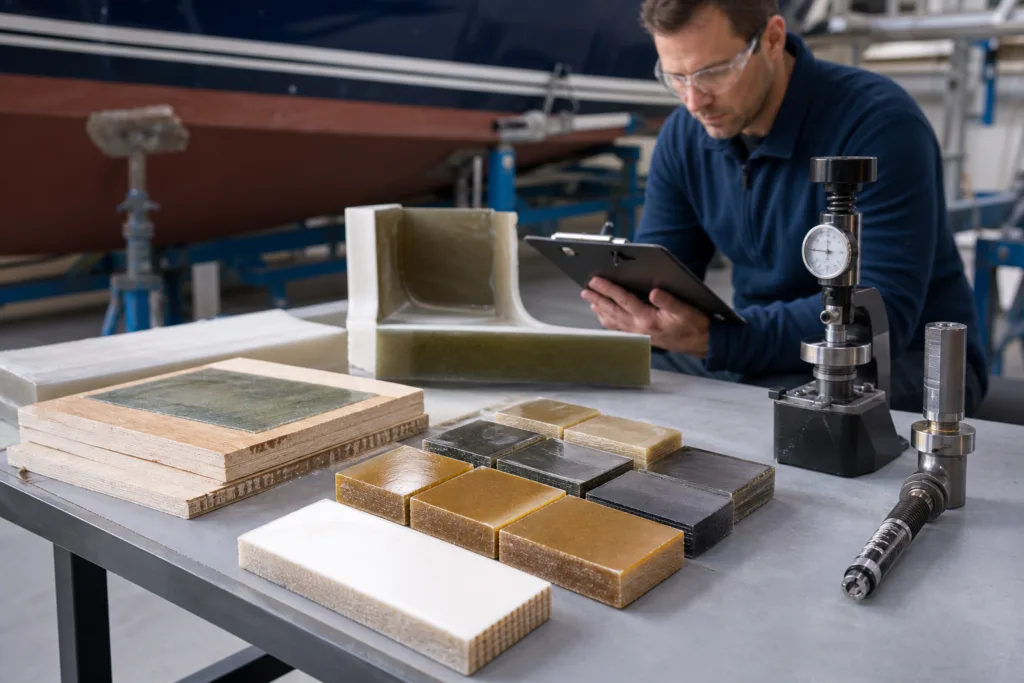
Start with the repair objective. If the task is structural bonding, prioritize toughness, verified adhesion, and a ratio the team can control accurately. If the task is large-area lamination, prioritize wet-out and pot life. If the task is fairing, prioritize sandability and shape control. Then confirm the working temperature window, expected section thickness, and substrate condition.
Before release to production or field use, verify these points:
- The specified ratio is clearly understood by weight or by volume
- Batch size is safe for the expected ambient temperature
- Substrate preparation method is defined and realistic
- The cure checkpoint matches the actual service requirement
- Any fillers or additives are approved for that system
- A simple site verification method is assigned for each batch or repair stage
When those controls are in place, a 2 part marine epoxy resin becomes much more predictable. Reliable marine bonding is less about finding one universal product and more about matching chemistry, ratio discipline, pot life, and cure management to the real conditions of the repair or assembly.
FAQs
Is a 5:1 marine epoxy always mixed 5:1 by volume?
No. A 5:1 label only applies to the basis stated by the manufacturer. Some systems are 5:1 by volume, while the same chemistry may translate to a different ratio by weight because resin and hardener densities are different. Always use the ratio and measuring method shown on the technical data sheet.
What happens if I add extra hardener to make marine epoxy cure faster?
Adding extra hardener is not a safe way to accelerate cure. It can leave unreacted material in the network, reduce final strength, create surface issues, and lower heat or water resistance. If faster turnaround is required, use a formulation with a faster hardener or adjust the cure temperature within the manufacturer’s limits.
How can I extend pot life during boat repairs in warm weather?
Use smaller batches, keep components at a controlled temperature before mixing, and move the mixed material into a shallow tray quickly so heat can escape. If the repair area is large, select a slower hardener rather than trying to stretch working time with ratio changes or unapproved additives.
Do fillers change the resin-to-hardener mix ratio?
No, fillers normally change viscosity and application behavior, not the required base stoichiometric ratio. The correct practice is to measure and mix resin and hardener first, then add approved fillers to reach the target consistency unless the manufacturer specifies a different procedure for that product.
How do I know whether a marine epoxy repair is cured enough for the next step?
Use the cure checkpoint that matches the operation. Tack-free may be enough for dust control, but sanding, machining, laminating, loading, or water exposure often require a deeper level of cure. In field work, check surface feel, scrape response, and hardness trend, then compare them with the manufacturer’s stated cure schedule at the actual temperature.
When should I ask for a custom marine epoxy formulation?
Request a custom formulation when standard products do not fit the process window or service demands, such as very low-temperature cure, unusually fast production cycles, specialized substrates, thick-section repairs with exotherm limits, or OEM programs that need private labeling and repeatable performance targets.
Related Reading
- how to epoxy seal marine plywood for long-lasting panels
- solutions for amine blush in marine epoxy applications
- epoxy resin safety for marinas: PPE and ventilation guidance
- avoid epoxy delamination in boat repairs: common causes and fixes
- marine deck coating systems: epoxy primer plus durable topcoats