
Selecting the right epoxy resin for concrete floors is not only about choosing a coating that looks durable on paper. In real projects, floor performance depends on the match between the concrete condition, moisture level, traffic demand, chemical exposure, film build, and curing environment. From our manufacturing perspective, the most reliable specification process follows a simple decision flow: check the substrate first, verify moisture and vapor drive, classify traffic and chemical exposure, decide the required thickness, and then choose the finish and topcoat based on wear, appearance, and maintenance expectations.
Explore resin flooring system options for concrete projects when you need to compare build types, finish options, and application logic before writing a project specification.
This guide is written for contractors, engineers, procurement teams, and facility decision-makers who need practical selection logic rather than generic product claims. A concrete floor may need a thin protective coating, a self-leveling system, a heavy-duty screed, or a multi-layer build with moisture mitigation and a chemical-resistant topcoat. The right answer changes with the project. Poor selection often leads to delamination, osmotic blistering, soft films, yellowing, or wear-through much earlier than expected.
At a specification level, proper epoxy selection affects lifecycle cost, shutdown risk, safety, cleanability, and maintenance frequency. It also affects indoor application conditions, odor profile, solvent release, and how much tolerance the system has for uneven porosity or marginal substrate quality. That is why floor resin decisions should be based on measurable acceptance criteria, not only appearance or nominal price per square meter.
Why proper epoxy selection matters for concrete floors
Concrete is not a uniform substrate. It can be porous, weak at the surface, contaminated with oil, sealed with curing compounds, or exposed to hidden moisture vapor transmission. Epoxy can create excellent adhesion and long-term durability, but only when the system matches actual site conditions. A low-build coating placed over weak, dusty, or damp concrete may fail even if the resin chemistry itself is sound.
Failure costs usually exceed initial material savings. Rework means surface removal, production downtime, disposal, reinstallation labor, and possible damage to owner confidence. In operating facilities, floor failure can also create slip hazards, contamination traps, and maintenance interruptions. For this reason, we encourage buyers to compare total system suitability rather than simply comparing unit price of resin.
Indoor air and application conditions also matter. Solids content, odor sensitivity, cure speed, and ventilation constraints all influence the practical choice between 100% solids, high-solids, water-based, or solvent-borne primers and coatings. A suitable floor system should meet performance goals without creating avoidable installation risk.
Quick decision matrix for common floor scenarios
| Scenario | Typical System | Recommended Build | Main Priority |
|---|---|---|---|
| Warehouse with moderate forklift traffic | Primer + 100% solids epoxy build coat + wear topcoat | Medium to heavy build | Abrasion resistance and impact tolerance |
| Light retail or back-of-house commercial area | Primer + pigmented epoxy coating + optional anti-slip topcoat | Thin to medium build | Cleanability, appearance, economical durability |
| Automotive repair workshop | Primer + build coat + chemical-resistant topcoat | Medium build | Oil, fuel, hot-tire and abrasion resistance |
| Chemical processing area | Moisture-managed primer + chemical-resistant epoxy or novolac-type system + protective topcoat | Medium to heavy build | Chemical resistance and low permeation |
| Decorative clear concrete floor | Sealing primer + clear build coat + UV-stable finish strategy | Thin to medium build | Clarity, leveling, stain resistance, yellowing control |
This table is only a starting point. Final system design should still be checked against substrate strength, moisture test results, expected cleaning chemistry, and service temperature.
Epoxy system types and where they fit best
Clear epoxy versus pigmented epoxy coatings
Clear epoxy is typically selected when the concrete surface, decorative flakes, metallic effects, or embedded aggregates need to remain visible. It can produce depth and gloss, but specifiers should remember that clear systems tend to show substrate defects more easily and may yellow faster under UV exposure depending on hardener type and service environment. Pigmented systems are usually more forgiving visually and are often preferred for industrial floors where color coding, dirt masking, or uniformity matters more than transparency.
When decorative performance is important, a system such as ZDS-400AB clear epoxy topcoat for decorative concrete floors may be evaluated for clarity and finish quality, but the specifier should still review yellowing behavior, film hardness, and recoat compatibility with the rest of the floor build.
Self-leveling epoxy, thin-film coatings, and epoxy mortar systems
Thin-film coatings are used where sealing, dust control, and moderate wear protection are sufficient. They are easier to apply and more economical in lower-demand environments, but they do not hide significant surface irregularities and generally offer less wear reserve than thicker systems.
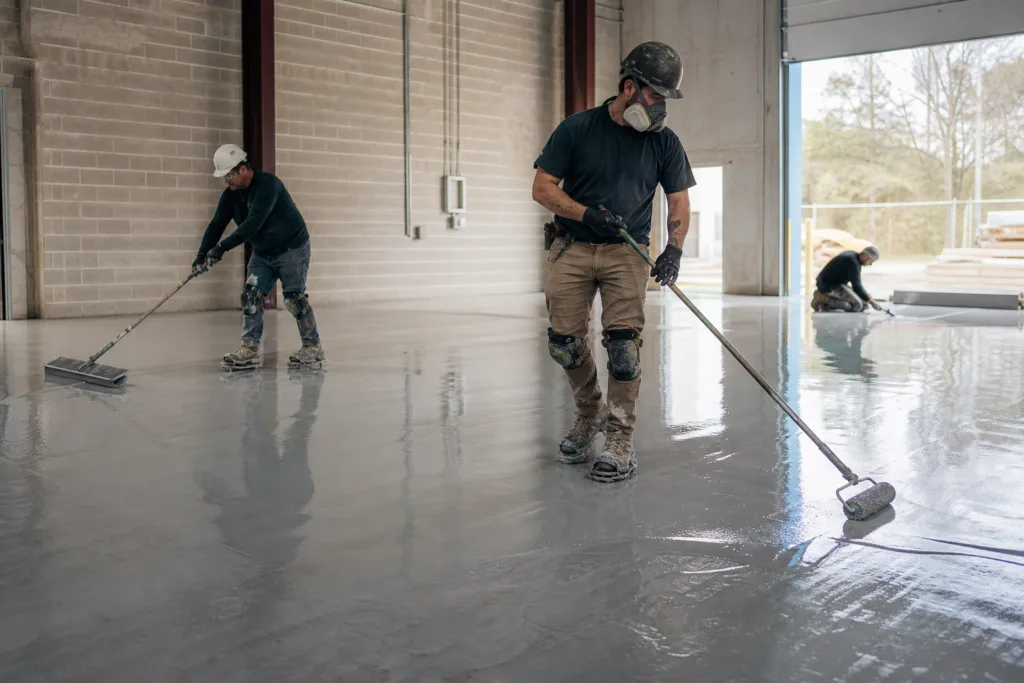
Self-leveling epoxy systems are designed to create a smoother and more uniform surface with greater build. They are often used in warehouses, clean production spaces, showrooms, and commercial interiors where a seamless finish and improved wear life are both important. Their flow behavior depends heavily on substrate profile, temperature, and pot life control.
Epoxy mortar or screed systems are used for heavy-duty conditions, severe impact, or where surface reconstruction is needed. These systems combine resin with fillers or aggregate to achieve much higher thickness, mechanical strength, and localized repair capability.
100% solids, high-solids, and solvent-borne systems
100% solids systems offer high film build per coat, low shrinkage, and little to no solvent release during cure. They are widely preferred for industrial flooring because they can create thicker, more protective films with fewer passes. The tradeoff is that they can be more sensitive to mixing quality, application temperature, and substrate porosity.
High-solids systems can offer a practical balance where application ease and moderate build are needed. Solvent-borne systems may still have a place in certain primers or specific application conditions, but teams must consider ventilation, odor, local compliance requirements, and solvent entrapment risk.
Fast-cure and temperature-specific systems
Some projects cannot wait for standard cure schedules. Fast-cure systems are useful for shutdown-sensitive facilities, cold-weather work, or repairs requiring shorter return-to-service windows. However, faster chemistry often narrows pot life, increases exotherm sensitivity, and can make mixing and placement discipline more important. For warm processing areas or thermal washdown conditions, a standard floor epoxy may not be enough and the full system should be checked for heat resistance, not just room-temperature hardness.
Adhesion to concrete: what every specifier must verify
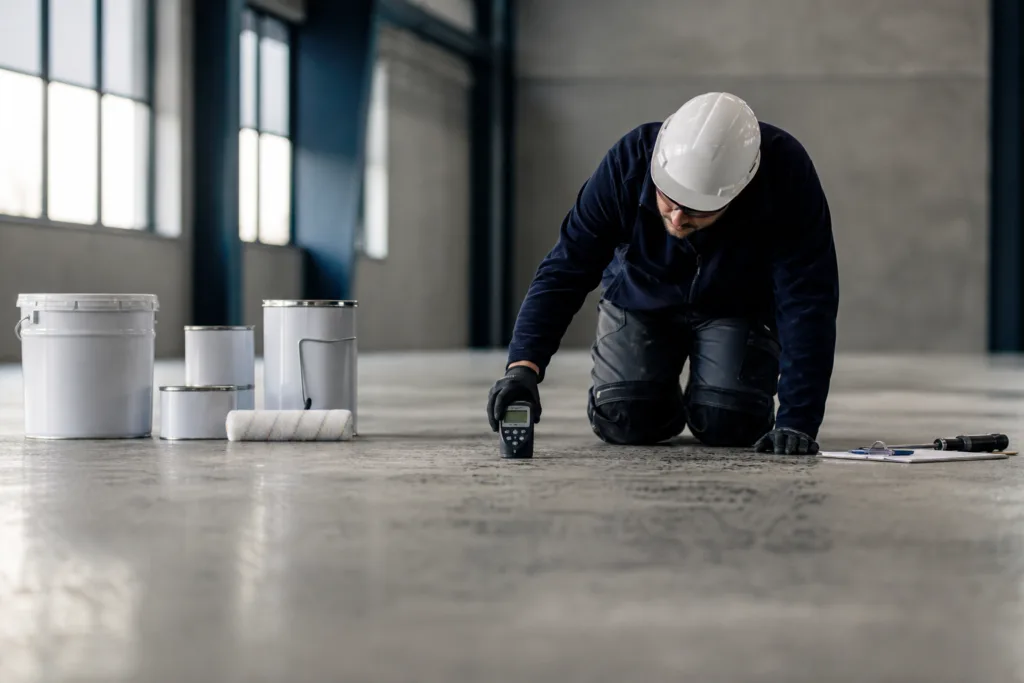
Adhesion starts with the concrete, not the coating. Surface tensile strength matters because epoxy often fails at the weakest layer of the slab rather than within the resin itself. If the substrate has laitance, dusting, poor curing, or weak near-surface paste, a high-performance coating can still detach cleanly from the slab.
As a practical baseline, the specifier should ask for minimum substrate strength requirements and pull-off acceptance criteria suitable for the intended service. On critical floors, field adhesion testing on prepared sample areas is more valuable than assumptions. ASTM pull-off testing is commonly referenced to evaluate whether failure occurs cohesively in concrete, at the interface, or within the coating build. Surface profile expectations should also be tied to the chosen system thickness.
Curing compounds, oils, grease, old sealers, tire residues, and hidden polishing treatments are common causes of weak adhesion. Visual inspection alone is not enough. Water absorption checks, contamination review, and mechanical preparation trials often reveal problems before full-scale application begins.
Surface preparation methods and acceptance criteria
Good floor systems usually fail less from resin chemistry than from inadequate preparation. Shot blasting is often preferred for many commercial and industrial epoxy floors because it cleans and profiles at the same time while removing weak surface paste. Diamond grinding is useful when a smoother profile is needed or where edge detail and localized corrections matter. Scarifying is more aggressive and is used for thicker removal, but it can leave a rougher surface that may require additional refinement before coating.
Acid etching is sometimes discussed for concrete, but from a manufacturer perspective it is usually less reliable than mechanical preparation for specification-grade work. It may not remove contaminants uniformly, may not create the desired profile, and can leave residue if poorly neutralized. For most durable floor systems, mechanical preparation remains the safer choice.
Concrete surface profile guidance
| System Type | Typical Surface Profile | Preparation Preference |
|---|---|---|
| Thin-film coating | CSP 1 to 2 | Light grind or controlled blast |
| Self-leveling epoxy | CSP 2 to 3 | Shot blast or grind with laitance removal |
| Heavy build broadcast system | CSP 3 to 4 | Shot blast with localized repair |
| Mortar or screed system | CSP 4 and above as needed | Aggressive mechanical preparation |
After preparation, acceptance checks should include a clean, dust-free surface, no visible curing compound film, no standing contaminants, and a profile consistent with the specified resin build. A simple water puddle test can help reveal unexpected repellency, while test patches help confirm wetting and bond before full rollout.
Where porosity and surface condition are uneven, a penetrating primer such as ZDS-1012AB epoxy primer to improve adhesion on concrete can help with sealing, wetting, and bond development, provided the slab is properly prepared and moisture is within the system’s tolerance.
Moisture management and vapor drive
Moisture is one of the most important causes of epoxy floor failure on concrete. Even if the slab surface appears dry, upward vapor drive can create osmotic blistering, bond loss, whitening, or long-term softening at the interface. This is why the specification should define both test method and acceptance threshold instead of using vague language such as dry enough.
Two common approaches are in-situ relative humidity testing and calcium chloride moisture vapor emission testing. Different systems tolerate different limits, so acceptable values should be tied directly to the selected primer and overall floor build. Moisture-sensitive systems should not be installed simply because the surface feels dry during the day.
Solutions depend on severity. Moderate moisture may be handled with a moisture-tolerant epoxy primer or a dedicated moisture mitigation layer. Higher vapor pressure may require a surface-applied vapor barrier system, deeper investigation of the slab design, or in severe cases concrete replacement or alternative flooring logic. Ignoring moisture data is rarely a harmless shortcut.
Primers and why they matter more than many buyers expect
Primers do more than improve stickiness. Their role can include pore penetration, porosity sealing, air release reduction, bond promotion between concrete and build coats, and moisture control in some systems. If the slab has mixed porosity, a correctly chosen primer often reduces pinholes and improves the uniformity of the final finish.
Primer selection should consider viscosity, solids content, concrete absorbency, moisture condition, and overcoat window. Low-viscosity primers are often useful for penetration. Higher-build primers can help seal rougher surfaces or function as part of a moisture management strategy. Water-based options may help in specific environments, but specifiers should check whether they suit the final chemical and wear requirements of the full system.
Coverage rate should never be copied blindly from a technical sheet without regard to surface profile and porosity. Rough concrete absorbs more resin, while over-thinning coverage can leave dry areas that later become weak points. The specification should also state the acceptable tack or recoat condition so that mid-coats are applied within the correct bond window.
Build thickness and system composition
Thickness influences durability, impact tolerance, porosity sealing, and the amount of wear reserve available before the floor starts to fail cosmetically or functionally. Thin systems may perform well in low-demand spaces, but they have less capacity to absorb abrasion or substrate irregularity. Heavier builds are usually more forgiving and longer lasting when traffic is frequent or cleaning is aggressive.
| Duty Level | Typical Dry Film Build | Common System Logic |
|---|---|---|
| Light duty | 200 to 500 microns | Primer plus one or two coating layers |
| Medium duty | 500 microns to 1.5 mm | Primer plus build coat plus topcoat |
| Heavy duty | 1.5 to 3 mm | Primer plus self-leveling or broadcast system plus wear topcoat |
| Mortar or screed | 3 mm and above | Filled resin layers for impact and reconstruction |
Multi-layer design is often more reliable than expecting one coat to do everything. A common industrial sequence is primer, build coat, aggregate or broadcast where needed, then a topcoat tuned for wear, slip resistance, UV considerations, or chemical cleaning requirements. For floors requiring stronger body and wear reserve, a layer such as ZDS-3136AB epoxy mid-coat for build and wear resistance can be evaluated as the structural middle layer within a broader system design.
Traffic, mechanical performance, and anti-slip selection
Traffic classification should be realistic. Pedestrian-only areas, pallet jack zones, fork truck aisles, heavy vehicle bays, and impact-prone loading areas place very different demands on the floor. A system that performs well in a showroom may wear rapidly in a warehouse with turning forklift wheels and abrasive dust.
Mechanical performance should be discussed using measurable properties where possible. Depending on the application, buyers may request Shore D hardness for surface toughness, abrasion data such as Taber wear results, and impact tolerance relevant to dropped tools or wheeled equipment. These numbers do not replace field judgment, but they help compare systems more objectively.
Slip resistance should also be engineered rather than improvised. Aggregate type, broadcast rate, and topcoat encapsulation all affect the final balance between traction, cleanability, and appearance. Fine textures may suit retail or light commercial spaces, while heavier anti-slip profiles may be justified in wet service corridors or process areas.
Chemical exposure and when standard epoxy is not enough
Chemical resistance selection starts with the actual exposure profile. Is the floor exposed to occasional drips, regular washdowns, standing liquids, solvent spills, battery acid, alkalis, fuels, or hot process chemicals? Exposure concentration, dwell time, and temperature all matter. A standard epoxy may resist occasional oil contact very well, yet struggle with long-term solvent immersion or strong acid cleaning.
Specifiers should request relevant test information, such as immersion or spot resistance under conditions similar to service. They should also ask whether the topcoat or full system was tested, because the weakest layer determines the practical resistance of the floor assembly. In environments with aggressive chemicals or combined wear and spill exposure, a chemical-resistant topcoat may be more important than simply increasing epoxy thickness.
When improved UV stability, stain resistance, or chemical resistance is needed over the epoxy build, a finish such as ZDS-8300AB polyurethane clear topcoat for chemical-resistant floors may be considered as part of the system. The key is not the product name itself, but whether the complete layered system has the right resistance profile for the actual cleaning and spill conditions.
Curing, pot life, and environmental control
Two-component floor resins are highly sensitive to temperature, humidity, mixing accuracy, and timing. Pot life is not the same as cure time. Pot life describes how long the mixed material remains workable in the container, while cure schedule describes when the installed film reaches handling, traffic, or chemical service stages.
Lower temperature typically slows reaction and can leave films softer for longer than expected. Higher temperature shortens pot life, speeds exotherm, and can make large mixed batches difficult to control. High humidity may contribute to surface blush in some systems, affecting appearance and intercoat adhesion. For this reason, the specification should define installation temperature range, substrate temperature relative to dew point, mixing instructions, and recoat window discipline.
Common cure-related defects include tacky areas from poor mix ratio control, soft films from under-reaction, roller marks from working beyond the open time, and intercoat bond loss from missed recoat windows. These are process failures as much as material failures.
Viscosity, solids content, and application method
Viscosity should match the job. Low-viscosity materials are valuable where penetration and pore wetting matter, such as primers and some crack-filling stages. Mid-viscosity materials work well for body coats and self-leveling layers. Thixotropic or heavily filled systems are better for patching, coving, or rebuilding damaged areas because they stay in place rather than flowing out.
100% solids systems can deliver thicker films in fewer coats and with no solvent evaporation losses, which often improves build efficiency. However, they may require more skilled application, stronger control of substrate defects, and tighter handling of mixing and placement time. High-solids alternatives may be easier in some field conditions but can require more coats to reach the same total protection.
In our formulation work at ZDSpoxy, we often see that application success depends as much on matching viscosity and working time to the crew and environment as on choosing the headline chemistry. A technically strong resin can still underperform if it is too fast, too thick, or too sensitive for the actual site workflow.
Clear epoxy floors and anti-yellowing strategy
Clear floors are attractive, but they need realistic expectations. Many epoxy systems will amber over time when exposed to UV light or certain indoor lighting conditions. Amine hardeners, elevated temperature, and sunlight all contribute. This does not always reduce floor strength, but it can affect appearance significantly in decorative projects.
If color stability matters, the specification should define whether the epoxy serves mainly as the build layer while a more UV-stable aliphatic polyurethane provides the final wear and appearance layer. Buyers should request weathering-related performance information where appearance retention is critical. For decorative concrete, it is usually wiser to design the system around expected yellowing behavior than to assume all clear epoxies will remain unchanged.
Common installation mistakes and practical troubleshooting
Most preventable failures follow a familiar pattern: poor surface preparation, underestimating moisture, choosing the wrong primer, inaccurate mixing, applying outside the correct temperature range, or missing the recoat window. These mistakes are common because floor jobs are often scheduled tightly and concrete variability is underestimated.
| Symptom | Likely Root Causes | Corrective Action |
|---|---|---|
| Delamination | Weak concrete surface, contamination, poor profile, moisture vapor pressure | Remove failed areas, reprepare mechanically, retest moisture and adhesion, rebuild with correct primer |
| Pinholes | Unsealed porosity, air release from slab, primer skipped or too thin | Use proper primer, adjust coverage, seal pores before build coat |
| Blushing or hazy surface | Humidity, condensation, incompatible recoat timing | Control environment, clean affected layer if required, recoat within guidance |
| Tacky or soft film | Incorrect ratio, incomplete mixing, low temperature, expired material | Remove soft material, verify mixing method and temperature, reinstall |
| Cracking | Substrate movement, reflective cracking, excessive brittleness, poor joint treatment | Treat joints properly, use suitable repair materials, review flexibility needs |
A practical prevention checklist includes mockup areas, pre-job moisture testing, batch control, measured mixing, dew point checks, and simple hold points before each coat. These controls are less expensive than floor replacement.
Specification checklist and what to request from a manufacturer
A useful specification should define minimum substrate condition, concrete surface profile, moisture limits by test method, required primer type, total dry film thickness, anti-slip expectation if relevant, cure windows, and acceptance testing. It should also state whether aesthetics or industrial durability is the main priority, because the build design may differ.
- Minimum concrete strength and pull-off acceptance criteria
- Allowed moisture thresholds and test method to be used
- Required preparation method and target CSP range
- Primer, build coat, broadcast, and topcoat sequence
- Total thickness range and tolerance
- Slip resistance strategy where required
- Chemical exposure list and required resistance confirmation
- Environmental installation limits and return-to-service timing
- Repair method for joints, cracks, and local defects
- Documentation package including TDS, SDS, and traceability
From a manufacturer, buyers should request product data sheets, safety data sheets, recommended system drawings, test data relevant to adhesion, abrasion, and chemical resistance, and practical guidance on recoat windows and application tolerances. If the project is unusual, custom formulation support or pre-project sample trials can be more valuable than selecting only from standard catalog items.
How to evaluate a floor resin manufacturer
Manufacturer quality matters because floor performance depends on more than one pail of resin. Buyers should look at formulation consistency, technical support capability, ability to explain tradeoffs clearly, responsiveness on test questions, and whether the supplier can help tailor viscosity, cure speed, or chemical resistance for the service environment.
For OEM brands, distributors, and project teams, useful evaluation criteria include lab testing capability, batch traceability, lead time reliability, packaging options, private label support when needed, and whether field trials can be supported with practical documentation. Warranty language should also be read carefully. A product-only warranty and a performance-based system warranty are not the same thing, especially where substrate condition and installation quality drive risk.
Quality control, acceptance, and maintenance planning
Floor success should be checked before, during, and after installation. Pre-installation mockups can confirm profile, build, color, and texture. During installation, teams should record temperature, humidity, batch numbers, mixing ratios, and coverage rates. After cure, dry film thickness checks, visual review, and adhesion testing in agreed sample areas help turn expectations into measurable acceptance.
Owners also need a maintenance plan. Routine cleaning should use compatible agents, not harsh chemicals that the floor was never designed to resist. Spills should be cleaned based on exposure risk rather than left to dwell. Periodic inspections help catch local wear, open joints, or impact damage before they spread. In many facilities, targeted repair with patching or recoating is more economical than full replacement if deterioration is addressed early.
Practical system recipes for common project types
Light commercial retail
A typical system may use a penetrating primer, a pigmented epoxy body coat, and a finish adjusted for appearance and light anti-slip texture. This approach usually balances cleanability, presentation, and reasonable wear resistance without requiring a very heavy build.
Heavy-duty warehouse with forklift traffic
A more durable approach often includes robust mechanical preparation, moisture verification, primer, a higher-build 100% solids epoxy layer, optional broadcast for texture, and a wear-focused topcoat. Here, abrasion reserve and impact tolerance matter more than gloss retention alone.
Chemical-exposed processing area
In processing environments, the correct answer may be a chemical-resistant epoxy build or a more specialized formulation combined with a resistant topcoat, depending on spill chemistry and temperature. The right system should be justified by testable resistance data, not by assumptions that all epoxy floors behave the same.
Conclusion
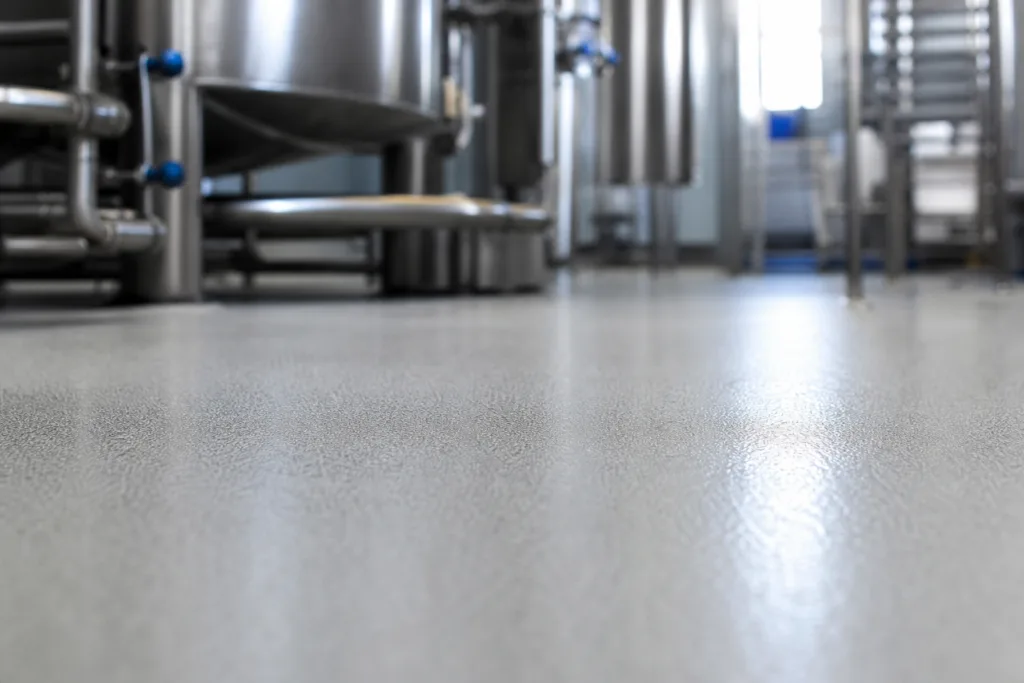
The right epoxy resin for concrete floors is the result of disciplined selection, not guesswork. Concrete condition, moisture behavior, surface preparation, build thickness, traffic class, chemical exposure, and curing environment all need to align. When these variables are checked early and tied to measurable acceptance criteria, epoxy floors are far more likely to deliver long service life, easier maintenance, and lower total rework risk. For most projects, the smartest path is to create a system-based specification rather than choosing a single coating in isolation.
FAQs
How do I know if my concrete is ready for epoxy flooring?
Concrete is usually ready only after you confirm it is sound, clean, properly profiled, and within the moisture limits of the selected system. Visual dryness is not enough; you should check for laitance, curing compounds, oil contamination, weak surface paste, and perform moisture testing and, when needed, adhesion testing on prepared sample areas.
What thickness is usually recommended for an epoxy floor on concrete?
The right thickness depends on service conditions rather than a single standard number. Light-duty floors may use a few hundred microns, while warehouse, broadcast, or self-leveling systems often require substantially more build, and mortar systems may go several millimeters thick to handle impact, wear, or surface reconstruction.
Can epoxy be applied over damp concrete?
Sometimes, but only if the selected primer or system is specifically designed to tolerate the measured moisture condition. Standard epoxy applied over uncontrolled slab moisture can blister or lose adhesion, so the decision should be based on RH or vapor emission test results and the manufacturer’s stated limits.
Is clear epoxy a good choice for decorative concrete floors?
Clear epoxy can work very well for decorative concrete when depth, gloss, or visibility of the substrate is important, but it should be specified with realistic expectations about yellowing and UV exposure. In appearance-sensitive projects, a UV-stable topcoat strategy is often just as important as the clear epoxy layer itself.
What is the most common cause of epoxy floor failure on concrete?
The most common cause is poor preparation combined with missed moisture problems. Even a strong resin system can fail if it is placed over dusty, contaminated, weak, or vapor-active concrete, which is why substrate testing and preparation control are more important than many buyers initially expect.
What should I ask an epoxy manufacturer before specifying a floor system?
You should ask for the full system build, moisture limits, surface preparation requirements, dry film thickness, cure schedule, relevant adhesion and chemical resistance data, and guidance for your specific traffic and cleaning conditions. It is also useful to ask whether custom formulation, field trials, or project-specific technical review are available when the service environment is unusual.