
Choosing among marine epoxy resin suppliers is rarely just a price comparison. For distributors, boatyards, and OEM buyers, the real decision is whether a supplier can deliver repeatable performance, stable batches, complete documentation, and dependable logistics without creating avoidable rework or compliance risk. From our manufacturing perspective, the strongest procurement decisions come from verifying the full supply picture: chemistry fit, quality control discipline, lot traceability, packaging practicality, technical support, and change control.
Explore marine epoxy systems and OEM/private-label supply options if you are comparing coating, repair, bonding, fairing, or encapsulation supply models and need a clearer view of bulk sourcing versus custom branded programs.
Where marine epoxy resin is used and why category matters
Marine procurement teams often group epoxy into one purchasing bucket, but the chemistry and performance profile can differ significantly by application. A thin, penetrating primer for timber restoration does not behave like a high-build barrier coat, and neither behaves like a potting compound or structural laminating system. Before asking for quotes, define the exact use case, substrate, film build, cure window, and environmental exposure.
Typical marine epoxy categories include primers, protective coating binders, laminating systems, fairing compounds, structural adhesives, casting resins, and potting or encapsulation materials. Buyers should also separate cosmetic needs from structural needs. A fairing material may need sandability and low slump, while a bonding resin may need higher toughness, better elongation, and stronger adhesion to composite or metal surfaces.
When a team is still deciding whether a product truly qualifies for marine service, our advice is to compare the chemistry against service conditions rather than rely on a vague label. This how marine-grade epoxy differs from standard epoxy for hulls and composites reference is useful when screening suppliers that use broad claims but provide limited technical detail.
The first checks buyers should complete before comparing price

A short pre-qualification checklist usually eliminates weak candidates early. Before requesting samples, confirm these basic items:
- SDS and TDS availability: Current versions should be easy to obtain and consistent with the quoted product.
- Lot traceability: Every shipment should tie to a batch or lot number, production date, and retained quality record.
- MOQ and packaging options: Clarify whether the supplier supports pails, drums, IBCs, or custom kits.
- Lead time: Ask for standard production lead time and actual shipping lead time by season.
- Technical support scope: Determine whether the supplier can review substrate prep, cure conditions, and troubleshooting.
- Shelf life: Confirm how it is labeled, what storage temperature is assumed, and what happens near expiry.
- Change notification: Buyers should know whether raw material or formulation changes require prior notice.
If a supplier struggles to answer those basic questions clearly, the later steps usually become harder, not easier.
Documentation and certifications worth requesting upfront
Procurement teams should request a document package before sample approval, not after the first container arrives. The minimum pack usually includes SDS, TDS, and a sample certificate or quality summary. For approved supply, the stronger package includes a certificate of analysis, lot traceability record, retained sample policy, and quality management documentation.
Important documents to request include:
- SDS: Verify hazard classification, PPE requirements, first-aid measures, storage guidance, and transport information.
- TDS: Check viscosity range, mix ratio, solids content if relevant, working time, cure schedule, and recommended substrates.
- COA: Should list batch-specific test values, not generic specification limits only.
- Lot traceability statement: Confirms linkage from raw materials to finished batch.
- Retained sample policy: Useful when disputes arise months after application.
- ISO 9001 evidence: Helpful as a process control indicator, though not a substitute for product-specific testing.
- Regulatory declarations: REACH, RoHS, VOC statements, or marine sector documentation where relevant to market and use.
Some buyers also request statements related to corrosion performance frameworks such as ISO 12944 or salt spray evidence aligned with ISO 9227. These are not universal for every marine epoxy category, but they matter when the resin is part of a protective coating system for metal structures, tanks, or high-salt environments.
Key technical specifications to compare side by side
Comparable data matters more than broad performance claims. Ask suppliers to present typical values, test methods, and specification ranges in a consistent format. Where possible, compare data measured at the same temperature and cure conditions.
| Specification | Why it matters | Buyer note |
|---|---|---|
| Viscosity | Affects wetting, flow, penetration, pumping, and mixing | Confirm test temperature and whether value is resin only or mixed system |
| Mix ratio | Controls field accuracy and risk of off-ratio cure | Prefer simple ratios for boatyard use unless metered equipment is standard |
| Pot life and gel time | Determines usable working window | Check volume effect, because larger mixed masses cure faster |
| Cure profile | Influences return-to-service timing and low-temperature performance | Request tack-free, sandable, and full-cure milestones |
| Glass transition temperature | Shows heat resistance after cure | Important for dark surfaces, engine spaces, or hot climate exposure |
| Hardness and flexibility | Balance between abrasion resistance and crack tolerance | Do not select only on hardness if substrate movement is expected |
| Adhesion | Critical for steel, aluminum, GRP, wood, and concrete | Ask for substrate-specific adhesion data, not one generic result |
| Chemical and saltwater resistance | Relevant for bilges, tanks, splash zones, and washdown areas | Request immersion conditions and exposure duration |
For two-component systems, buyers should also examine ratio tolerance, induction time if any, and sensitivity to humidity during cure. Teams that need a refresher on field handling can use this guide to 2-part marine epoxy mix ratios, pot life and cure control when setting acceptance rules for site crews.
Which test standards are most relevant in marine procurement
Not every supplier test report has equal decision value. Ask for test methods that relate directly to the service condition. Typical examples include pull-off adhesion, hardness, abrasion resistance, salt spray exposure, and corrosion classification references where the epoxy is part of a coating system.
- ASTM pull-off adhesion: Useful for checking bond performance to prepared steel, composite, or concrete substrates.
- ASTM D4060 abrasion: Helps compare wear resistance for deck or maintenance-zone coatings.
- ASTM D2240 hardness: Gives a quick indicator of cured surface hardness.
- ISO 9227 salt spray: More useful for protective coating systems than for general adhesive marketing claims.
- ISO 12944 references: Relevant when corrosion-protection system design is under review for marine steel exposure classes.
Pass or fail should always be interpreted in context. A high adhesion number after ideal lab curing may not mean much if the product loses bond on a damp repair patch or cold-weather boatyard application. Procurement teams should therefore ask for sample preparation details, cure schedule, and film thickness with every test report.
Bulk formats, packaging, and logistics details that affect real cost
Packaging format affects labor, contamination risk, transfer loss, and storage efficiency. Small kits support repair work and field consistency. Drums and IBCs improve throughput for higher-volume operations but require better transfer discipline and temperature control.
| Format | Typical use | Main advantages | Main cautions |
|---|---|---|---|
| Small kits | Repairs, trial programs, boatyard jobs | Lower mixing error, simpler handling | Higher packaging cost per kg |
| Pails | Routine workshop production | Manageable manual handling | Need reseal discipline after opening |
| Drums | Distributor stock, OEM lines | Better unit economics | Viscosity changes with temperature can slow transfer |
| IBCs or totes | Large volume continuous use | Operational efficiency | Need pump compatibility and clean transfer procedures |
Ask about UN classification where relevant, palletization method, liner or moisture-control practices, and whether labels show manufacture date, lot number, net weight, and shelf-life end date clearly. For amine hardeners, moisture pickup during repeated opening can become a hidden quality issue, so repacking procedures should be documented.
Application-specific products can also reveal how a supplier thinks about packaging and field usability. For example, a system such as ZDS-2060AB solvent-free wood rot primer for marine timber repairs is typically evaluated not only on bond and penetration, but also on low-odor handling, kit balance, and realistic use in confined restoration work.
How to verify batch stability and quality control discipline
Batch stability is one of the clearest separators between strong and weak suppliers. Buyers should not accept a statement like “same formula every time” without evidence. Ask what the supplier tests on every batch, what the acceptance limits are, and how nonconforming material is handled.
A useful COA typically shows several batch-specific values such as viscosity, color or appearance, density, epoxy equivalent or amine value where applicable, solids content if relevant, and gel or cure-related control points. The exact items vary by product type, but the principle is the same: the COA should prove the batch was measured against defined limits.
Questions worth asking include:
- Are retained samples stored for every lot, and for how long?
- What is the normal acceptable variance for viscosity and reactivity?
- How are raw-material substitutions controlled?
- Is accelerated aging used to monitor shelf-life risk?
- What statistical sampling plan is applied for packaging verification and final release?
From our manufacturing perspective, the most useful answer is not “our quality is stable,” but “here is what we test, here are the limits, and here is how we handle deviation.”
A practical sample evaluation protocol for distributors and boatyards
Controlled trials should be planned before samples arrive. Otherwise, teams compare products under inconsistent conditions and end up arguing over impressions instead of data.
Recommended sample test sequence
- Define the use case: Primer, fairing, bonding, barrier coat, potting, or deck repair.
- Select the substrate: Steel, aluminum, GRP, wood, or concrete, matching the real application.
- Prepare panels consistently: Record abrasion grade, cleanliness, moisture condition, and profile.
- Standardize mixing: Use calibrated weight or volume tools, identical mixing time, and same batch size.
- Control environment: Record temperature, humidity, substrate temperature, and dew point margin.
- Apply to a written target: Wet film, dry film, spread rate, or bond line thickness.
- Record workability: Pot life, sag, penetration, leveling, exotherm, and odor profile.
- Test cure milestones: Tack free, sandable, recoatable, and full cure.
- Run service checks: Adhesion, water exposure, abrasion, or thermal cycling as relevant.
- Set acceptance criteria in advance: Avoid changing the pass line after seeing results.
For timber and deck repairs, a buyer may also compare penetration and gap-bridging behavior between a primer and filler system. A product like ZDS-1240 epoxy wood gap filler for sealing deck joints should be judged on filling stability, sanding behavior, shrink tendency, and bond after moisture cycling, not just on initial appearance.
Field acceptance should not conflict with lab acceptance
Lab data helps screening, but marine service introduces moisture, operator variability, mixed substrates, and temperature swings that a clean lab cannot fully reproduce. Buyers should therefore align lab acceptance and field acceptance before approving scale supply.
A good practice is to define two gates. The first is lab suitability: the resin meets target viscosity, cure, hardness, adhesion, and handling criteria. The second is field suitability: the same material performs acceptably in an actual boatyard or OEM workflow during a limited run-in period. Extended trials are especially wise when the application includes overhead coating, cold-weather cure, damp timber, or long-open-time fairing work.

Private-label and OEM supply considerations
Private-label procurement adds another layer beyond product performance. Buyers need clarity on formulation ownership, packaging customization, label approval process, MOQ by SKU, and who controls specification changes. If a distributor is building its own brand, change control and confidentiality become contract issues, not just technical issues.
At ZDSpoxy, we see buyers ask the most useful questions when they separate standard catalog supply from custom-formulated supply. A custom viscosity target, faster low-temperature cure, reduced blush, or revised kit size can all be reasonable requests, but each one can affect MOQ, lead time, revalidation scope, and batch release criteria.
For OEM programs, request written confirmation on:
- Formula revision control and notification period
- Artwork approval and packaging change process
- Exclusivity terms if requested
- Intellectual property boundaries for custom development
- What happens if a critical raw material becomes unavailable
Compliance, safety, and environmental points that should be written down
Marine facilities often work across multiple regulatory environments, so verbal reassurance is not enough. Buyers should confirm VOC declarations where relevant, REACH status for target markets, transport classification under ADR or IMDG where applicable, and storage temperature requirements. Shelf-life management matters because some slow-moving SKUs spend too long in distributor stock.
Operationally, the procurement file should also include required PPE, ventilation expectations, spill handling guidance, and sensitization warnings. These details matter during onboarding because the wrong assumptions at the marina or workshop level can create both health and product-performance problems.
Cost drivers and total cost of ownership
The cheapest quoted kilogram can become the most expensive program. Total cost should include yield, transfer loss, packaging waste, labor efficiency, cure speed, rework rate, and the commercial exposure of a failed repair or coating run.
Important cost drivers include resin and hardener quality, pigment and filler loading where relevant, packaging complexity, freight class, import duty, storage temperature control, and technical support burden. If two products are close in price, the one with better lot consistency, clearer instructions, and lower field error risk often wins on total cost of ownership.
Capacity, lead times, and contingency planning
Marine demand can be seasonal, and many buyers underestimate how quickly lead times stretch when several distributors or repair yards pull stock at the same time. Ask suppliers for normal lead time, peak-season lead time, and what finished-goods or raw-material buffer they maintain.
Buyers with recurring demand should share rolling forecasts, define safety stock expectations, and clarify how partial shipments are handled. A realistic contingency plan should cover alternate pack sizes, emergency production scheduling, and pre-agreed substitute logistics routes when port or carrier disruptions occur.
Supplier capability checklist and common red flags
A supplier audit does not need to be complicated, but it should be disciplined. If a site visit is possible, review raw-material storage, batch identification, weighing controls, mixing records, QC test equipment, sample retention, packaging line cleanliness, and complaint handling procedures.
Positive capability signals
- Clear batch records tied to raw materials and finished goods
- QC lab with documented methods and calibrated equipment
- Technical staff able to explain trade-offs between hardness, flexibility, viscosity, and cure speed
- Structured nonconformance and corrective-action process
- Consistent document versions across quote, TDS, and shipment paperwork
Red flags
- Anonymous or generic COAs without batch-specific values
- Evasive answers on retained samples or failed batches
- Frequent unexplained changes to appearance or cure speed
- Unclear labeling of manufacture date and shelf life
- No written process for notifying customers about formula changes
Contract terms, warranties, and service levels that matter
Good procurement work is incomplete without clear contract language. Buyers should define acceptance testing windows, rejection remedies, lot replacement terms, and reporting timelines for suspected defects. If the resin supports a branded OEM line, the contract should also address artwork ownership, confidentiality, and transition support if a product revision is introduced.
Recommended clauses often include acceptance by agreed tests, responsibility for replacement of nonconforming lots, notice period for specification changes, liability limits aligned with product use, and procedures for dispute resolution based on retained samples or mutually reviewed test data. Service-level expectations can also cover response time for technical questions, root-cause support during complaints, and training availability for crews or distributors.
How to score suppliers with a weighted procurement checklist
A weighted scorecard helps prevent price from dominating every decision. Buyers can adapt the weighting to their risk profile, but a balanced model often works well.
| Dimension | Suggested weight | What to score |
|---|---|---|
| Technical fit | 30% | Adhesion, cure, viscosity, durability, substrate compatibility |
| Quality control | 20% | COA quality, retained samples, batch stability, traceability |
| Commercial terms | 15% | MOQ, payment terms, tooling or label costs, change fees |
| Logistics | 15% | Lead time, packaging options, export handling, shelf-life support |
| Technical service | 10% | Training, troubleshooting, response speed, documentation quality |
| Strategic fit | 10% | Private-label flexibility, forecast cooperation, contingency readiness |
This approach makes internal approval easier because procurement, operations, and technical teams can see where a supplier is strong or weak in measurable terms.
Common buying mistakes and how to avoid them
The most common error is approving a supplier on sample performance alone without confirming batch control and release documentation. Another is accepting broad marine claims without substrate-specific testing. We also see buyers underestimate storage conditions, especially for slow-moving hardeners or moisture-sensitive components.
Other avoidable mistakes include skipping field trials, ignoring operator mixing error, failing to define acceptance criteria before testing, and not writing change-control terms into the supply agreement. In practice, many procurement problems start as documentation gaps long before they become performance failures.
A practical procurement workflow from first RFQ to scale-up
A disciplined workflow reduces surprises:
- Initial screening: Review documents, packaging options, MOQ, lead time, and technical fit.
- RFQ and data request: Ask for TDS, SDS, COA examples, regulatory declarations, and test reports.
- Sample testing: Run controlled lab and field trials with written acceptance criteria.
- Audit or capability review: Confirm QC, batch traceability, and release procedures.
- Pilot order: Start with a limited commercial batch under tighter incoming inspection.
- Contract finalization: Lock change notification, rejection remedies, and service expectations.
- Ongoing QC: Verify incoming lot data and keep trend records for viscosity, cure, and appearance.
- Periodic re-audit: Review performance, complaints, capacity, and any raw-material risks.
For most distributors, boatyards, and OEMs, the goal is not to find a perfect supplier on paper. It is to establish a supply relationship that remains technically stable, commercially workable, and operationally predictable as volumes grow.
Conclusion
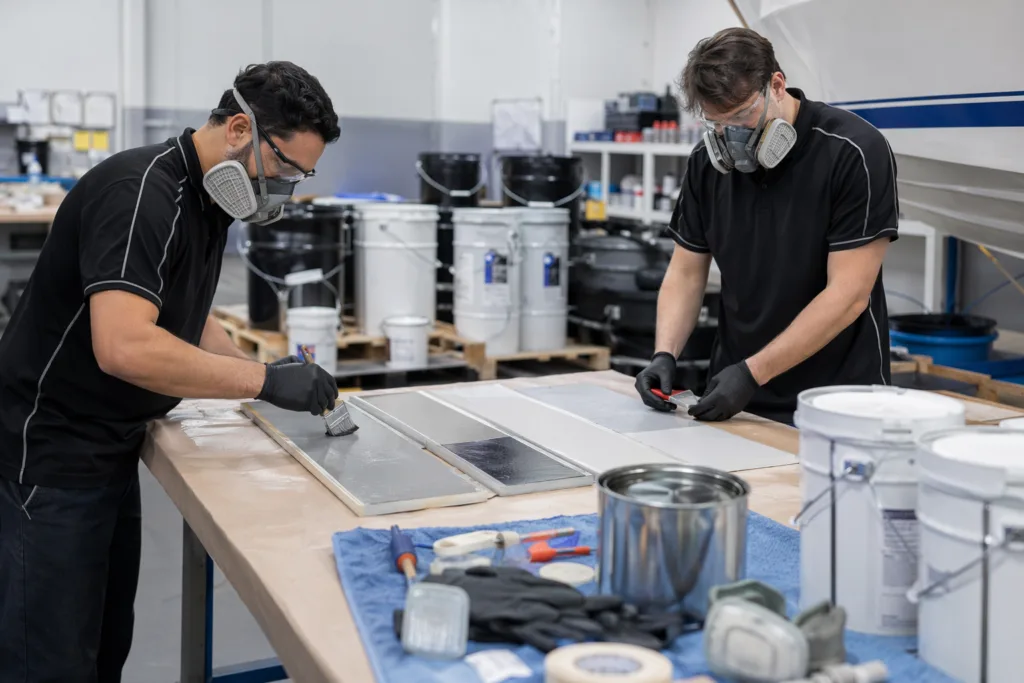
Strong marine epoxy procurement depends on disciplined comparison, not broad claims. The right marine epoxy resin suppliers will provide more than a product: they will provide traceable batches, usable documentation, realistic technical support, stable logistics, and a clear process for managing change. If your team builds a checklist around batch consistency, test relevance, packaging fit, and contract clarity, supplier selection becomes far more reliable and far less reactive.
FAQs
What documents should I request first from marine epoxy resin suppliers?
Start with the SDS, TDS, a recent batch-specific COA example, and a lot traceability statement. If the product may be sold into regulated markets, also request relevant REACH, VOC, transport, or other compliance declarations and confirm how document revisions are controlled.
How can I check whether batch quality is really consistent?
Ask which properties are tested on every batch, what the specification limits are, and whether retained samples are stored for complaint review. A reliable supplier should be able to show batch-specific values for core properties such as viscosity, appearance, density, or cure-related controls rather than only giving generic product literature.
What is the best way to evaluate a marine epoxy sample before placing a bulk order?
Run a controlled trial on the real substrate with documented surface preparation, mixing method, environmental conditions, and acceptance criteria. Measure workability, cure milestones, adhesion, and any application-specific performance such as water exposure, sanding behavior, or gap filling so the result reflects actual service conditions.
When does private-label marine epoxy make sense for a distributor or OEM?
Private-label supply makes sense when you need consistent branding, repeat purchasing volume, and some control over packaging, kit size, or formulation details. It becomes more valuable when the supplier can also manage change control, confidentiality, and long-term specification stability in writing.
Should I prioritize lab test reports or field trials?
You need both, but they serve different purposes. Lab reports help compare suppliers under controlled conditions, while field trials confirm whether the resin performs under the actual substrate, climate, crew practices, and cure constraints that matter in a marine yard or OEM production setting.
Which contract terms matter most for marine epoxy procurement?
Focus on acceptance testing methods, time limits for inspection, remedies for nonconforming lots, change-notice requirements, shelf-life guarantees, and technical support responsibilities. These terms reduce dispute risk and make it easier to manage problems before they affect repairs, coating schedules, or distributor stock.
Related Reading
- technical data sheets and product specifications download center
- marine epoxy resin uses, benefits and selection basics
- supplier questions for low-VOC marine epoxy: compliance and odor control
- epoxy resin safety for marinas: PPE, ventilation and sensitization prevention
- osmosis barrier coat guide: step-by-step hull protection strategy