
An epoxy resin garage floor can look simple from a distance, but specification decisions behind a durable floor are rarely simple. Contractors, flooring distributors, workshop owners, and procurement teams usually need to balance abrasion resistance, chemical exposure, cure speed, slip resistance, appearance, installation conditions, and wholesale supply reliability at the same time. From our manufacturing perspective, the right answer is not one universal coating package. It depends on traffic class, substrate condition, expected spills, sunlight exposure, installation schedule, and whether the project prioritizes low cost, decorative finish, or long service life.
Explore resin flooring solutions and system options for garages and workshops if you are comparing system build-ups, finish types, or performance priorities before finalizing a specification.
For most projects, the decision map is straightforward. Light-duty private garages often perform well with a properly prepared concrete slab, penetrating primer, pigmented epoxy body coat, and optional clear topcoat. Commercial workshops and service bays usually need higher film build, stronger chemical resistance, better impact performance, and stricter surface preparation controls. Decorative systems such as full-broadcast flakes or quartz require additional planning around texture, topcoat selection, and film thickness. Heavy-use bays, sunlit garages, and fast-turnaround projects often justify a hybrid approach using epoxy for bond and build, then an aliphatic topcoat for UV stability and quicker return to service.
Who this guide is for and what decisions it helps solve
This guide is written for contractors specifying garage floor systems, distributors building a wholesale product range, OEM brands evaluating private-label opportunities, and procurement teams comparing manufacturers. The practical questions are usually consistent:
- Which resin chemistry fits the duty level and jobsite conditions?
- What film build is realistic for light-duty, decorative, and heavy-use garages?
- How should you compare 100% solids, waterborne, solvent-borne, and hybrid systems?
- What topcoat strategy reduces yellowing while preserving process efficiency?
- What testing, QC, and supplier documentation should be required before purchase?
- How do lead time, shelf life, packaging, and formulation support affect wholesale decisions?
We will focus on decision-making logic rather than generic product promotion. That means practical ranges, trade-offs, and specification language you can adapt to your own projects.
Key decision drivers for garage floor resin selection
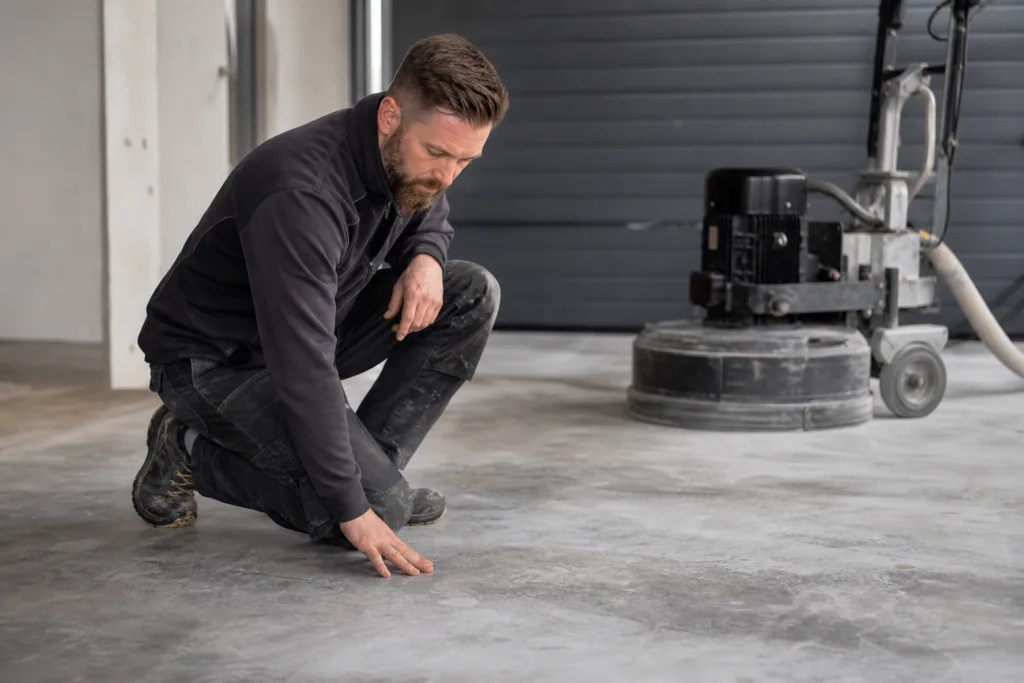
When selecting an epoxy resin garage floor system, durability is only one part of the picture. A floor that resists abrasion but fails under hot-tire pickup, oil contamination, or UV yellowing can still become a commercial problem. In our formulation work, we typically evaluate garage and workshop floors across several performance dimensions at the same time.
| Decision driver | Why it matters | Typical selection impact |
|---|---|---|
| Abrasion resistance | Vehicle traffic, tools, grit, and cleaning wear the floor surface | Favors higher-build systems and durable topcoats |
| Chemical resistance | Gasoline, oils, brake fluid, cleaners, and salts can stain or soften weak films | Requires resistant binder chemistry and a compatible topcoat |
| Cure speed | Short shutdown windows are common in active workshops | May justify fast-curing epoxy or polyaspartic topcoat |
| UV stability | Sun-exposed garages and door thresholds yellow quickly without protection | Usually points to aliphatic topcoats |
| Slip resistance | Wet tires, oil drips, and wash-down conditions increase fall risk | Requires aggregate or broadcast texture planning |
| Aesthetics | Residential and detailing shops often prioritize decorative appearance | May favor flake, quartz, or metallic systems |
| VOC and odor limits | Regulations and occupied-site constraints can limit chemistry choices | Often favors 100% solids or low-VOC systems |
| Maintenance burden | Highly textured floors may trap dirt while glossy floors show scratching faster | Affects broadcast density and topcoat finish choice |
A common procurement mistake is optimizing only for unit price per kilogram. A garage floor system should be compared at installed film build, required labor, expected recoat interval, and probable maintenance cost. Low initial material cost can be offset by higher labor, slower cure, more callbacks, or shorter service life.
System types explained for garage and workshop use
100% solids epoxy
This is often the benchmark for high-build garage flooring. It offers strong bond potential, low shrinkage, good chemical resistance, and substantial film build in fewer coats. Because there is little or no volatile carrier to evaporate, the cured layer can be dense and durable when the slab is properly prepared. Limitations include sensitivity to mixing accuracy, shorter pot life in some formulas, and slower cure at low temperatures. It also tends to amber under UV exposure unless protected by a suitable topcoat.
Solvent-borne epoxy
Solvent-borne systems can wet porous substrates well and may be easier to apply in some field conditions, but they generally bring odor, VOC, and shrinkage considerations. Film build per coat is usually lower than 100% solids systems. For many modern garage projects, especially indoor or occupied environments, they are less attractive unless the specification has a clear reason for using them.
Waterborne epoxy
Waterborne epoxy is often selected for lower odor, easier cleanup, and thinner-film sealing or dustproofing roles. It can be appropriate for light-duty garages or as part of a staged system where heavy film build is not required. Its limitations usually include lower chemical resistance and lower ultimate build compared with high-solids alternatives.
Epoxy and aliphatic hybrid logic
For many contractor-driven projects, the most practical system is a hybrid sequence: epoxy primer and body coat for adhesion and build, followed by an aliphatic clear topcoat for UV stability and better gloss retention. This is one area where ZDSpoxy often sees better field outcomes, because each layer is doing the job it does best rather than forcing one chemistry to solve every problem.
Decorative systems for garages, service areas, and showrooms
Decorative garage floors are no longer limited to appearance. Broadcast media can improve slip resistance, hide substrate variation, and reduce the visibility of dirt or abrasion patterns. The main question is how much texture, build, and cleanability the end user can accept.
Broadcast flake systems
Flake systems are widely used because they balance appearance, repairability, and slip resistance. A partial broadcast can provide visual texture with smoother cleanability, while a full broadcast provides denser coverage and better disguise of wear. Typical build-up may include primer, pigmented epoxy basecoat, flake broadcast to refusal or near-refusal, scraping, and one or two clear coats.
For decorative projects needing depth and gloss, a ZDS-400AB high-gloss clear epoxy topcoat for decorative flake systems can fit the intermediate clear-layer role where UV exposure is limited or where an additional UV-stable finish coat will be applied above it.
Quartz broadcast systems
Quartz systems are usually specified when a garage or workshop needs stronger slip resistance, thicker wear layers, or more industrial appearance. Aggregate size and broadcast density determine both texture and maintenance burden. These systems are effective for wash bays, ramps, and wet work areas but can be more labor-intensive.
Metallic epoxy finishes
Metallic systems are mostly aesthetic and are best suited to showrooms, detailing spaces, or premium residential garages with controlled expectations. They are visually striking but less forgiving during installation. Surface uniformity, mixing discipline, and application technique strongly affect final appearance.
Topcoat options and why aliphatic systems matter
Epoxy alone can produce a durable floor, but many garages fail aesthetically before they fail structurally. Yellowing at door openings, gloss loss in sunlit areas, and surface wear from grit are common complaints. That is why polyaspartic and aliphatic polyurethane topcoats are often favored for the final exposed layer.
Aliphatic polyaspartic topcoats are popular because they combine UV resistance, relatively fast return to service, good abrasion resistance, and high gloss retention. Trade-offs include shorter pot life in some formulas, faster reaction in warm conditions, and narrower application discipline. Contractors need to condition material temperature, plan crew sequence, and maintain wet edge control.
For jobs where UV resistance and quick reopening matter, many specifiers review a ZDS-1223AB polyaspartic clear topcoat for fast cure and UV resistance type of finish because it addresses the common weakness of standard epoxy under direct sunlight.
| Topcoat type | Main advantage | Main limitation | Typical use |
|---|---|---|---|
| Clear epoxy | Good build and clarity | Yellows in UV exposure | Interior decorative garages with limited sunlight |
| Polyaspartic | Fast cure and UV stability | Short working time in some climates | Sunlit garages and fast-turnaround projects |
| Aliphatic polyurethane | UV and gloss retention | May require more controlled application conditions | Premium finish layers and commercial spaces |
Formulation variables contractors must evaluate before approving a system
Not all epoxy flooring materials that look similar on a data sheet will behave the same way on site. Contractors and distributors should review at least the following variables before committing to a product line:
- Solids content: affects shrinkage, build, odor, and expected cured thickness.
- Viscosity: influences penetration, self-leveling behavior, and aggregate wetting.
- Pot life: determines realistic batch size and crew speed.
- Tack-free and recoat windows: drive scheduling and intercoat adhesion planning.
- Glass transition tendency and heat performance: relevant for hot tires and warmer service environments.
- Shore hardness: useful for comparing surface hardness, though not enough on its own.
- Flexibility and impact resistance: important where slabs crack, vibrate, or see dropped tools.
- Adhesion chemistry: critical for concrete condition, porosity, and residual contamination risk.
As a rough guide, garage systems often target Shore D hardness values in the moderate-to-high range, but too much hardness without enough toughness can increase brittleness. A balanced floor is often better than the hardest floor on paper.
UV resistance and anti-yellowing strategy
If any part of the floor receives direct sunlight, anti-yellowing strategy should be designed into the system from the start. Standard aromatic epoxy chemistry typically amber shifts over time. That does not always mean performance loss, but it does affect appearance and can be unacceptable in decorative or customer-facing spaces.
There are several ways to manage this. Some formulations improve color stability through resin selection and additive packages, but in practical garage flooring the most reliable solution is usually to place an aliphatic UV-stable topcoat over the epoxy build layers. Direct sunlight at the garage threshold, front parking zone, or glazed shop entrance is where this matters most. Buyers should ask suppliers for realistic expectations rather than assuming any clear coat is fully non-yellowing forever. Exposure intensity, orientation, film thickness, and maintenance all affect visual aging.
Cure speed planning and installation scheduling
Scheduling is a major decision factor, especially for service bays and active commercial sites. A floor that meets mechanical requirements but keeps the site closed too long may still be the wrong system. Temperature and humidity affect reaction speed, viscosity, surface flow, and recoat timing. Material conditioned at 20 to 25 degrees Celsius generally behaves more predictably than cold product from a warehouse floor.
Fast-cure systems can help compress project duration. On short shutdown jobs, a contractor may consider a ZDS-1011AB fast-curing epoxy system for quick turnaround garage floors when the priority is rapid layer build and earlier access for subsequent work.
| Workflow | Typical logic | When suitable |
|---|---|---|
| 24-hour accelerated workflow | Fast primer/body coat plus rapid topcoat sequence | Commercial bays needing short downtime |
| 48-hour standard contractor workflow | Primer, build coat, decorative broadcast, clear finish | Most garage installations with moderate schedule pressure |
| 7-day full cure planning | Allows conservative chemical-service return | Heavier duty workshops and cautious commissioning |
Even when foot traffic is possible in hours, heavy vehicle loading and full chemical exposure should usually wait until the system reaches its intended cure stage. Procurement documents should distinguish between walk-on time, light-duty use, and full-service cure.
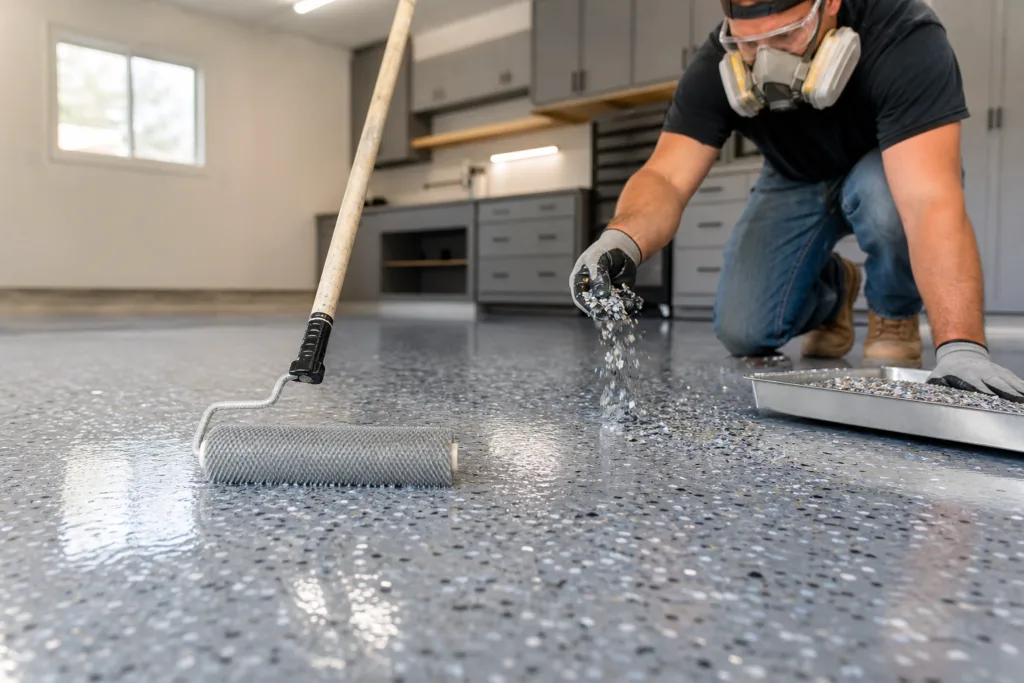
Substrate preparation, diagnostics, and adhesion targets
Concrete condition decides whether a garage coating becomes durable or troublesome. Surface preparation should not be treated as a generic preliminary step. It is the foundation of bond performance. Mechanical profiling by diamond grinding or shot blasting should be selected according to slab hardness, contamination level, and target profile. Weak laitance, curing compounds, oil saturation, old sealers, and moisture pressure all reduce adhesion reliability.
Primers play an important role where the slab is porous, mixed in density, or vulnerable to localized contamination. In these situations, a system such as ZDS-1012AB epoxy primer for concrete to improve adhesion and longevity reflects the kind of first-layer logic contractors should evaluate when consistency and substrate anchoring matter.
Before installation, we recommend checking these conditions:
- Moisture vapor emission or internal slab humidity where relevant to project risk
- Surface pH within the coating supplier’s acceptable range
- Absence of oil, silicone, tire dressing residue, and degreasing soap contamination
- Compressive integrity of the concrete surface zone
- Existing cracks, patch repairs, or movement joints that require compatible treatment
For adhesion performance, pull-off values should be interpreted carefully. High values are helpful, but the failure mode matters just as much. Cohesive failure in the concrete can indicate the coating bond exceeds the surface strength of the slab. Adhesive failure at the interface usually points to contamination, poor profile, moisture, or timing errors.
Thickness, build recommendations, and use-case matching
Garage floor specifications should match real service conditions instead of using one standard thickness for every project. Typical recommendations may look like this:
| Use case | Typical build logic | Approximate total thickness |
|---|---|---|
| Private residential garage | Primer plus pigmented epoxy, optional clear topcoat | 10 to 20 mils |
| Decorative flake garage | Primer, basecoat, flake broadcast, clear sealer and topcoat | 20 to 40 mils |
| Two-car workshop or detailing bay | Higher-build epoxy body coat with UV-stable clear finish | 20 to 30 mils |
| Heavy vehicle or service bay | Robust primer, thicker body coat, optional aggregate, industrial topcoat | 30 to 60 mils or more depending on duty |
These ranges are not universal rules, but they help frame realistic expectations. Thin-film systems can perform well in dry, light-duty settings, while heavy-use bays generally need more build and more rigorous surface preparation to preserve service life.
Slip resistance, chemical resistance, and safety planning
A garage floor should be easy to clean, but not so smooth that it becomes unsafe under wet tires or oil contamination. Slip resistance is usually adjusted by aggregate type, particle size, and broadcast density. Fine texture may be enough for private garages, while ramps or wash bays often need more aggressive surface profile. The right balance depends on whether the area is walked more than it is scrubbed.
Chemical exposure should also be specified realistically. Many garage users ask whether epoxy resists gasoline, oil, brake fluid, or cleaners. The right answer is usually: resistance depends on concentration, contact time, cure state, and whether the exposure is intermittent or continuous. Well-cured systems often tolerate incidental spills well, but pooled chemicals should still be removed promptly. For critical projects, spot testing on cured sample panels remains a sensible requirement before large-volume purchase.
Application best practices and quality control checkpoints
Most field failures begin with avoidable process inconsistency rather than chemistry alone. Good practice includes temperature-conditioning the resin and hardener, using calibrated mixing ratios, mixing for full incorporation without excessive air entrapment, and monitoring wet-film thickness during application. Batch size should match pot life and crew speed. Large mixed masses accelerate reaction and can shorten working time dramatically.
Quality control checkpoints commonly include:
- Pre-job slab inspection and moisture review
- Surface profile confirmation after preparation
- Primer absorption review and pinhole observation
- Mixing record by batch and time
- Wet-film thickness or spread-rate monitoring
- Intercoat timing verification
- Final cure check before opening to traffic
Roller application remains common for garages, but squeegee-and-back-roll methods are often more efficient for higher-build self-leveling coats. Airless spray may be used in some topcoat situations, but overspray control, film uniformity, and site conditions must be managed carefully.
Common installation mistakes and troubleshooting
Even a well-selected system can fail if installation controls are weak. Common issues include:
- Amine blush: often linked to cool, humid cure conditions; remove surface contamination before recoating.
- Pinholes: usually related to substrate porosity or trapped air; use primer strategy and correct application method.
- Fish-eyes: often caused by silicone, oil, or other repellant contamination.
- Outgassing craters: more common when coating warming concrete; timing and primer choice matter.
- Low adhesion: typically caused by inadequate profile, contamination, moisture, or expired recoat window.
- Uneven gloss or shade: can result from inconsistent film build, mixing, or substrate absorption.
Many troubleshooting problems can be reduced at the procurement stage by asking suppliers for practical application limits, not just ideal laboratory values.
Testing, acceptance criteria, and procurement checklist
Contractors and distributors comparing suppliers should request more than a sales sheet. A complete review normally includes technical data sheets, safety data documentation, packaging details, batch traceability, shelf-life conditions, and clear coating-window guidance. Depending on the project, useful acceptance criteria may include adhesion pull-off, abrasion test references, hardness readings, gloss expectations, and cure verification methods.
A practical supplier evaluation checklist includes:
- Factory QC consistency and batch traceability
- Ability to explain formulation fit by use case
- R&D support for custom viscosity, cure speed, or finish requirements
- Packaging options suitable for contractor crews or distributor inventory
- Shelf life under stated storage temperature
- Sample policy and realistic lead times
- Support for OEM or private-label projects where relevant
For wholesale buyers, MOQ, freight classification, palletization, and destination climate are not minor details. A garage floor resin system stored too hot, too cold, or too long in distribution can create downstream application problems even if the original factory batch was sound.
Cost versus lifecycle thinking for garage floors
Material cost should be viewed together with labor intensity, expected maintenance interval, and likelihood of repair. A very low-cost system that needs more surface repair, more coats, or faster recoating can lose its advantage quickly. Decorative full-broadcast systems generally cost more to install than simple pigmented coatings, but they may offer better visual durability and easier spot blending in some situations. UV-stable topcoats increase cost, yet they can reduce appearance complaints at sunlit entrances.
From a lifecycle perspective, the most economical choice is often the system that matches the actual duty level without overspecifying the entire floor. Not every residential garage needs an industrial quartz build, but commercial service bays rarely benefit from thin decorative-only systems.
Aftercare, maintenance, and repair strategy
A garage floor lasts longer when maintenance expectations are defined early. Neutral or compatible cleaners are generally safer than harsh degreasers used without rinsing control. Grit removal reduces abrasion. Chemical spills should be cleaned promptly, especially during early cure periods. Localized damage can often be repaired with compatible patching and recoating materials if the original system build and recoat compatibility are documented.
For distributors, maintenance guidance is part of the product package. The easier it is for end users to understand cleaning, touch-up, and recoat timing, the lower the risk of preventable callbacks.
Conclusion
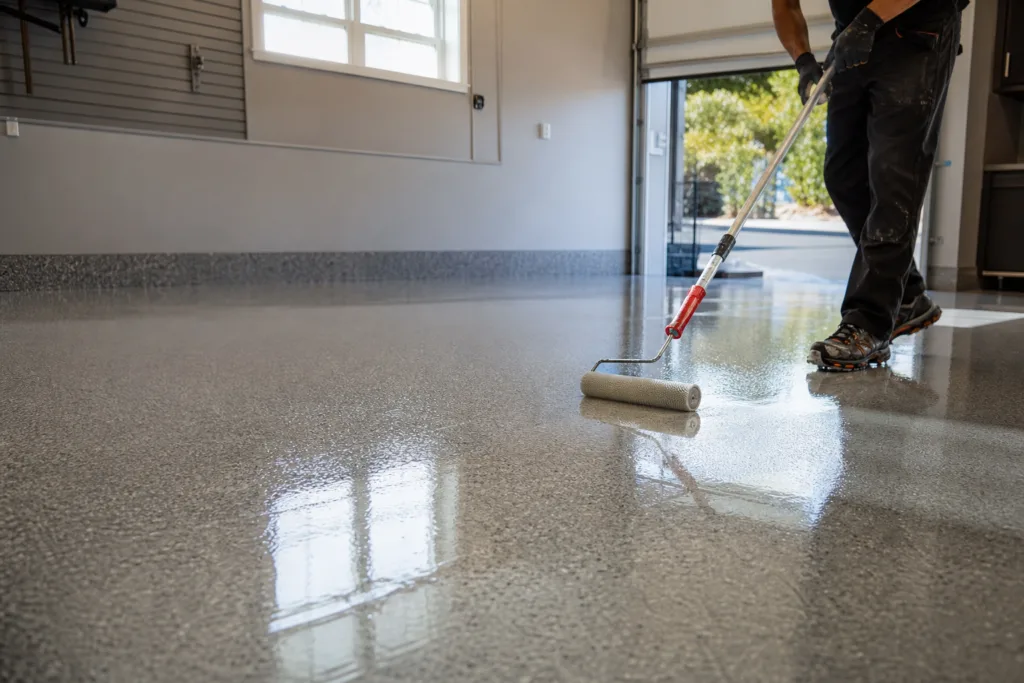
Selecting an epoxy resin garage floor system is ultimately a specification exercise, not just a color or price choice. Contractors and procurement teams should evaluate substrate condition, duty level, sunlight exposure, cure schedule, slip requirements, and supplier capability as one connected decision. In our manufacturer view, the most reliable projects usually combine proper slab preparation, realistic film build, chemistry matched to exposure, and documentation that supports repeatable installation. When those elements are aligned, garage floors can deliver both practical durability and strong long-term value.
FAQs
What is the most practical epoxy resin garage floor system for a standard residential garage?
For many residential garages, a practical system is a mechanically prepared concrete slab, an epoxy primer if the substrate is porous, a pigmented epoxy body coat, and a UV-stable clear topcoat if sunlight reaches the floor. This balances adhesion, appearance, and cleanability without the cost of a heavy industrial build.
Is a full flake system better than a plain epoxy coating for garage floors?
A full flake system is often better when appearance, slip resistance, and wear camouflage matter, but it also adds material and labor cost. A plain epoxy coating is simpler and can perform well in light-duty spaces, while full broadcast flakes are usually preferred for decorative garages, detailing shops, and floors where dirt and abrasion marks need to be less visible.
How thick should an epoxy garage floor system be?
Thickness depends on traffic and exposure, but many private garages fall in the 10 to 20 mil range, decorative flake systems often reach 20 to 40 mils, and heavier service areas may require 30 to 60 mils or more. Thickness alone does not guarantee performance, because surface preparation and layer compatibility are just as important.
Can epoxy garage floors resist gasoline, oil, and brake fluid?
Well-formulated and fully cured systems can usually handle incidental contact with common automotive fluids, but resistance depends on contact time, cure state, and the exact chemistry of the spill. For important projects, it is wise to request chemical resistance guidance from the manufacturer and perform spot tests when the exposure profile is uncertain.
Why do some epoxy garage floors turn yellow near the door?
Most standard epoxy systems are not fully UV stable, so sunlight at garage openings can cause ambering or yellowing over time. The usual prevention method is to use epoxy for build and adhesion, then protect the exposed surface with an aliphatic topcoat such as a polyaspartic or aliphatic polyurethane finish.
What should distributors ask a garage floor epoxy manufacturer before placing a wholesale order?
Distributors should ask about batch consistency, shelf life, packaging sizes, lead times, private-label support, technical data documentation, storage requirements, and whether the manufacturer can recommend system builds for different duty levels. It is also useful to confirm sample policy, traceability, and what application support is available for contractor customers.
Related Reading
- decorative flooring system options for garages and workshops
- How vinyl flakes transform floors: style, safety, and maintenance
- Manufacturer’s guide to specifying epoxy resin for concrete garage floors
- navigate the ZDSpoxy product catalog for wholesale and distributor buying
- what is resinous flooring: system types, benefits, and project fit