
Epoxy grout for patios is often considered when a project needs more than basic joint filling. Outdoor tile joints have to tolerate water exposure, thermal cycling, foot traffic, dirt, oils, cleaning chemicals, and in many regions repeated freeze–thaw stress. From our manufacturing perspective, the right epoxy grout can reduce water uptake, improve stain resistance, and support longer maintenance intervals, but only when the grout formulation, joint design, substrate condition, and installation controls are all aligned with outdoor service conditions.
Explore epoxy grout system options for outdoor tile projects if you are comparing material types, joint widths, climate conditions, or project-specific performance requirements before final specification.
When epoxy grout is the right choice for patios and when it is not
For many patio installations, epoxy grout is selected because the project team wants lower water absorption, better stain resistance, and more predictable chemical durability than standard cementitious grout. That can be especially relevant around pool surrounds, food service terraces, shaded courtyards with organic staining, and exterior decks where water remains in contact with the joint system for extended periods.
However, epoxy grout is not automatically the right answer for every exterior tile job. A rigid, highly crosslinked grout in a poorly detailed assembly can still fail if the substrate moves excessively, if control joints are ignored, or if water is trapped beneath tile and forced through the joint edges during freeze–thaw cycling. Good material cannot compensate for bad drainage or missing movement joints.
- Use epoxy grout when: stain resistance, low absorption, chemical resistance, hygiene, or reduced maintenance are key priorities.
- Use caution when: the patio has major substrate movement, poor slope, chronic moisture entrapment, or highly unstable tile support conditions.
- Do not rely on grout alone: waterproofing strategy, tile bond system, movement joints, and drainage detailing must be addressed separately.
Outdoor performance requirements for patio tile joints
Water exposure and standing water
Outdoor joints do not all face the same water exposure. A covered patio with occasional rain splash behaves differently from an uncovered terrace with puddling, and a pool surround behaves differently again because it combines splash, cleaning chemicals, sunscreen residues, and regular wetting-drying cycles. When specifying patio grout, it helps to separate splash zones from standing water zones. Splash zones usually prioritize stain and wash resistance, while standing water zones place greater emphasis on capillary uptake, bond integrity, and cure reliability under humid conditions.
Low water absorption is one of the strongest reasons epoxy systems are chosen outdoors. Still, low absorption does not eliminate the need for drainage. If water remains at joint edges or below tile, hydraulic pressure and seasonal expansion can stress the interface between tile, adhesive, and grout.
Temperature cycling and freeze–thaw stress
Patios experience daily and seasonal movement. Tile warms in sunlight, cools overnight, and in cold regions cycles around freezing. That means grout selection should consider not only hardness, but also how the cured system behaves under expansion and contraction. Very hard grout can perform well in compression and abrasion, but if the entire assembly lacks movement accommodation, edge cracking or debonding can develop at weak points.
For cold-climate work, contractors often ask about cure behavior at lower temperatures because installation windows may be narrow. In those cases, evaluating a system such as ZDS-3315AB low-temperature epoxy grout for cold-climate patios can be useful where ambient conditions would otherwise slow cure and delay service readiness.
UV exposure and color stability
Outdoor UV exposure affects appearance more than many buyers expect. Not every epoxy system is formulated primarily for color retention under direct sunlight. For patios, the practical question is not whether some color shift is possible, but how much visual change the project can tolerate. Light colors, decorative projects, and premium residential surfaces usually require closer review of pigment stability and any anti-yellowing strategy. Darker or textured joints may hide slight change more effectively.
Stain sources and surface contamination
Patio joints are regularly exposed to leaf tannins, soil, food spills, cooking oils, algae-promoting moisture, de-icing residues, and sometimes pool treatment chemicals. Cementitious grout can absorb many of these contaminants more readily. Epoxy grout generally offers better resistance, but stain performance still depends on full cure, proper wash procedure, and whether the surface was left with resin haze that attracts dirt.
Mechanical abrasion and traffic wear
Commercial terraces, restaurant patios, and public walkways can see grit abrasion from shoes, moved furniture, and cleaning equipment. Abrasion resistance matters, but it should be balanced against joint movement requirements. In our formulation work, the most durable outcome usually comes from matching filler content and cured hardness to traffic level without making the joint unnecessarily brittle for the climate and tile layout.
How epoxy grout differs from cementitious and hybrid grouts
Traditional cement grout remains common because it is familiar, lower in upfront cost, and easier for many crews to install. But for exterior joints, it usually has higher porosity and more variable stain behavior. Epoxy grout is typically a multi-component system with resin, hardener, and mineral filler structure designed to cure into a dense, chemically resistant matrix.
Two-component and filled epoxy systems generally provide stronger water resistance and better contamination control than conventional cement grout. Modified hybrid products can improve workability, but buyers should confirm whether the product behaves more like true epoxy or like a modified cement grout in long-term outdoor service.
Filler choice also matters. Sanded epoxy grouts are common for wider joints because filler reduces shrinkage, improves body, and supports compression strength. Lower-viscosity or finer-filled systems may be more suitable for narrow joint profiles. For projects using fine joint spacing, it is worth reviewing ZDS-4131AB low-viscosity grout for tight patio joints and fine seams where flow and packability are more critical than bulk body.
| Characteristic | Epoxy grout | Cementitious grout |
|---|---|---|
| Water absorption | Typically low | Typically higher |
| Stain resistance | Generally strong after full cure | More variable, often needs sealing |
| Chemical resistance | Usually better | Usually limited |
| Installation sensitivity | Higher | Moderate |
| Pot life management | Critical | Less critical |
| Color consistency | Often more consistent if mixed correctly | Can vary with water and curing conditions |
| Lifecycle maintenance | Often lower | Often higher |
Key performance metrics to specify and verify
Pot life, working time, and cure window
Patio work is highly temperature dependent. A material that is comfortable to apply at 20 to 25°C may become difficult to spread in summer heat or slow to cure in cold weather. Specification should request realistic pot life and working time ranges at stated temperatures, not a single number with no context. Crews need to know how long the mixed grout remains workable in the bucket, how long it can remain in the joint before finishing, and when it reaches tack-free and service-ready condition.
Hardness and thermal movement balance
Final hardness can indicate wear resistance and surface durability, but hardness alone is not a complete quality measure for exterior use. Patio joints must tolerate some thermal movement. A very rigid formulation may be appropriate in stable assemblies with proper movement joint design, while other installations benefit from a more balanced hardness-flexibility profile.
Bond and interface integrity
For exterior joints, the practical issue is not only bulk strength but adhesion at the tile edge and cohesion within the cured grout mass. Ask whether the product has been evaluated for adhesion to the relevant tile category and whether porous, textured, or dense surfaces create any installation limitations. This is especially important for porcelain surfaces, where epoxy grout compatibility and color stability for porcelain and outdoor tile should be reviewed before finalizing the spec.
Water absorption and capillary behavior
Request performance information related to water uptake, not just general statements such as waterproof or weatherproof. The lower the absorption, the lower the chance that staining agents and freeze-related moisture will occupy the grout body. Keep in mind that grout alone does not waterproof the whole assembly; it simply reduces vulnerability at the joint.
Chemical resistance
Outdoor patios can encounter cleaners, de-icers, diluted acids, oils, grease, and chlorinated or treated pool water. Not all epoxy systems resist all chemicals equally. If the patio is near a pool, food service area, or vehicle-adjacent terrace, request a chemical exposure list relevant to the project. For wet exterior zones, our recommendation is to assess waterproofing, stain and chemical resistance for grout in wet outdoor areas before locking in a product choice.
Specification-ready performance checklist
- Declared pot life at at least one warm and one moderate temperature condition
- Working time suitable for planned crew size and joint area
- Tack-free and light-service cure timeline
- Water absorption or permeability-related data
- Chemical resistance guidance for expected contaminants
- Recommended joint width and depth range
- Temperature limits for application and cure
- Cleaning procedure and final wash window
- Storage stability and batch traceability
Substrate and tile compatibility for patios
Substrate stability is a major predictor of success. Concrete slabs, bonded mortar beds, screeds, and tile-over-tile renovations each impose different stresses on the grout line. The grout should never be specified in isolation from the tile adhesive, waterproofing layer, and movement-joint layout.
Dense porcelain tile edges behave differently from porous quarry tile or natural stone. Some stone materials may be stain sensitive or require pretesting to confirm that the resin does not darken the face or lodge in surface texture. Joint width also matters. If the gap is narrow, the grout must be able to penetrate and fully fill the joint without voids. If the gap is wider, the product needs enough body and filler structure to resist slump and shrink-related defects.
From a manufacturer’s point of view, the most common compatibility mistake is assuming that one outdoor epoxy grout fits every tile body and every climate. At ZDSpoxy, we generally look first at tile density, joint geometry, substrate movement, expected moisture, and installation temperature before suggesting a formulation path.
Joint detailing, drainage, and movement management
Even a high-performance grout will struggle if the tile layout ignores movement. Exterior assemblies require properly placed movement joints, edge detailing, and transitions to accommodate substrate movement and temperature-driven expansion. The grout should fill normal tile joints, while designed movement joints should be handled with a material intended for elastic movement where required by the assembly design.

Drainage is equally important. Patios need positive slope and water shedding so joints are not used as reservoirs. Areas with repeated puddling often show earlier discoloration, dirt retention, or interface stress. If water sits at the perimeter or in low spots, the design issue should be corrected rather than expecting the grout to solve it.
- Maintain clear distinction between regular grout joints and movement joints.
- Preserve control and transition joint function through the tile assembly.
- Verify slope and drainage paths before grouting.
- Avoid trapping water under edge terminations or decorative borders.
Selection matrix for common patio scenarios
| Scenario | Main risks | Grout priorities | Selection notes |
|---|---|---|---|
| Uncovered patio in freeze–thaw region | Water entry, ice expansion, slow cold cure | Low absorption, cold-weather cure reliability, good interface integrity | Confirm cure at expected temperature and ensure drainage design is sound |
| Pool surround | Chlorinated water, sunscreen, slip-zone dirt, constant wetting | Chemical resistance, stain resistance, color stability | Check exposure list and maintenance cleaners before approval |
| Shaded courtyard | Organic debris, algae, moisture retention | Low porosity, easy cleaning, resistance to biological staining conditions | Prioritize cleaning protocol and sunlight-related drying limitations |
| Commercial terrace | Traffic abrasion, furniture movement, regular washdown | Abrasion resistance, consistent cure, manageable installation speed | Request mockup and assess crew workflow for pot life control |
Practical installation guide for outdoor conditions
Pre-installation checks
Before mixing, verify substrate dryness level appropriate to the system, tile bond stability, ambient temperature, surface contamination, and weather forecast. Oils, laitance, dust, release agents, and residual cleaners can undermine bond at the tile edge. Outdoor work should not begin when rain, condensation, or major temperature swings are expected during the cure window.
Mixing and pot-life management
Measure and mix according to the product design. Partial mixing without controlled ratio verification is a common cause of soft cure or color inconsistency. In warm weather, smaller batch sizes and staged mixing help protect working time. In cool weather, conditioned materials may improve spreadability, but never exceed manufacturer recommendations for preheating.
Application and finishing
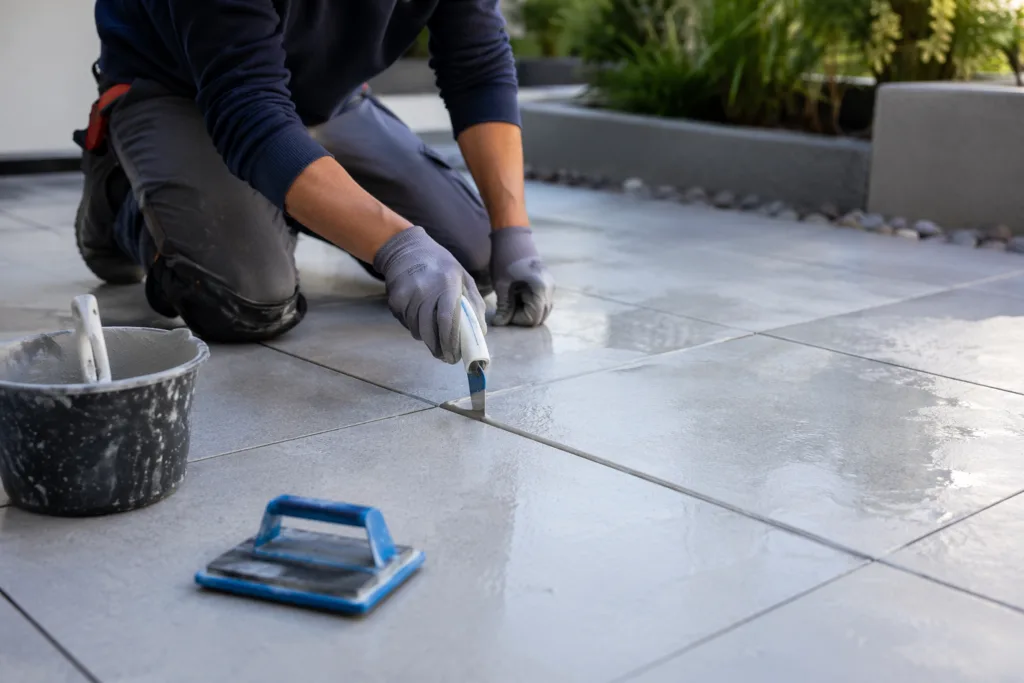
Pack the grout fully to the bottom of the joint to avoid hidden voids. On narrow joints, low-viscosity systems can improve filling, but crews should still work diagonally across the tile face and confirm complete joint loading. Remove excess promptly and complete the wash process within the recommended window. Delayed cleaning can leave film, while over-washing too early can disturb the joint surface.
Curing and reopening
Protect the area from rain, washdown, and early traffic until the grout reaches the required cure stage. Outdoor epoxy installations often fail because the project is reopened based on schedule pressure rather than actual cure condition. Reopening should reflect ambient temperature, surface temperature, and product-specific cure progression.
Quality control and acceptance testing on site
A small field mockup is one of the most practical risk-control tools for patio grout work. It allows the team to evaluate color, washability, finish texture, edge adhesion, and cleaning procedure under site conditions. For larger or more exposed projects, sample patch approval should happen before full-area installation.
- Check color consistency after cure, not only immediately after installation.
- Inspect for pinholes, voids, edge pullback, or uneven wash texture.
- Use simple indentation checks to detect under-cure where appropriate.
- Confirm that residue has been removed from textured tile faces.
- Request batch identification records for traceability.
When the project has unusual exposure, it is reasonable to request supporting test data, chemical compatibility notes, or project-specific sample evaluation from the supplier. That is especially important when the patio combines cold-weather curing, decorative color expectations, and aggressive maintenance chemicals.
Common failure modes and how to troubleshoot them
Cracking or debonding during temperature cycling
Typical causes include poor movement-joint design, trapped water, inadequate joint fill, contaminated tile edges, or a mismatch between grout rigidity and assembly movement. Corrective action starts with root-cause review. Regrouting without addressing drainage or movement will usually repeat the failure.
Staining, biological growth, or color loss
Organic buildup often points to poor cleaning routines, persistent shade moisture, or residue left during installation. Discoloration can also result from dirt captured by surface haze rather than true grout-body staining. Use cleaners that are confirmed as compatible with cured epoxy grout and avoid harsh methods that scratch the surface.
Blushing, pinholes, or incomplete cure
These issues often trace back to moisture exposure during cure, off-ratio mixing, cold substrate, or entrapped air from application technique. Localized under-cure may require removal and replacement of affected joints. Pinholes or surface porosity should be evaluated to determine whether they are only cosmetic or if they indicate incomplete packing.
Maintenance, cleaning, and repair planning
Patio grout lasts longer when maintenance is simple and consistent. Routine cleaning should remove soils before they build into textured surfaces or shaded damp zones. Use pH-appropriate cleaners where possible and rinse thoroughly. Avoid assuming that because epoxy grout is resistant to staining it needs no maintenance at all.
Local repair is often possible if deterioration is limited to isolated joints, but repair quality depends on how cleanly the failed material can be removed and whether the surrounding grout has fully stabilized in color. Full replacement is more appropriate when widespread debonding, chronic trapped moisture, or repeated movement failure is present.
Specification language and supplier questions
Architects, engineers, and procurement teams usually benefit from specification language that describes required performance rather than relying only on brand names or generic product categories. The goal is to make submittal review easier and reduce ambiguity during installation.
Sample specification points
- Epoxy grout for patios shall be suitable for exterior tile joints exposed to rain, thermal cycling, and routine cleaning.
- Product shall have stated application temperature limits, pot life, working time, and cure schedule.
- Supplier shall provide recommended joint width and depth range and cleaning procedure.
- Product shall demonstrate low water absorption and suitability for expected chemical or stain exposure relevant to the project.
- Mockup or sample patch approval shall be completed before production work where color and finish are critical.
Questions to ask a supplier
- What is the realistic pot life at the site temperature range?
- How does the grout perform after repeated wetting and drying?
- What joint widths are recommended for this tile format?
- Is the formulation optimized for cold-weather cure, fine joints, or high chemical exposure?
- What batch traceability and technical documentation are available?
- What cleaning agents are compatible after full cure?
- Can the supplier support project-specific sampling or formulation adjustments if needed?
Environmental and safety considerations
Many exterior epoxy grout systems are formulated without added solvent, but jobsite safety still matters. Crews should use gloves, eye protection, and suitable site ventilation practices where needed. Mixed and unmixed components should be handled according to the product safety documentation, and spill response should be planned before installation starts. Disposal should follow local requirements for resin-containing materials and contaminated wash media.
Lifecycle expectations and cost-performance thinking
Epoxy grout usually has a higher initial installed cost than standard cement grout, largely because the material itself costs more and the installation process is less forgiving. But on patios where water, staining, traffic, and maintenance frequency drive ownership cost, epoxy often makes sense over the life of the installation. Fewer call-backs, less staining, reduced resealing needs, and better appearance retention can offset the higher entry cost.
The practical decision is not whether epoxy grout costs more on day one. It is whether the patio will benefit from the lower absorption, easier cleaning, and longer service stability enough to justify that premium. On premium residential patios and demanding commercial terraces, the answer is often yes when the assembly is properly designed and installed.
Conclusion
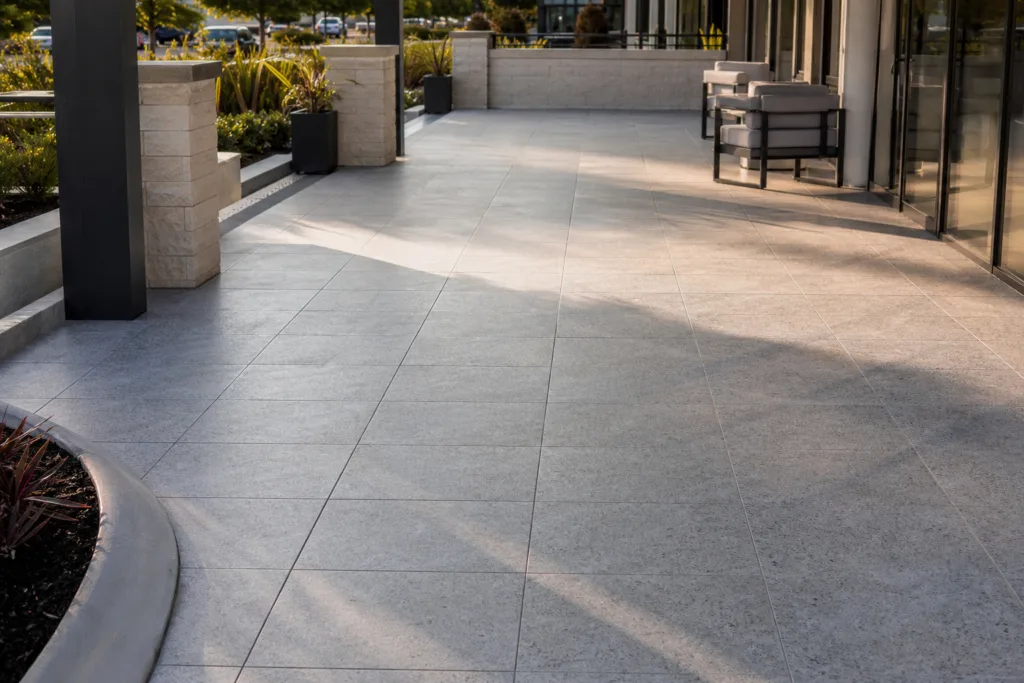
Epoxy grout for patios is a strong specification choice when the project needs low absorption, better stain control, stronger chemical durability, and more predictable long-term joint performance outdoors. The decision should be based on climate, joint geometry, tile type, drainage, movement detailing, cure conditions, and maintenance expectations rather than on generic product claims. When those factors are reviewed early, contractors and specifiers can avoid the most common outdoor grout failures and select a system that performs for the actual service environment, not just the day of installation.
FAQ
Can epoxy grout be used outdoors on patios?
Yes, epoxy grout can be used outdoors on patios when the assembly has proper drainage, movement joints, sound tile bonding, and installation temperatures within the product’s recommended range. It is especially useful where low water absorption, stain resistance, and easier cleaning are priorities.
What joint width is suitable for epoxy grout on a patio?
The suitable joint width depends on the grout formulation, filler type, and tile layout, so the product data should always be checked. In practice, narrow joints need good flow and full packing, while wider joints need enough body and filler support to prevent voids, washout, or shrink-related defects.
Will epoxy grout crack during freeze–thaw cycles?
It can if the patio has trapped moisture, poor movement detailing, inadequate joint fill, or a mismatch between grout rigidity and assembly movement. The grout itself is only one part of the system, so freeze–thaw reliability depends heavily on drainage, substrate stability, and correct joint design.
Does epoxy grout fade or yellow in sunlight?
Some color shift can occur outdoors depending on resin chemistry, pigment selection, and UV exposure intensity. If visual consistency is important, especially with light colors or decorative patios, ask for guidance on UV stability and confirm whether the product has outdoor color-retention considerations built into the formulation.
Is epoxy grout harder to install than cement grout?
Usually yes, because pot life, mixing accuracy, cleaning timing, and weather control are more critical. Crews that manage batch size, surface cleaning, and wash windows carefully usually get good results, while rushed installation often causes haze, under-cure, or inconsistent joint finish.
Can damaged epoxy grout joints be repaired without replacing the whole patio?
Often yes, if the problem is localized and the root cause is understood. Small sections can sometimes be removed and regrouted successfully, but widespread cracking, debonding, or chronic moisture problems usually require broader corrective work rather than isolated patching.