
Epoxy resin flooring is a practical choice when a floor must do more than look clean. In industrial and commercial settings, the right system has to resist traffic, chemicals, abrasion, impact, cleaning cycles, and daily operational abuse while still matching site conditions and installation constraints. From our manufacturing perspective, epoxy performs well when the substrate is properly prepared, moisture is controlled, the system thickness matches the load profile, and the specification reflects real service conditions rather than a generic product category. That is why selection should begin with function, testing, and risk reduction, not color charts or nominal thickness alone.
Explore resin flooring solutions for industrial and commercial projects if you are comparing system builds, thickness ranges, and finish options before writing a specification or approving a project scope.
Executive summary: when epoxy resin flooring is the right choice
Epoxy flooring is usually the right choice when the project requires a bonded, seamless, hard-wearing surface over concrete and the operating environment is reasonably well defined. It is especially suitable where hygiene, dust control, appearance consistency, and repairable long-term service matter. It is often specified for factories, warehouses, workshops, garages, showrooms, laboratories, plant rooms, back-of-house commercial interiors, and selected retail environments.
- Choose epoxy when you need good adhesion to prepared concrete, strong abrasion resistance, a seamless finish, and a balance between performance and installed cost.
- Choose thicker epoxy systems when forklift traffic, pallet movement, dropped tools, or mechanical wear are part of daily operations.
- Choose chemical-resistant epoxy variants when exposure includes oils, dilute acids, alkalis, cleaning agents, or process chemicals.
- Be cautious with standard epoxy if slab moisture is high, hydrostatic pressure is suspected, substrate contamination is unresolved, or UV color stability is critical.
- Consider hybrid or alternative top layers when return-to-service windows are very short or when sunlight exposure is substantial.
Who should use this guide
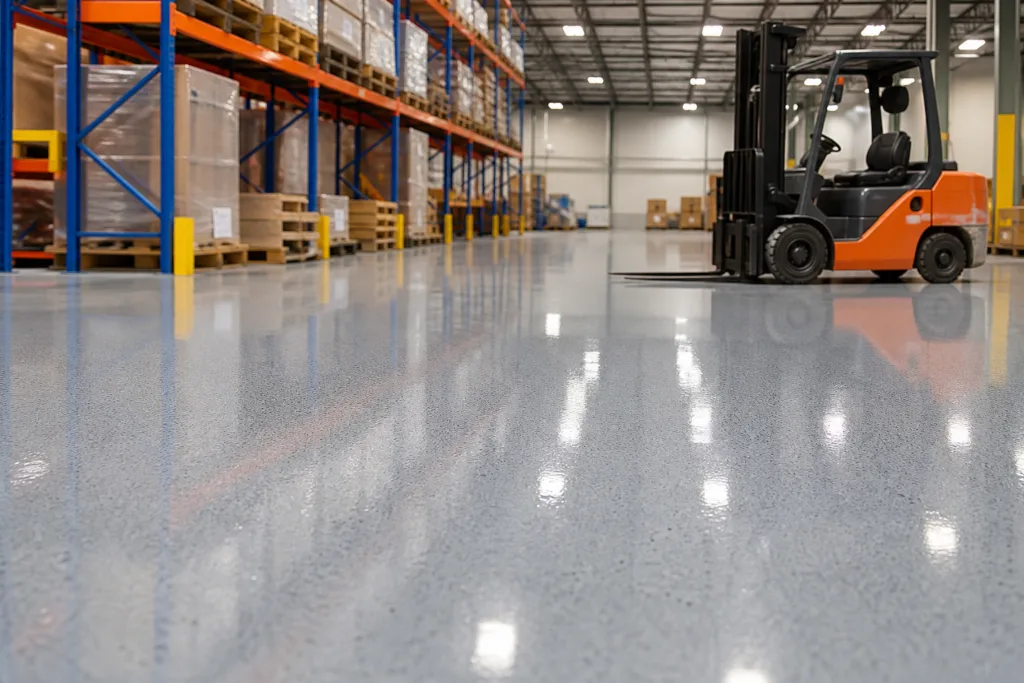
This guide is written for engineers, specifiers, facility managers, flooring contractors, procurement teams, and project managers who need to approve or reject an epoxy flooring option based on measurable criteria. It is also useful for OEM or private-label buyers evaluating whether a manufacturer can provide a standard system or a custom formulation.
The goal is simple: reduce specification risk. Rather than asking whether epoxy is generally durable, the better question is whether a particular epoxy system is suitable for your substrate, service environment, traffic profile, installation window, and maintenance plan.
Quick decision checklist
Before selecting any epoxy resin flooring system, we recommend checking the following points early in the project:
- Traffic and load: foot traffic only, pallet jacks, forklifts, steel wheels, point loads from racking, or rolling machinery.
- Chemical exposure: water, detergents, oils, fuels, acids, alkalis, battery electrolyte, solvents, or intermittent splash conditions.
- Abrasion profile: clean wheeled traffic, sand contamination, dragged pallets, metal parts, or workshop debris.
- Substrate moisture: in-situ relative humidity, calcium chloride test results, slab age, and any sign of hydrostatic pressure.
- Temperature range: installation temperature, service temperature, washdown cycles, and localized thermal shock.
- Slip resistance: dry, wet, oily, or ramp conditions and required texture level.
- Downtime tolerance: whether the client can allow standard cure time or needs a fast-return schedule.
- Aesthetic needs: smooth glossy finish, quartz broadcast, flake decorative finish, or a utilitarian heavy-duty surface.
- Special functions: ESD control, chemical containment, line marking retention, or food-area cleanability.
- Budget logic: initial installed cost versus maintenance burden and replacement frequency over 5 to 15 years.
Overview of epoxy flooring system types and where they fit
Self-leveling epoxy
Self-leveling systems are typically chosen for smooth, seamless surfaces in commercial interiors, laboratories, light manufacturing areas, and clean workshops. They provide a refined appearance and good cleanability, but they are not the first choice for severe impact or highly uneven slabs unless the substrate is corrected first. They work well where light to medium traffic is expected and visual consistency matters.
Epoxy mortar or screed
For heavy industrial floors, epoxy mortar systems are often the stronger candidate. They are built for higher thickness, better load distribution, and improved resistance to impact and mechanical abuse. Where forklifts, pallet movement, machining activity, or repeated point loading are present, mortar-based systems are usually more reliable than thin film coatings.
Broadcast quartz or flake systems
These systems are useful where abrasion resistance, slip control, and appearance all matter. Quartz broadcast floors can create a more durable wearing layer and consistent texture. Flake systems are often selected for garages, service areas, locker rooms, and commercial back-of-house spaces where decorative value and easier maintenance are both relevant.
Anti-slip textured epoxy
Ramps, wet process aisles, loading areas, and workshops with oil or water exposure often need texture rather than a smooth finish. In these cases, the floor must balance traction with cleanability. Overly aggressive texture can trap dirt and increase maintenance labor, so the profile should match the contamination risk and cleaning method.
Conductive and ESD epoxy
Electronics manufacturing, testing labs, cleanrooms, and static-sensitive assembly zones may require conductive or static-dissipative performance. These systems depend on more than the topcoat. The full build, including conductive primer paths or copper grid design where specified, must align with the target resistance range and acceptance testing plan.
Novolac and chemically resistant epoxy
Battery rooms, chemical handling spaces, maintenance bays, and process plants may exceed the resistance range of standard bisphenol-based epoxy systems. In those environments, chemically resistant epoxy formulations, including novolac-based options, are often more appropriate. Chemical exposure must be classified by concentration, temperature, dwell time, and spill frequency rather than by broad labels alone.
Key technical performance metrics to specify
Many flooring failures begin with weak specifications. A product name is not a performance standard. Good specifications identify measurable requirements, test methods, and acceptance criteria that reflect the service environment.
| Metric | Why it matters | Typical decision logic |
|---|---|---|
| Abrasion resistance | Indicates wear rate under traffic and contamination | Lower Taber mg loss is generally preferred for high-traffic floors |
| Adhesion or pull-off strength | Shows bond quality to the concrete substrate | Bond should exceed project minimums and ideally approach concrete failure in sound slabs |
| Hardness and impact resistance | Helps balance scratch resistance with toughness | Harder is not always better if impact or substrate movement is expected |
| Chemical resistance | Confirms fit for oils, cleaners, acids, alkalis, and process fluids | Review by reagent, concentration, temperature, and exposure duration |
| Moisture tolerance | Critical for slab compatibility and blister prevention | Must align with RH and MVE test results before installation |
| Cure speed and pot life | Affects application risk and return-to-service | Shorter pot life may improve schedule but requires disciplined application control |
Abrasion resistance
ASTM D4060 Taber abrasion is a common reference point. For warehouses, workshops, and production spaces, specifiers usually want lower mass loss values because the floor will face repeated wear. The exact threshold depends on the wheel type, load, and test cycle selected, so comparison must use the same test conditions. In practice, a floor facing dirty forklift traffic needs more than a low number on paper; system thickness, aggregate loading, and topcoat wear behavior also matter.
Adhesion or pull-off strength
ASTM D4541 pull-off testing is useful for bonded floors because bond failure is often more serious than surface scratching. Minimum targets vary by project, but the floor should not be specified without defining both substrate compressive condition and pull-off acceptance. Where the slab is weak or contaminated, no coating can compensate for poor substrate integrity. A sound slab and correct surface profile are prerequisites.
Hardness, flexibility, and impact resistance
Shore D hardness under ASTM D2240 helps describe surface rigidity, while impact resistance under ASTM D2794 helps indicate toughness. These metrics must be balanced. A highly hard system may scratch less, but if the floor sees impact, vibration, or slight slab movement, a brittle build can crack or chip. In our formulation work, the better approach is to match hardness and elongation to the operating environment rather than seeking the hardest possible film.
Chemical resistance protocols
Chemical resistance should be evaluated by splash, intermittent contact, full immersion, or combined exposure depending on the site. A warehouse with occasional oil drips is different from a battery charging room or a process area with acidic washdowns. Always ask for chemical compatibility information tied to concentration and temperature. General claims such as “chemical resistant” are not enough for critical areas.
Moisture testing and slab suitability
ASTM F2170 in-situ RH testing and ASTM F1869 calcium chloride testing are widely used to judge whether the slab is ready for an epoxy installation. Moisture vapor emission limits differ by system. If moisture is above the recommended threshold, a moisture-tolerant primer or vapor mitigation strategy may be needed, or the site may be unsuitable for a standard epoxy build at that time. Slab moisture is one of the most common reasons otherwise good systems fail.
Temperature, solids, VOC, and working properties
Service temperature and installation temperature should both be checked. Standard epoxy systems can soften or discolor under sustained heat, especially near ovens, hot process lines, or steam cleaning zones. Solids content and VOC limits may affect regulatory fit and film build expectations. Viscosity, thixotropy, and pot life influence whether the material can self-level properly, fill profile, hold on ramps, or wet out broadcast aggregate without defects.
In practical build-ups, a properly selected primer layer such as ZDS-1012AB epoxy primer for concrete and ceramic floors can help improve penetration, bond consistency, and substrate sealing when the concrete profile and porosity are variable.
Substrate and site conditions that determine whether epoxy is suitable
The slab usually decides more than the product brochure. Epoxy is most successful when concrete strength is adequate, laitance and contamination are removed, cracks are evaluated, and joint strategy is planned before coating begins.
Concrete age, strength, and surface profile
New concrete must be sufficiently cured and dimensionally stable. Surface profile should follow the system requirement, often referenced through ICRI CSP ranges. Thin self-leveling systems need a controlled, even profile, while mortar systems can tolerate or correct more surface irregularity. Weak surface paste, curing compounds, and dusting slabs create bond risk.
Moisture vapor and hydrostatic pressure
If hydrostatic pressure is active, a standard film-build epoxy may blister regardless of nominal adhesion values at installation. Moisture testing should be supplemented by site history, visible symptoms, and drainage review. Moisture-related risk should never be treated as a minor item in a flooring project.
Existing coatings and contamination
Oil saturation, silicone contamination, old paint, adhesive residues, and incompatible sealers all interfere with bonding. Remedial methods may include degreasing, scarification, shot blasting, localized concrete replacement, or test patches. Where legacy contamination is suspected, a mock-up area is often more valuable than assumptions.
For projects that require a balanced build between primer and topcoat, an intermediate layer such as ZDS-3136AB epoxy mid-coat for industrial and commercial floors may be used to build thickness, smooth defects, or support aggregate loading depending on the floor design.
Installation process overview and critical control points
Even high-quality materials fail when the process is uncontrolled. Installation should be treated as a sequence of measurable checkpoints rather than a single coating event.
Surface preparation methods
Shot blasting is commonly preferred for large floor areas because it creates a clean, textured profile and removes weak surface material. Diamond grinding can be effective for leveling and thin coating removal, while scarification is used when heavier removal is needed. The chosen method should leave the slab clean, sound, and profiled to suit the system thickness.
Priming, patching, body coat, and seal layers
A typical sequence includes substrate inspection, moisture testing, mechanical preparation, dust removal, priming, crack and pit repair, build or body coat application, optional aggregate broadcast, and final topcoat. Each layer must respect recoat windows and environmental limits. Recoat timing matters because intercoat adhesion can suffer if windows are missed or contamination occurs between steps.
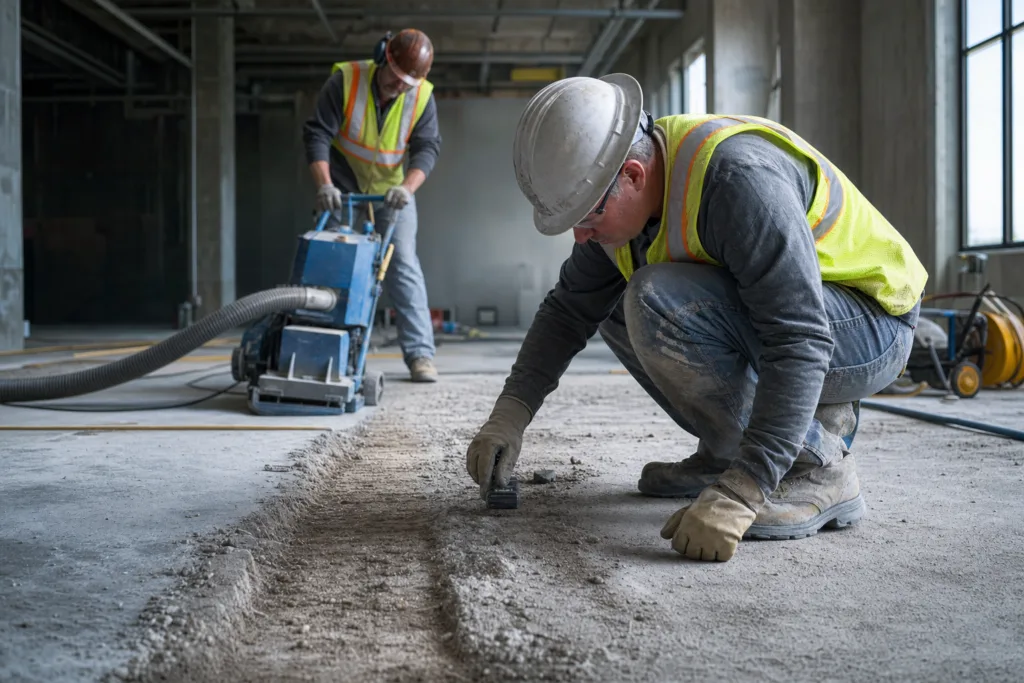
Temperature and pot-life management
Epoxy reaction speed changes significantly with temperature. High temperatures shorten pot life and increase exotherm risk in mixed material, while low temperatures slow cure and can affect flow and gloss. Batch size, mixing method, and crew planning should be aligned with actual site conditions, not only nominal laboratory values.
Layer thickness and return-to-service timing
Thin film systems may return to light foot traffic sooner, but heavy-duty service usually needs thicker build-ups and longer cure periods. Vehicle traffic, pallet jacks, or chemical exposure should not begin until the system reaches the required cure stage. Some projects needing quicker commissioning may use an epoxy base with a faster finishing layer; for example, ZDS-1223AB polyaspartic clear topcoat for fast-return floors can be considered where schedule pressure is a major constraint and the system design supports it.
Common installation mistakes and how to avoid them
- Skipping moisture assessment: leads to blistering, osmotic pressure issues, and debonding.
- Inadequate surface preparation: the most common cause of adhesion failure.
- Wrong system for the traffic profile: thin decorative build used in forklift areas.
- Poor mixing control: creates soft spots, gloss variation, or incomplete cure.
- Overextending pot life: causes poor leveling, roller marks, and weak film formation.
- Ignoring joints and cracks: reflective cracking and edge failure appear early.
- Premature service return: traffic before full cure shortens floor life.
From our manufacturing perspective, the best QA checkpoint sequence includes substrate inspection records, moisture test documentation, environmental logs, batch traceability, wet film thickness checks where relevant, pull-off verification on mock-up areas, and a signed acceptance standard for finish appearance.
Life-cycle cost and comparison with alternatives
Epoxy is often selected because it sits in a useful middle ground between performance and cost. However, the right comparison should include maintenance, shutdown cost, and replacement frequency.
| System | Strengths | Tradeoffs |
|---|---|---|
| Epoxy | Good bond, chemical resistance, seamless finish, cost-effective for many sites | UV yellowing, moisture sensitivity on poor slabs, moderate cure time |
| Polyurethane | Better flexibility and thermal shock resistance in some environments | Different cost structure and application behavior |
| MMA | Very fast return-to-service | Application complexity, odor, and project controls may be stricter |
| Polished concrete | Low film-build, attractive in some spaces | Limited chemical barrier and different repair logic |
| Vinyl tile | Fast aesthetic upgrade in light-duty interiors | Seams, lower heavy-duty durability, adhesive dependence |
For many factories, warehouses, and garages, epoxy remains attractive because repairs can be localized, system thickness can be tailored, and the floor can be engineered around both wear resistance and budget. In our view, the correct question is not whether epoxy is cheaper at installation, but whether it provides the lowest operational disruption over its intended life.
Environmental, health, safety, and regulatory considerations
VOC limits, ventilation planning, worker protection, and disposal procedures should be reviewed before application. Low-VOC or high-solids systems may reduce emissions, but installers still need appropriate PPE, mixing controls, and site ventilation. Fire-rating needs, food-area compliance requirements, and local regulatory restrictions should be addressed in the specification phase, not after product approval.
For high-wear service zones, the selected wearing layer matters as much as the underlying coats. A finishing layer such as ZDS-4220AB industrial epoxy floor topcoat for high-wear areas may be relevant where abrasion, cleaning cycles, and appearance retention are key decision factors.
Real-world use profiles
Factory with heavy forklift traffic
A thin self-leveling floor is rarely enough. A thicker epoxy mortar or heavily built broadcast system is usually more suitable, with special attention to impact points, turn zones, and rack aisle wear lines.
Warehouse with pallet racking
Point loads and repetitive wheel traffic often justify a heavier-duty build than the client first expects. Joint treatment and slab flatness also influence long-term performance.
Automotive workshop
Oil resistance, tire marking tolerance, cleaning chemical resistance, and anti-slip balance matter more than decorative finish alone. Localized repairability is also important.
Commercial retail interior
A self-leveling or decorative flake/quartz system may be suitable where aesthetics and cleanability are prioritized and traffic is mostly pedestrian. UV exposure near glazed façades should still be considered.
Garage or service bay
Exposure to oil, road salts, hot tires, and occasional impact means the system should be chosen for chemical tolerance and adhesion, not only appearance. Moisture testing is still essential even in smaller projects.
Specification checklist and acceptance items
- Define substrate strength and required surface preparation method.
- State moisture test methods and maximum acceptable limits before installation.
- Specify system type, nominal dry film thickness, and layer sequence.
- Set adhesion acceptance criteria and mock-up requirements.
- List required chemical resistance exposures by actual reagent and concentration.
- Define slip resistance expectations for dry and wet service areas.
- Include curing windows before foot traffic, wheeled traffic, and chemical exposure.
- Require batch traceability, technical data sheets, and application instructions.
A short specification snippet may read as follows: bonded epoxy flooring system over mechanically prepared concrete, substrate moisture within manufacturer limits, primer plus body coat plus topcoat build, slip profile suited to service area, pull-off bond meeting project threshold, and mock-up approved before full installation. The exact numbers should be tailored to the site and verified with the selected manufacturer.
How to evaluate a manufacturer or system supplier
Engineers and buyers should evaluate more than a single product sheet. The manufacturer should be able to explain resin chemistry, recommend system adjustments for site conditions, provide consistency in batch production, and support trial installations when the project has unusual risks.
- Production capability for repeatable batch quality
- Technical documentation and test reference transparency
- Ability to customize formulation for chemical, cure, or viscosity requirements
- Support for primers, mid-coats, aggregates, and topcoats as a coherent system
- Lead time reliability and sample availability
- Troubleshooting support before and after installation
At ZDSpoxy, we see the most successful projects when the buyer shares operating conditions early, including moisture data, traffic type, cleaning chemicals, and return-to-service limits. That allows system design to be based on evidence rather than assumptions.
Samples, pilot panels, and trial installations
For critical projects, ask for technical data sheets, application guides, compatibility notes, sample panels, and where needed, a site mock-up or pilot area. Trial sections are especially useful when substrate history is unclear, gloss expectations are strict, or anti-slip texture needs to be tuned for both safety and cleanability.
Troubleshooting common failures and repair strategies
Delamination
Usually caused by poor preparation, contamination, or moisture. The repair scope depends on whether the failure is isolated or systemic. Local grinding and patching may work for small areas, but widespread bond loss often requires broader removal.
Blistering
Often linked to moisture vapor, trapped air, or rising slab temperature during application. The fix may require moisture mitigation rather than simple recoating.
Yellowing or gloss change
Standard epoxies can amber under UV exposure. This is often aesthetic rather than structural, but if color retention is important, the top layer or system chemistry should be adjusted.
Localized wear paths
These usually indicate that traffic concentration exceeded the original design. A heavier maintenance topcoat or localized reinforcement can extend service life if addressed early.
Maintenance practices that extend floor life
Maintenance should be written into the operating plan, not left to housekeeping improvisation. Use cleaning chemicals compatible with the floor, remove abrasive debris quickly, inspect joints and high-turn areas regularly, and repair chips or wear zones before contamination reaches the substrate. For industrial floors, a simple quarterly inspection and annual condition review can significantly improve lifecycle performance.
Decision matrix for selecting the right epoxy floor
| Site condition | Likely epoxy choice | Key minimum focus |
|---|---|---|
| Light commercial interior | Self-leveling epoxy | Appearance, cleanability, moderate abrasion resistance |
| Forklift manufacturing area | Epoxy mortar or heavy broadcast | Thickness, impact resistance, strong bond, wear control |
| Wet ramp or wash area | Textured anti-slip epoxy | Slip profile, drainage logic, cleanability |
| Battery or chemical room | Chemically resistant epoxy | Reagent-specific compatibility, joint detailing |
| Electronics assembly | Conductive or ESD epoxy | Resistance range, full-system testing, maintenance discipline |
Conclusion
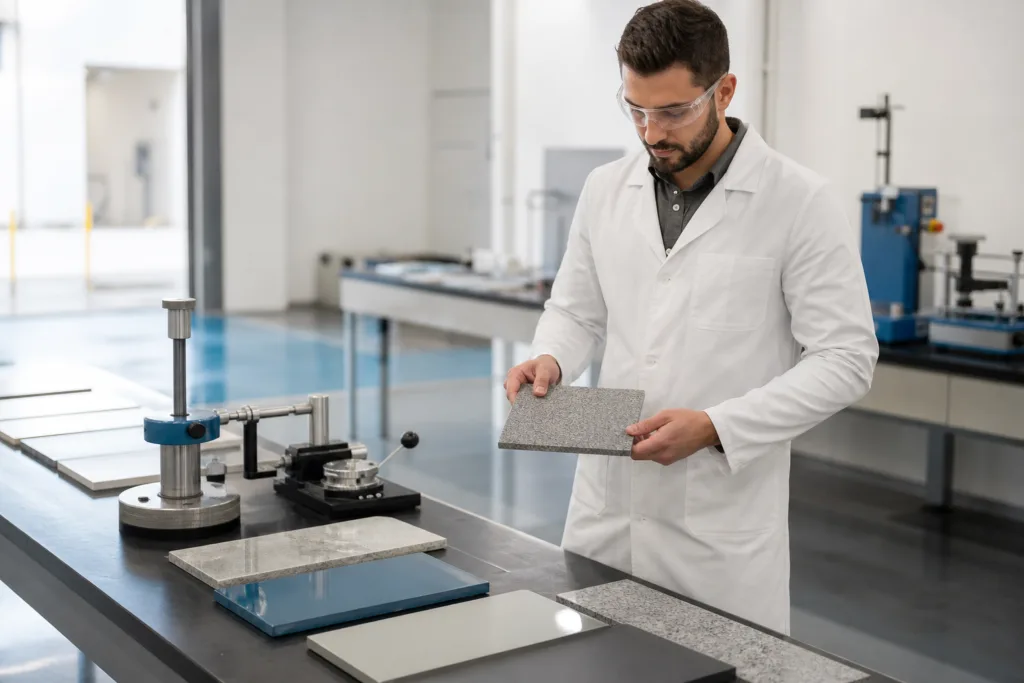
Epoxy resin flooring is the right choice when the floor needs a durable, bonded, seamless surface and the project team is prepared to match system design to real service conditions. The decision should be based on traffic, chemicals, moisture, substrate quality, cure window, and maintenance expectations. A good outcome usually depends less on broad claims about epoxy and more on disciplined specification, site testing, mock-ups, and manufacturer-backed quality control. For industrial and commercial floors, those steps turn epoxy from a generic category into a reliable engineered system.
Frequently Asked Questions
When is epoxy resin flooring better than polished concrete?
Epoxy resin flooring is usually the better option when you need a true chemical barrier, a seamless surface, more controlled slip texture, or a higher-build system that can bridge minor surface variation and improve cleanability beyond what polished concrete typically offers.
Can epoxy flooring be installed on damp concrete?
It depends on the measured moisture condition and the specific system limits, because some epoxy systems tolerate more slab moisture than others, but installation should never proceed without documented testing such as in-situ RH or calcium chloride results and a manufacturer-approved moisture strategy.
What thickness is usually needed for industrial epoxy floors?
The required thickness depends on traffic, impact, and substrate condition, with light-duty coatings needing far less build than mortar or broadcast systems used in forklift zones, so thickness should be selected from the service profile rather than a single default number.
How do specifiers confirm that an epoxy floor is properly bonded?
Bond is commonly verified through pull-off testing, substrate inspection, and mock-up approval, and the results should be reviewed alongside surface preparation records and concrete condition because a good bond requires both a sound slab and a correctly applied system.
Is standard epoxy suitable for areas with frequent chemical spills?
Not always, because standard epoxy may perform well with oils and cleaning chemicals yet be unsuitable for concentrated acids, alkalis, solvents, or hot chemical exposure, which is why chemical compatibility should be checked by actual reagent, concentration, and contact conditions.
What should buyers ask a flooring manufacturer before approval?
Buyers should ask for the full system build, technical data sheets, installation guidance, moisture and substrate limits, cure times, chemical resistance notes, sample or mock-up support, and clear quality documentation so the project can be approved on evidence rather than assumptions.
Related Reading
- What Is Resinous Flooring? a manufacturer’s guide to resin floor systems
- Resin Flooring vs Epoxy Flooring: comparison and selection guide
- ESD anti-static epoxy flooring solutions for electronics and cleanrooms
- Chemical-resistant resin flooring options for factories and warehouses
- Decorative resin flooring systems for commercial interiors