
In industrial and commercial facilities, grout is often treated as a small line item until failure disrupts equipment alignment, contaminates wet areas, or forces shutdowns for repair. That is usually where the difference between standard cement grout and high performance epoxy grout becomes very clear. Cement-based products can be suitable in many general construction situations, but when loads are high, chemicals are present, moisture is persistent, or dimensional stability matters, resin-based systems often provide a much more reliable specification path. From our manufacturing perspective, grout selection should be tied to actual service conditions rather than tradition, because most grout failures start with a mismatch between exposure profile and material design.
Compare epoxy grout system options for heavy-duty installations before finalizing a specification, especially when the project involves machine bases, aggressive cleaning chemicals, immersion, impact, or tight production schedules where rework would be expensive.
This guide is written for engineers, procurement teams, contractors, and project managers who need specification-ready logic rather than broad marketing claims. We will focus on where cement grout tends to fail, what defines a high-performance resin system, how to read technical performance data, and how to specify the right epoxy grout for heavy equipment, sanitary areas, water exposure, marine environments, and industrial flooring details. The aim is practical decision support: measurable properties, failure-mode analysis, installation variables, and supplier evaluation criteria that reduce risk.
Where standard cement grout becomes inadequate
Standard cement grout usually fails in demanding service for predictable reasons. Its limitations are not simply about compressive strength on a datasheet. Real failures more often involve a combination of shrinkage, low chemical durability, microcracking under cyclic loading, water ingress, and bond loss at the interface with concrete or steel. In heavy-duty facilities, those combined stresses are common.
Typical failure conditions include:
- Heavy machinery bases with vibration, impact, anchor bolt stress, and alignment sensitivity
- Chemical process zones exposed to acids, alkalis, oils, solvents, or aggressive washdowns
- Sanitary and food-related areas where constant cleaning and moisture cycling attack porous materials
- Marine decks and submerged details where prolonged water exposure undermines cementitious systems
- Floor-mounted equipment in warehouses and plants where wheel traffic, thermal movement, and point loading concentrate stress
- Wet service joints where moisture penetration causes staining, cracking, debonding, or freeze-thaw damage in some climates
In these conditions, cement grout can initially appear acceptable because it fills the space and hardens. The problem is long-term stability. Shrinkage can reduce bearing contact. Porosity allows water and chemicals to enter. Repeated loading can generate fatigue cracking. Once cracks form, chemical attack and moisture penetration accelerate damage. For procurement and engineering teams, this is why the true evaluation should focus on lifecycle performance, not only initial placement cost.
What defines high-performance epoxy grout

High-performance means more than being resin-based. A grout should be considered high performance when its formulation is intentionally built for mechanical load transfer, dimensional stability, adhesion, chemical durability, and service-specific installation conditions. In specification work, the most useful performance categories are compressive strength, flexural strength, tensile or bond strength, shrinkage behavior, modulus, elongation, chemical resistance, water resistance, and thermal stability.
For many industrial applications, relevant targets may include:
- High compressive strength for bearing and load transfer under machine bases and columns
- Strong bond to prepared concrete and steel to reduce interface failure risk
- Low shrinkage to maintain full support and alignment
- Improved fatigue resistance under cyclic or vibrating loads
- Low permeability for wet and sanitary environments
- Resistance to selected chemical classes at known concentrations and temperatures
- Controlled viscosity for either deep pours, tight gaps, or non-sag joint filling
- Predictable cure schedule that matches installation windows and return-to-service needs
Not every project needs the same balance. A high-strength machine grout may prioritize stiffness and compressive performance, while a wet-service grout may need stronger moisture tolerance and lower sensitivity to substrate condition. In our formulation work, this is one of the most important distinctions: a product that performs well in dry foundation grouting may not be the right system for submerged, chemically exposed, or fast-turnaround repair work.
Epoxy chemistry choices and why they matter
The resin backbone influences how the grout behaves under chemical, thermal, and mechanical stress. Buyers do not need to become chemists, but understanding the broad chemistry types helps when comparing supplier data.
Bisphenol A epoxy systems
These are common in general industrial formulations because they offer a good balance of adhesion, strength, cost, and processability. They can work well for many standard heavy-duty grouting applications where chemical exposure is moderate and temperature demands are controlled.
Novolac epoxy systems
Novolac-based formulations are often considered when chemical resistance and elevated temperature performance become more demanding. They can be useful in process areas exposed to harsher chemicals or where cleaning regimes are more aggressive. The trade-off may include different viscosity behavior, cost, and installation sensitivity.
Cycloaliphatic and specialty systems
These are selected more selectively for specific performance needs such as improved weathering, electrical properties, or other niche requirements. They are not automatically better for every grout job, but they can solve a narrow exposure problem when standard systems are inadequate.
High-temperature formulations
Where thermal cycling, hot process lines, or radiant heat affect the grout zone, heat resistance must be engineered into the system. That usually means reviewing both short-term and long-term temperature limits, not just a single headline value. High temperature also changes modulus, bond stress, and chemical behavior, so performance should be checked as a package.
Fillers, aggregates, and formulation design
The aggregate package is not a minor detail. Engineered fillers and graded particle systems control shrinkage, thermal behavior, flow, density, abrasion resistance, and even exotherm in larger pours. A well-designed grout uses the resin and filler system together, not as separate decisions.
| Formulation element | Main role | Specification impact |
|---|---|---|
| Graded mineral aggregate | Reduces shrinkage and improves load transfer | Better dimensional stability in thick sections |
| Fine fillers | Adjusts flow and packing density | Improves gap filling and surface contact |
| Thixotropic additives | Controls sag and vertical hold | Useful for joints or non-level details |
| Conductive or specialty fillers | Adds functional properties | Relevant for static control or specialized OEM needs |
| Toughening components | Improves impact or fatigue behavior | Can reduce brittle failure in dynamic loading |
For machine base applications, heavily filled systems often provide better bearing stability and lower shrinkage. For narrow gaps or fine seam work, a lower-viscosity approach may be more suitable. This is where product selection becomes application-specific rather than brand-driven. For example, a system such as ZDS-4130AB high-compressive epoxy grout for heavy machinery bases suits situations where compressive performance and support under severe mechanical loads are central to the design.
Curing behavior, viscosity, and pot life
Many site failures start before cure is complete. Pot life, working time, viscosity, and exotherm all affect whether the mixed grout actually reaches the intended place in the intended condition. A grout may have excellent cured properties on paper and still fail if its handling profile does not match the installation method.
Key curing and handling variables include:
- Ambient and substrate temperature
- Mix volume and resulting exotherm
- Gap depth and pour thickness
- Crew speed and placement method
- Need for flowability versus anti-sag control
- Required return-to-service timing
Fast-set systems can reduce downtime, but they also narrow the working window. Extended-pot-life systems help with large pours or complex geometry, but they may delay early strength development. Engineers should request not only final cure data, but also strength development over time at realistic site temperatures. Procurement teams should also verify packaging configuration, because package size can influence heat build-up and mixing control.
Moisture, wet substrates, and bond reliability
Moisture is one of the most underestimated specification variables in grouting. A dry-lab bond value is useful, but field performance depends on actual substrate condition. Some projects involve recently cast concrete, high ambient humidity, active seepage, splash zones, or fully submerged repairs. Those conditions require either a moisture-tolerant grout, a compatible primer, strict drying controls, or a combination of these measures.
Good practice usually involves checking:
- Whether the substrate contains free water, only residual dampness, or active moisture transmission
- Whether a moisture-tolerant primer is needed to stabilize bond performance
- Whether substrate temperature is above dew point and stable during cure
- Whether surface contamination includes laitance, oil, salts, or old coatings
When damp concrete cannot be fully dried, a primer strategy becomes critical. In those cases, a material such as ZDS-2870AB high-adhesion epoxy primer for wet concrete and challenging substrates can help improve interface reliability before grout placement, provided the system compatibility and site sequence are properly reviewed.
For submerged or continuously wet service, the grout itself must also be selected for that exposure rather than relying only on surface preparation. A product like ZDS-1417AB high-strength underwater epoxy grout for submerged applications reflects the kind of formulation logic needed when immersion is not incidental but continuous.
Chemical exposure mapping and compatibility logic
Chemical resistance data should be read carefully. A statement such as resistant to acids or resistant to solvents is too broad for specification use. Real compatibility depends on chemical class, concentration, temperature, immersion time, spill frequency, and mechanical cleaning method. A grout near a dosing skid may face occasional splash, while a tank perimeter detail may experience repeated pooling and hot washdown. Those are different exposure profiles.
| Exposure type | Main risk to grout | What to verify |
|---|---|---|
| Dilute acids | Surface softening or gradual attack | Concentration range, temperature, splash vs immersion |
| Alkalis and caustics | Chemical degradation and bond loss | Cleaning cycle frequency and dwell time |
| Hydrocarbons and oils | Swelling, staining, softened matrix in some systems | Continuous contact or intermittent spill |
| Solvents | Rapid polymer attack in incompatible systems | Specific solvent family and concentration |
| Salt water and process water | Water ingress, osmotic pressure, interface damage | Immersion duration and temperature |
If chemical attack is severe, the grout may need to work as part of a system with a chemical-resistant coating or top layer. In aggressive wet process zones, ZDS-2186AB chemical-resistant underwater epoxy coating for aggressive environments illustrates how the protective chemistry above or around the grout can matter as much as the grout itself.
Mechanical loading, fatigue, and stiffness selection
For equipment bases and anchor bolt zones, a grout must do more than resist crushing. It must transfer load without excessive creep, maintain bearing contact, tolerate vibration, and support alignment over time. This is why fatigue behavior, bond integrity, and stiffness are often more meaningful than a single peak compressive value.
Design teams should consider:
- Static compressive load versus dynamic load
- Shear stress at concrete and steel interfaces
- Anchor bolt tension and vibration transfer
- Need for high modulus versus some toughness
- Thermal movement between equipment and substrate
A very rigid grout can provide strong support under heavy machinery, but if the system is too brittle for the movement profile, edge cracking or interface stress can still develop. Conversely, too much flexibility may compromise alignment and load transfer. The correct balance depends on the equipment, footprint geometry, and service environment. From a manufacturer standpoint, the right question is not simply how strong is it, but what stress mode is dominant over the service life.
Thermal cycling, UV, and environmental constraints
Thermal exposure affects epoxy grout in several ways. It changes cure speed during installation, alters modulus and bond stress during service, and can create mismatch between the coefficient of thermal expansion of grout, concrete, and steel. Repeated heat-up and cool-down cycles are often more damaging than a brief temperature peak.
Where grout is exposed outdoors or near sunlight, UV stability can also matter. Most structural grouts are not selected primarily for color retention, but surface chalking or yellowing may still be relevant in visible commercial settings. More importantly, exterior exposure usually comes with moisture and temperature cycling, so the combined environmental profile should guide material choice.
When buyers ask ZDSpoxy about high-temperature or exterior-use grout, we usually shift the discussion away from one temperature number and toward the full service pattern: peak temperature, continuous temperature, cycling frequency, wet-dry alternation, and whether a protective topcoat is needed.
Tests and acceptance criteria worth requiring
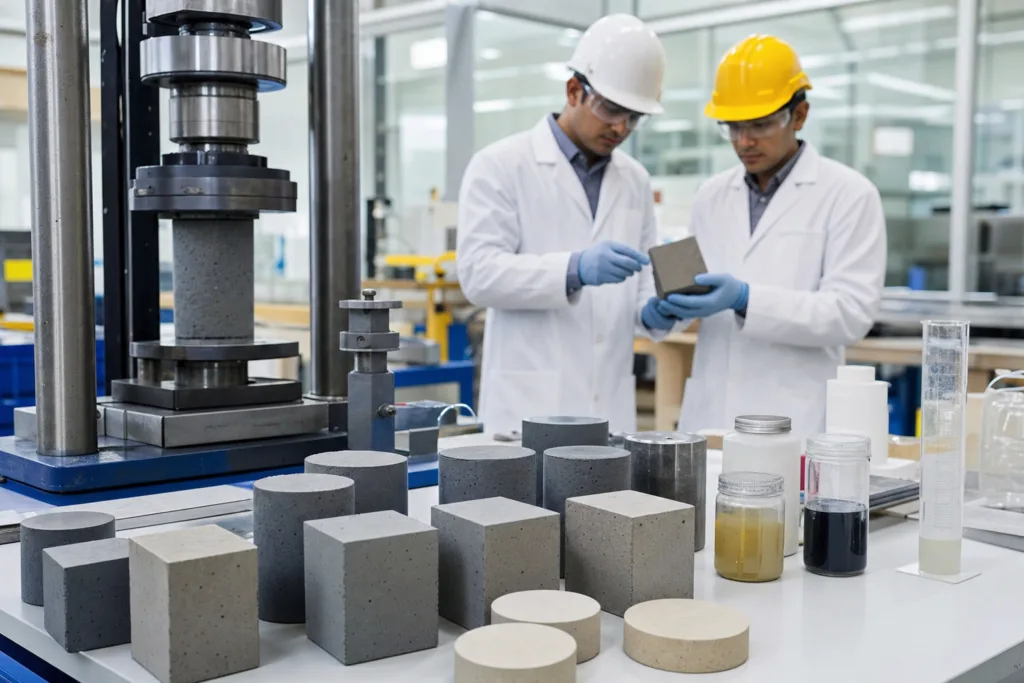
Specification documents should require test data that actually relates to the service conditions. Generic brochures are not enough. A supplier should be able to provide test methods, sample preparation basis, cure conditions, and enough information to interpret results responsibly.
Useful acceptance categories may include:
- Compressive strength development and final compressive strength
- Flexural and tensile or bond strength
- Shore hardness where relevant to the system design
- Chemical resistance by chemical class and exposure method
- Thermal stability or heat deflection related indicators where applicable
- Water absorption or permeability related data
- Shrinkage behavior and dimensional stability
- Density and filler ratio consistency for production control
Project teams should also request clarification on cure conditions. A value obtained after extended warm cure may not represent field performance in a cool plant turnaround. If the application is critical, mock-up testing or site trials can be justified before full rollout.
Installation best practices from a manufacturer perspective
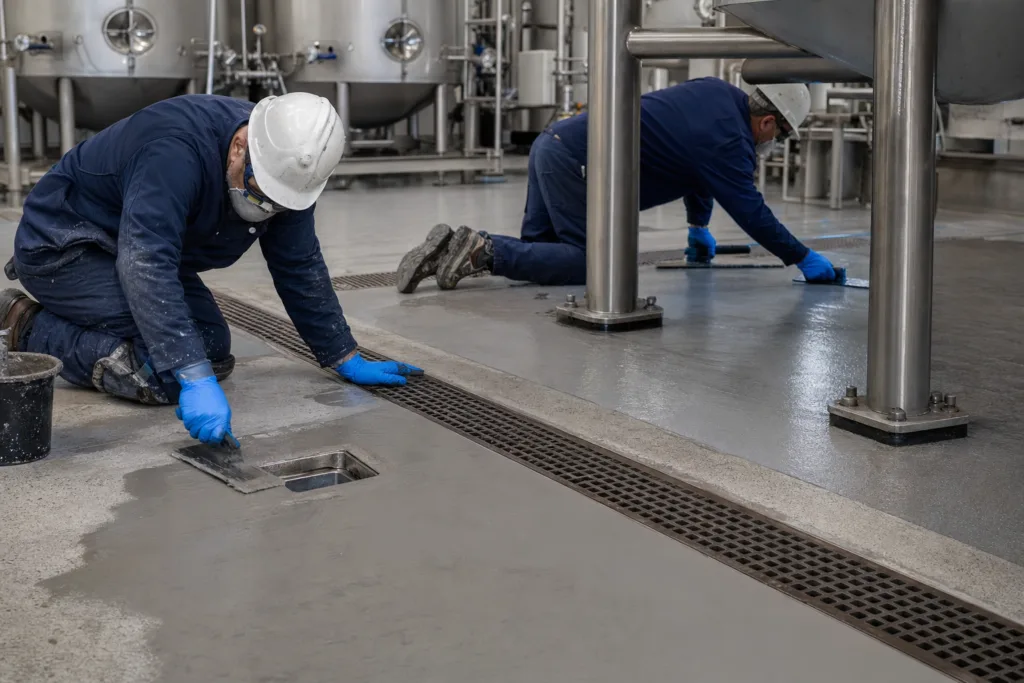
Even a well-selected material can fail through poor installation. Most avoidable problems come from substrate contamination, inaccurate mixing, poor temperature control, or premature loading. The core installation logic is simple: create a clean, sound profile, keep the interface stable, mix accurately, place within pot life, and protect the cure.
Surface preparation
Remove weak concrete, laitance, oil, curing compounds, salts, and old coatings. Achieve a sound profile that allows mechanical interlock and clean bonding. Steel contact areas should also be prepared to the required cleanliness and roughness for the specified system.
Mixing control
Use the full manufacturer-defined mix ratio. Partial mixing without strict weighing often causes soft spots, incomplete cure, or inconsistent strength. Mechanized mixing can improve consistency on larger jobs, but it must not introduce excessive air.
Temperature management
Store materials within the recommended range, monitor substrate temperature, and avoid application when condensation risk is present. In cool conditions, warming materials may improve flow, but overheating shortens working time.
Placement and consolidation
Flowable systems should be guided to avoid air entrapment and dead zones. Thick sections need attention to exotherm control and lift planning. Not all epoxy grouts should be vibrated, so the placement method must match the formulation.
Cure protection
Protect from water, contamination, impact, and early loading until the required strength milestone is reached, not merely until the surface feels hard.
Common mistakes that drive failure
The most common failure causes we see are specification and installation issues rather than inherent resin defects. They include:
- Using cement grout in a chemical or immersion environment where it was never likely to last
- Choosing a high-strength epoxy without checking viscosity and placement suitability
- Ignoring active moisture or poor surface dryness control
- Mixing partial units inaccurately
- Applying outside the recommended temperature window
- Loading equipment before adequate cure development
- Assuming chemical resistance is universal rather than chemical-specific
- Failing to account for thermal movement and stiffness mismatch
These issues are preventable when the specification includes both material requirements and installation controls.
Maintenance, inspection, and repair planning
High-performance grout is often specified to reduce maintenance, but low maintenance is not the same as no inspection. Critical equipment bases, wet joints, and chemical-exposed details should be checked periodically for edge cracking, bond line separation, softening, discoloration linked to attack, and movement around anchors or supports.
Minor defects may be repairable with compatible epoxy repair compounds or local re-grouting after proper removal of damaged material. The decision to reclaim or replace usually depends on whether the damage is superficial, localized, and non-structural, or whether it indicates broader interface failure. If chemical attack is the root cause, replacement with the same chemistry will not solve the problem. The exposure profile must be re-evaluated.
Lifecycle cost and selection economics
Initial material cost often makes epoxy grout look expensive compared with cement grout. That comparison is incomplete. The better comparison is total installed value over the service period, including downtime, alignment loss, contamination risk, repair labor, and replacement frequency.
| Decision factor | Standard cement grout | High-performance epoxy grout |
|---|---|---|
| Upfront material cost | Lower | Higher |
| Dimensional stability | Moderate to low in demanding conditions | Typically higher |
| Chemical resistance | Limited | Can be engineered for target exposure |
| Downtime risk from failure | Higher in severe service | Often lower when properly specified |
| Maintenance frequency | Potentially higher | Often lower |
| Suitability for immersion or aggressive washdown | Often poor | Much better with correct formulation |
If an equipment shutdown costs more than the material upgrade, the specification decision usually shifts quickly. This is why industrial buyers increasingly evaluate grout as a reliability component rather than a commodity filler.
Custom formulation and supplier evaluation
Some projects need more than an off-the-shelf grout. OEM packaging, private label production, controlled viscosity, color, conductivity, anti-sag behavior, cure speed, or hardness tuning may all matter. In those cases, the manufacturer’s formulation capability becomes part of the specification value.
A practical supplier checklist should include:
- Can the supplier provide batch-level traceability and QC records?
- Are compressive, bond, chemical, and curing data available under stated test conditions?
- Can viscosity or pot life be adjusted for the intended installation method?
- Can the supplier support moisture-tolerant or underwater applications?
- What is the minimum order quantity for custom systems?
- How are packaging sizes selected relative to mix control and exotherm?
- Is pre-project sample testing available?
- Can the supplier help align primer, grout, and topcoat compatibility?
- What are realistic production lead times?
- What technical support is available during trial or rollout?
These questions are often more useful than broad claims about product quality. For engineers and procurement teams, a supplier who can explain trade-offs clearly is usually easier to specify with confidence.
Troubleshooting common failures
When grout fails, the visible symptom is only the starting point. Good troubleshooting separates the symptom from the root cause.
| Observed issue | Likely root cause | Corrective direction |
|---|---|---|
| Delamination from concrete | Poor preparation, moisture, contamination, wrong primer strategy | Remove unsound material, reprepare surface, use compatible moisture strategy |
| Soft or tacky zones | Incorrect mix ratio or poor mixing | Remove affected grout and reinstall with controlled mixing |
| Chemical softening | Incompatible resin chemistry | Reassess exposure and upgrade chemical resistance package |
| Cracking at edges or anchors | Shrinkage, overload, thermal stress, brittle system mismatch | Review load path, geometry, and toughness requirements |
| Voids or incomplete fill | Viscosity mismatch, air entrapment, poor placement method | Revise flow design and placement sequence |
Specification-ready language and case-based thinking
For project documents, short-form requirements can define the system quickly: epoxy grout, low-shrinkage, high bond strength, suitable for the stated chemical and moisture environment, with supplier-submitted test data for compressive strength, bond, chemical resistance, and cure schedule. Long-form specifications should add substrate preparation requirements, primer compatibility, placement temperature range, acceptance criteria, and early loading restrictions.
It also helps to think in case terms. A crusher base may prioritize compressive load transfer and fatigue resistance. A submerged utility detail may prioritize underwater bond reliability and water resistance. A sanitary washdown area may require chemical resistance plus non-absorbent service behavior. The same product should not be assumed to serve all three equally well without evidence.
Conclusion
High performance epoxy grout is not necessary for every job, but it becomes highly valuable when failure carries operational, structural, or hygiene consequences. Standard cement grout usually falls short where vibration, immersion, chemical exposure, thermal cycling, or low-permeability requirements dominate. The most reliable specification process starts with service conditions, then aligns resin chemistry, filler design, viscosity, cure profile, and installation controls to those conditions. For engineers, contractors, and procurement teams, the goal is not simply to choose a stronger grout, but to specify a resin system that remains stable under real-world stress over time.
FAQ
When should high performance epoxy grout be specified instead of cement grout?
It should be specified when the application involves high mechanical loads, vibration, chemical exposure, sustained moisture, immersion, or strict dimensional stability requirements, because these are the conditions where cement grout is more likely to crack, shrink, absorb liquids, or lose bond over time.
What properties matter most when comparing epoxy grout systems?
The most useful properties are compressive strength, bond strength, shrinkage behavior, chemical resistance, water resistance, viscosity, pot life, cure speed, and the balance between stiffness and toughness, since those factors determine how the grout will perform during installation and under service loads.
Can epoxy grout be applied to damp or wet concrete?
Some epoxy grout systems can be used on damp or wet substrates, but success depends on the degree of moisture, surface condition, and whether a compatible moisture-tolerant primer is required, so the substrate condition should always be evaluated before product selection.
How do engineers verify chemical resistance for a grout specification?
They should ask for chemical resistance data tied to the exact chemical class, concentration, temperature, and exposure method, because broad statements about acid or solvent resistance are not specific enough for a reliable industrial specification.
Why does pot life matter so much in epoxy grout installation?
Pot life controls how long the mixed material remains workable, so if it is too short for the volume, temperature, or placement complexity, the grout may thicken too quickly, trap air, fail to fill properly, or develop inconsistent cured properties.
What should buyers ask an epoxy grout manufacturer before purchase?
Buyers should ask for batch traceability, compressive and bond test data, chemical compatibility information, cure schedule details, substrate preparation requirements, packaging options, installation guidance, and whether the formulation can be adjusted for specific viscosity, moisture, or turnaround needs.
Related Reading
- epoxy grout applications and typical industrial use cases
- heavy machinery foundation grouting best practices
- tight-gap low-viscosity epoxy grouting for fine seam filling
- Waterproof epoxy grout: performance, chemical resistance and wet-area guidance
- Epoxy grout vs cement grout: choosing the right system for durability and maintenance