
Marine epoxy resin is a two-part thermosetting system formulated for demanding water-exposed environments where reliable adhesion, low shrinkage, structural strength, and long-term moisture resistance matter. In practical marine work, it is used for fiberglass lamination, wood saturation, core bonding, crack filling, deck waterproofing, metal-to-composite bonding, fairing, and electrical encapsulation. For contractors, OEMs, repair yards, and procurement teams, the important question is not just what marine epoxy resin is, but which formulation profile fits the substrate, exposure, cure conditions, and performance target of the job.
Explore epoxy systems for boat repair, waterproofing, and composite construction when you need a starting point for comparing resin families, application methods, and formulation options for marine projects.
What marine epoxy resin means from a manufacturer perspective
From our manufacturing perspective, marine epoxy resin is not one single product. It is a family of epoxy systems built around epoxy base resins and matched hardeners, often modified with reactive diluents, flexibilizers, fillers, wetting aids, anti-sag agents, or curing accelerators depending on the application. The resin and hardener react to form a crosslinked polymer network. That network is what gives epoxy its combination of adhesion, cohesive strength, dimensional stability, and chemical resistance.
In marine environments, formulation details matter more than the generic label. A low-viscosity laminating resin for wet layup behaves very differently from a thixotropic gap-filling adhesive. A fast-cure repair system used in field conditions behaves differently from a slow-curing shop resin designed to maximize wet-out and reduce exotherm in thicker laminates. Buyers should therefore evaluate marine epoxy by use case, not by name alone.
Typical marine systems include:
- Laminating resins for fiberglass reinforcement, wood sheathing, and composite build-ups.
- Structural adhesives for core bonding, tabbing, and load-bearing joints.
- Fairing compounds and putties for profile correction and surface finishing.
- Penetrating or primer-style epoxies for porous wood or degraded timber before rebuild work.
- Moisture-tolerant repair systems for less controlled site conditions.
- Encapsulation and potting systems for electrical components exposed to vibration and humidity.
The common thread is durability in wet service, but the formulation balance between hardness, flexibility, cure speed, viscosity, and chemical resistance changes with the intended task.
Key performance attributes that define a marine-suited epoxy

In marine service, a resin system should be judged by how it performs under water exposure, temperature cycling, mechanical stress, and maintenance realities. The word marine-grade is often used loosely in the market, so it helps to break the evaluation into measurable attributes.
Adhesion across difficult substrates
Good marine epoxy needs strong bonding to wood, fiberglass, cured laminate, some prepared metals, and composite cores. Adhesion depends on both chemistry and preparation. A high-strength resin can still fail if it cannot wet the surface well or if the substrate is contaminated, oxidized, or damp beyond its tolerance.
Low water uptake and resistance to hydrolysis
Marine exposure is not only about direct leaks. Water vapor ingress over time can weaken bonds, soften matrices, and contribute to blistering or osmotic problems in hull structures. For that reason, low water absorption and stable long-term immersion behavior are important, especially below the waterline or in bilges, lockers, and deck systems that stay wet.
Mechanical strength with balanced flexibility
Very hard systems can become brittle under impact or vibration. Very flexible systems may lose dimensional stability or compressive strength. Marine epoxy often needs a balanced profile: enough stiffness for structural integrity, but enough toughness to handle hull movement, fastener zones, wave loading, and thermal expansion mismatch between substrates.
Glass transition temperature and thermal stability
The glass transition temperature, or Tg, indicates when an epoxy begins to lose stiffness as temperature rises. In dark-painted decks, engine spaces, or composite parts exposed to sun, a resin with insufficient Tg may soften and print through. Buyers should compare service temperature expectations with the fully cured system’s thermal behavior, not just room-temperature strength.
Low shrinkage and gap stability
Epoxy is often chosen over polyester because it typically shrinks less during cure. Lower shrinkage helps maintain bond line integrity, reduces print-through risk, and improves dimensional accuracy in repairs and molded parts.
Saltwater and chemical resistance
Fuel splashes, cleaners, oils, and salt exposure all challenge a resin system. A marine epoxy used near tanks, engine compartments, or through-hull penetrations may need stronger chemical resistance than a general deck fairing compound.
UV behavior and topcoat requirements
Most epoxy systems are not inherently UV-stable for long-term exterior exposure. They may chalk, amber, or degrade on the surface. That does not make them unsuitable for boats, but it does mean topcoat compatibility matters. Marine epoxy often serves as the structural or barrier layer, while primers, paints, varnishes, or protective topcoats provide weathering performance.
Marine epoxy product families and where they fit
| Product family | Typical viscosity | Main use | Key benefit | Main caution |
|---|---|---|---|---|
| Laminating resin | Low to medium | Wet layup, cloth wet-out, sheathing | Good fiber wetting and bond strength | Can run on vertical surfaces |
| Infusion resin | Low | Vacuum infusion and closed molding | Fast flow through reinforcement | Process control is critical |
| Structural adhesive | Medium to high | Bonding cores, stringers, inserts | Gap filling and load transfer | Bond line design matters |
| Fairing compound | High, thixotropic | Profiling and smoothing | Easy sanding and shape control | Not always structural |
| Penetrating or primer system | Low | Porous wood stabilization | Deep wetting of dry or degraded timber | Substrate condition must be assessed |
| Potting or encapsulation resin | Low to medium | Marine electronics, cable sealing | Moisture and vibration protection | Exotherm in large volumes |
| Fast-cure repair epoxy | Varies | Field repair and urgent maintenance | Shorter downtime | Reduced pot life and faster heat build-up |
For timber restoration, system selection often starts with substrate condition. On degraded but salvageable plywood or wooden structures, a low-viscosity primer can improve wetting before filling and rebuilding. In that context, a product such as ZDS-2060AB solvent-free wood rot repair primer for marine plywood fits situations where lower odor and deeper penetration into porous wood are part of the project requirements.
How marine epoxy differs from polyester, vinylester, and polyurethane
Marine buyers often compare epoxy with polyester, vinylester, and polyurethane because each has a place in marine construction and maintenance.
| Material | Strengths | Limitations | Typical marine use |
|---|---|---|---|
| Epoxy | High adhesion, low shrinkage, strong bonding to many substrates, good moisture resistance | Higher cost, UV topcoat usually needed, mix ratio accuracy is critical | Structural repair, lamination, bonding, barrier systems, wood construction |
| Polyester | Lower cost, common in production fiberglass work, easy handling | Higher shrinkage, weaker secondary bonding, lower moisture resistance than epoxy in many repairs | Open-mold FRP production, non-critical repairs |
| Vinylester | Better corrosion and moisture resistance than polyester, good for FRP | Still not equal to epoxy in many secondary bond situations | Corrosion-resistant laminates, some hull and tank structures |
| Polyurethane | Flexibility, abrasion resistance, coating performance | Different bonding profile, not a direct substitute for structural epoxy | Topcoats, sealants, elastic bonding in selected assemblies |
As a simplified rule, epoxy is usually chosen when the project depends on strong secondary bonding, dimensional stability, wood sealing, or structural composite repair. Polyester may still be economical for certain production laminates, while vinylester can be attractive where corrosion performance and process familiarity matter. Polyurethane is commonly used as a coating or flexible sealant rather than as a like-for-like replacement for marine epoxy resin in structural repairs.
Typical marine applications and required performance
Wooden boat saturation and cold-molded construction
Epoxy is widely used to saturate dry timber, seal end grain, bond veneers, and sheath wood with fabric. Here, low viscosity, good wetting, low shrinkage, and controlled cure are important. If timber is damaged locally, a filling product such as ZDS-1240 epoxy wood gap filler for structural timber repairs can illustrate the kind of thixotropic rebuilding material buyers may compare when they need shape retention in joints, seams, or voids.
Fiberglass lamination and delamination repair
For FRP repair, the resin must wet glass reinforcement effectively, bond reliably to properly abraded cured laminate, and cure without excessive brittleness. Where delamination is involved, the key question is not only bond strength but whether the resin can flow into the repair geometry without trapping air and whether the cure profile matches the laminate thickness.
Core bonding
Balsa, foam, honeycomb, and other core materials require a careful balance between viscosity and gap control. A resin that is too thin may drain away or print through. A resin that is too thick may not wet the skins or core cells sufficiently. For loaded panels, bond line toughness and peel resistance matter as much as nominal strength values.
Through-hull sealing and deck waterproofing
Around penetrations, the epoxy must resist intermittent standing water, thermal movement, and local compression from fasteners or hardware. Water resistance alone is not enough; installers also need compatible primers, fillers, and topcoats to build a durable system.
Metal hull bonding and corrosion-sensitive assemblies
Epoxy can be used in aluminum and steel assemblies, but surface prep becomes decisive. Oxide layers, galvanic concerns, and thermal expansion mismatch need to be considered. In many metal-related projects, epoxy acts as part of a total system that includes mechanical design, isolation details, and corrosion control measures rather than serving as a stand-alone fix.
Electrical potting and encapsulation
Marine electronics benefit from epoxies that protect against humidity, salt mist, and vibration. Here, dielectric behavior, cure exotherm, and dimensional stability may be more important than high structural strength.
Selection criteria checklist for marine epoxy resin
When we help buyers evaluate a marine epoxy system, we usually organize the decision around substrate, environment, mechanics, process, and finish requirements. That structure avoids a common mistake: selecting by cure speed or price first, then discovering compatibility problems later.
| Decision factor | What to check | Why it matters |
|---|---|---|
| Substrate | Wood, fiberglass, aluminum, steel, foam, cured composite | Drives surface prep and adhesion chemistry |
| Exposure | Immersion, splash zone, UV, salt, fuel, cleaners | Defines moisture, chemical, and weathering needs |
| Mechanical target | Shear, tensile, flexural, impact, elongation, hardness | Prevents brittle or under-strength selections |
| Viscosity | Low, medium, high, thixotropic | Controls wetting, flow, sag, and gap filling |
| Pot life and cure | Working time, gel time, full cure, post-cure | Must match crew size, temperature, and repair scale |
| Topcoat compatibility | Paint, primer, gelcoat, antifouling, sanding window | Prevents intercoat adhesion failure |
| Compliance and documentation | TDS, SDS, batch data, testing references | Supports procurement and quality control |
Substrate compatibility and preparation needs
Wood demands moisture awareness, porosity control, and often staged sealing. Fiberglass needs abrasion to a clean, sound profile. Aluminum usually requires deoxidizing, abrasion, and fast priming or bonding before re-oxidation occurs. Steel requires rust removal and contamination control. Mixed-material assemblies need attention to differential movement and galvanic isolation where metals are involved.
Mechanical targets
Do not rely on a single strength number. A resin may show strong tensile values yet still perform poorly in peel, impact, or fatigue. For joints, lap shear and elongation can be more useful than hardness alone. For laminated panels, flexural modulus and interlaminar behavior become more relevant.
Environmental exposure
Continuous immersion is more demanding than splash exposure. Sun-exposed deck work needs a topcoat plan. Saltwater contact near metals may require a broader corrosion-control strategy. Fuel and solvent exposure should be checked separately, because not every marine epoxy is designed for prolonged chemical contact.
Process constraints
Application temperature can completely change the job outcome. Low temperatures increase viscosity and slow cure. High temperatures reduce pot life and increase exotherm risk. Shop fabrication allows more control, while field repairs may need moisture-tolerant or faster-curing systems. In our formulation work, this is often where customized hardener speed or viscosity adjustment becomes valuable.
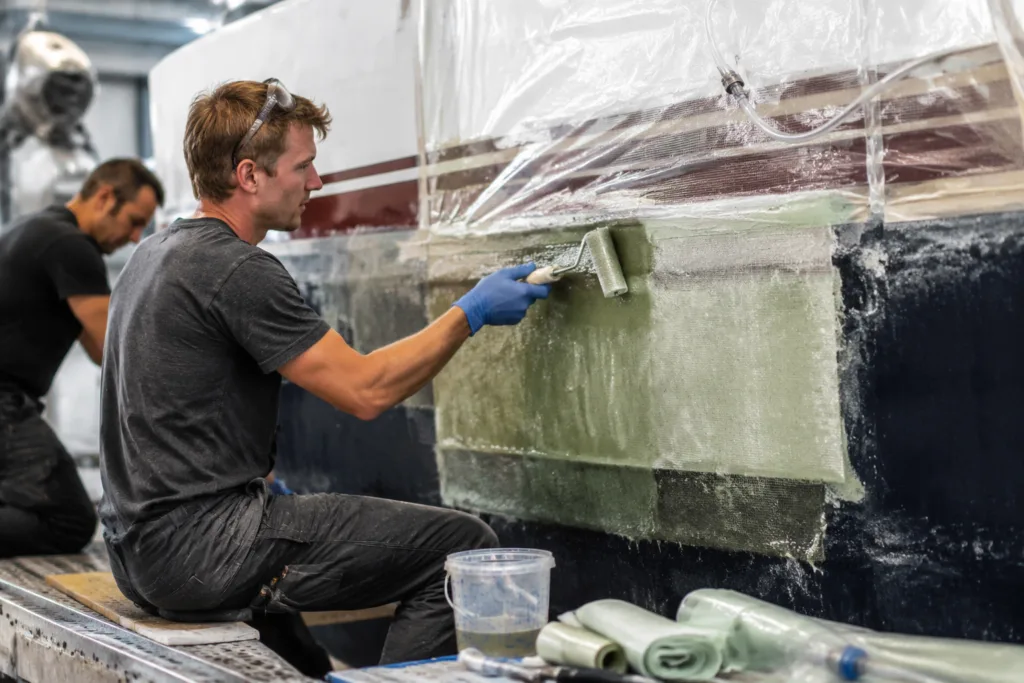
For procurement teams comparing manufacturer capability, ZDSpoxy is one example of why it helps to work with a source that can discuss resin chemistry, hardener matching, test methods, and custom formulation trade-offs rather than supplying only a generic name and a basic sales sheet.
Finish and topcoat compatibility
Marine projects rarely end at cure. They continue into sanding, fairing, priming, painting, or antifouling. Buyers should ask about overcoat windows, amine blush behavior, sanding ease, and whether the epoxy surface needs washing before recoating.
Practical application guidance and best practices
Surface preparation by substrate
- Wood: remove decayed fibers, dry to an acceptable moisture range for the chosen resin, sand to open the surface, and clean dust thoroughly.
- Fiberglass: grind or sand to sound laminate, feather repair edges, remove waxes and contaminants, and avoid bonding over glossy or chalked surfaces.
- Aluminum: degrease, abrade, deoxidize if required, and bond promptly before oxide regrowth reduces adhesion.
- Steel: remove rust and salts completely, then protect prepared surfaces from flash rust before application.
Mixing accuracy and technique
Marine epoxy failures are often caused by mixing errors rather than bad chemistry. Use the correct resin-to-hardener ratio by weight or volume as specified. Mix in a clean vessel, scrape sides and bottom, and transfer to a second cup for critical work if needed. Poorly blended material leaves soft zones, surface tack, or uneven cure.
Temperature control and exotherm management
Do not mass-mix large batches unless the product data supports it. Epoxy generates heat as it cures. Large volumes in deep containers can accelerate rapidly, shorten working time, and create brittleness or discoloration. Spread mixed resin into trays when possible, stage thick build-ups, and respect recoat windows.
Wet layup, vacuum bagging, and infusion
Wet layup needs complete fiber wet-out without excess resin. Vacuum bagging adds compaction and can reduce voids if consumables and vacuum integrity are correct. Infusion requires especially low, stable viscosity and careful process setup. The resin must stay workable long enough to flow through the laminate before gelation begins.
Overcoating and fairing workflow
Plan whether secondary operations will happen inside the chemical recoat window or after full cure and sanding. If the system is prone to blush, wash and dry before abrasion. For localized cosmetic rebuilds on timber or joinery, a material such as ZDS-189 wood repair putty for hull and joinery touch-ups represents the kind of finishing compound buyers may evaluate where sanding behavior and edge stability matter more than deep penetration.
Common mistakes and troubleshooting
| Issue | Likely cause | How to detect it | Typical fix |
|---|---|---|---|
| Amine blush | Cool, humid cure conditions | Waxy or greasy surface film | Wash, dry, then sand before recoating |
| Tacky surface | Wrong mix ratio or incomplete mixing | Soft or sticky areas after expected cure | Remove uncured material and reapply correctly mixed resin |
| Incomplete cure | Low temperature or expired components | Low hardness and poor sanding response | Check temperature, batch age, and mix accuracy |
| Delamination | Poor prep, contamination, or movement | Hollow sound, lift, visible separation | Cut back to sound substrate and rebuild |
| Voids and pinholes | Air entrapment or porous substrate outgassing | Surface pores or internal pockets | Seal coat, apply at stable temperature, use proper roller technique |
| Bloom or surface haze | Moisture interaction or contamination | Dull surface appearance | Clean thoroughly and assess if sanding is needed |
| Osmotic concerns | Moisture ingress over time | Blistering or moisture-related laminate issues | Dry, diagnose source, then rebuild barrier system |
One recurring lesson in marine repair is that the visible defect is not always the root cause. A pinhole problem may begin with warm substrate outgassing. A bond failure may begin with residual amine blush under the next coat. A brittle joint may begin with a batch that overheated in the cup before application.
Performance testing and supplier data you should request
Serious buyers should ask for more than a marketing summary. A technical data sheet should provide working values and test context. Exact numbers vary by formulation, but the supplier should be able to discuss typical ranges and test methods for the following:
- Pot life and gel time at a defined temperature and mass
- Viscosity range and test temperature
- Tensile strength and elongation
- Lap shear or adhesive bond performance
- Flexural strength and modulus
- Shore hardness after full cure
- Glass transition temperature, especially if post-cure is required
- Water absorption or immersion behavior
- Thermal service limits
- Salt exposure or corrosion-related screening where relevant
For severe substrate degradation, especially where older timber has absorbed moisture and contaminants, buyers may also compare a stronger-penetrating primer profile such as ZDS-1060AB solvent-based wood rot primer for severe marine conditions when field conditions and wood condition point toward solvent-assisted penetration rather than a standard laminating resin.
Decision rules: fast-cure versus slow-cure, laminating versus adhesive, coating versus filler
Fast-cure shop or field resins
Choose faster cure when downtime is expensive, temperatures are low, or the repair area is small and labor efficiency matters. Avoid fast cure for large laminates or inexperienced crews if exotherm, short pot life, or wet-out consistency will become problems.
Slow-cure laminating systems
Choose slower systems for large wet layups, vacuum work, hot weather, or parts where complete reinforcement saturation matters more than speed. The extra open time often improves laminate quality.
Structural adhesive versus laminating resin
Use a structural adhesive when the joint needs gap filling, non-sag behavior, and designed load transfer. Use a laminating resin when the main job is wetting fiber reinforcement and building a composite skin. They are not interchangeable just because both are epoxy.
Coating or barrier system versus filler
Barrier coatings are optimized for film build and moisture resistance. Fillers are optimized for shape correction and sanding. Using a fairing putty where a true barrier system is required can create avoidable long-term moisture issues.
Material compatibility, coatings, and galvanic considerations
Marine assemblies often combine epoxies with primers, antifouling coatings, gelcoat repairs, stainless hardware, aluminum structures, and core materials. Compatibility should be checked in sequence, not as isolated products. Ask whether the cured epoxy needs washing before primer, whether the planned antifouling system needs a tie coat, and whether metal contact points require isolation to reduce galvanic risk.
For aluminum in particular, epoxy bonding cannot be separated from corrosion design. Stainless fasteners, trapped seawater, and coating holidays can undermine otherwise good adhesive performance. In marine procurement, the system view is more useful than a single-product view.
Safety, handling, and environmental discipline on marine projects
Even low-odor systems require good practice. Use gloves, eye protection, and suitable ventilation. Avoid repeated skin contact, because sensitization risk can grow over time. Keep absorbents ready for spills, segregate mixed waste from unmixed components, and follow disposal rules for epoxy residues, contaminated rags, and empty packaging. Boat interiors, lockers, and enclosed repair spaces can accumulate vapors or heat, so ventilation planning matters as much as PPE.
How to evaluate a manufacturer or supplier
For contractors, OEMs, and procurement teams, supplier selection should be evidence-based. A useful checklist includes:
- Formulation range: can the supplier offer laminating, adhesive, filler, primer, and encapsulation systems rather than one generic epoxy?
- Customization: can viscosity, cure speed, or filler loading be adjusted for your process?
- Documentation: are TDS and SDS complete, consistent, and technically meaningful?
- Batch traceability: can materials be tracked for quality assurance and complaint handling?
- Sample testing: will the supplier support panel trials or pilot production evaluation?
- Technical support: can they discuss substrate prep, topcoat compatibility, and process troubleshooting?
- Lead time and packaging: are supply and pack sizes aligned with yard, distributor, or OEM needs?
- Private label or OEM capability: is there support for brand owners or specialized product lines?
From our side as a manufacturer, the most productive projects begin with complete information: substrate type, laminate schedule or joint geometry, service environment, target cure conditions, topcoat plan, and whether the work is in-shop or in-field. That allows resin selection to be based on engineering logic rather than broad assumptions.
Practical buyer checklist for comparing marine epoxy candidates
- Define whether the job is lamination, bonding, fairing, sealing, or encapsulation.
- Confirm substrate type and actual condition, including moisture, contamination, and existing coatings.
- List environmental exposure: immersion, splash, UV, fuel, salt, thermal cycling.
- Set process limits: application temperature, humidity, crew size, batch size, available cure time.
- Request TDS values for pot life, viscosity, hardness, Tg, tensile, flexural, and water resistance.
- Verify topcoat and antifouling compatibility.
- Run small-scale test panels or sample bonds before full deployment.
- Check batch traceability and consistency for repeat work or OEM supply.
Three selection examples
Plywood stitch-and-glue small boat
This project usually benefits from a low-viscosity sealing resin for edge grain, a laminating resin for tape and cloth, and a thixotropic adhesive or filler for fillets and gaps. Cure speed should match workshop temperature and assembly pace, not just the desire for speed.
Fiberglass hull delamination repair
The priority is removal of damaged laminate, moisture assessment, sound surface preparation, and a resin that wets reinforcement well while bonding strongly to abraded cured FRP. If the area is large or weather is warm, a slower laminating system may produce a more reliable rebuild than a fast repair resin.
Aluminum hull bonding and keel attachment details
This kind of job should be approached cautiously. Proper surface preparation, galvanic isolation strategy, load path review, and validation testing matter more than any generic claim on the label. Where epoxy is used, it should be as part of a designed joint and corrosion-managed assembly, not a simple substitution for welding or mechanical fastening without engineering review.
Conclusion
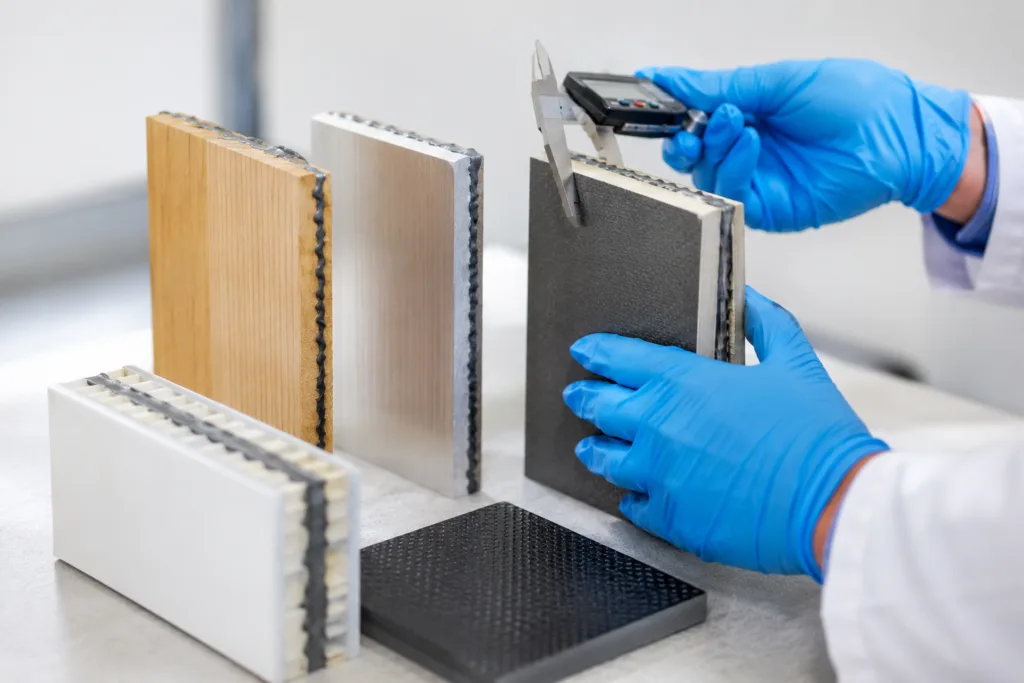
Marine epoxy resin is best understood as a group of specialized resin systems rather than a universal product. The right choice depends on substrate, water exposure, structural demand, cure conditions, and finishing sequence. For boat repair, boatbuilding, waterproofing, and composites, the safest path is to narrow the project into clear requirements, review technical data carefully, and validate the system through sample panels, mock-ups, or small trial repairs before full-scale use. When buyers provide complete service conditions and process details, manufacturers can usually recommend a much more accurate resin profile and reduce the risk of avoidable field failures.
FAQs
Can marine epoxy resin be applied to damp wood?
Usually it should be applied to wood that is dry enough for the specific system, because excess moisture can reduce penetration, interfere with adhesion, and increase the risk of later failure. Some repair systems are more moisture-tolerant than others, but buyers should still confirm the acceptable substrate condition in the product data and test a sample area when working on older timber.
What is the difference between marine epoxy resin and epoxy putty?
Marine epoxy resin usually refers to a liquid or flowable two-part system used for laminating, bonding, sealing, or coating, while epoxy putty is a highly filled, paste-like material intended for gap filling, contour repair, or localized rebuilding. The putty may be part of a marine repair system, but it is not a substitute for a laminating or sealing resin where wet-out and penetration are required.
How do you remove amine blush before recoating?
Amine blush is normally removed by washing the cured surface with clean water and a suitable abrasive pad or similar mechanical assist, then drying the area before sanding if needed. If blush is left in place, the next coat can lose adhesion even when the base epoxy itself cured properly.
Is marine epoxy better than polyester for boat repair?
For many secondary bonding and structural repair situations, epoxy is preferred because it typically offers stronger adhesion, lower shrinkage, and better moisture resistance. Polyester can still be useful in some production or lower-cost applications, but it is often less forgiving than epoxy when the repair depends on bonding to existing cured laminate or sealing wood effectively.
What supplier data should procurement teams request for marine epoxy?
Procurement teams should ask for a current technical data sheet and safety data sheet, along with key values such as pot life, gel time, viscosity, hardness, tensile or lap-shear data, flexural properties, Tg, and water resistance information. It is also useful to confirm batch traceability, storage conditions, and whether the supplier can support sample testing before full project approval.
Does marine epoxy need a UV-protective topcoat?
In most exterior marine applications, yes. Many epoxy systems perform very well structurally and as moisture barriers, but prolonged sunlight can cause yellowing, chalking, or surface degradation. A compatible marine paint, varnish, or other protective topcoat is usually the right way to preserve appearance and long-term weathering performance.