
Choosing epoxy grout for kitchen tile and backsplash work is usually less about appearance alone and more about long-term resistance to grease, staining, repeated cleaning, and hygiene-sensitive use. In both residential and commercial kitchens, grout joints are often the first place where oils, sauces, pigments, and moisture collect. From our manufacturing perspective, the right epoxy grout can reduce porosity, simplify cleaning, improve color stability, and lower the risk of early rework when compared with conventional porous grout systems. The key is not to specify epoxy generically, but to match the grout chemistry, working properties, cure profile, and cleaning resistance to the actual kitchen environment.
Explore epoxy grout system options for kitchens and backsplashes when the project requires a tighter balance between stain resistance, workable installation time, and easy-clean joint performance.
This guide is written for contractors, project managers, specifiers, procurement teams, and facility decision-makers who need a practical way to compare grout systems for backsplashes, wall tile, food-prep zones, and adjacent wet-cleaned surfaces. It is also useful for private-label brands and OEM buyers evaluating manufacturers that can adjust viscosity, cure speed, or color stability for specific market needs. Rather than treating all epoxy grout as equal, we focus on what should be specified, what should be tested, and which installation details affect field performance most.
Why epoxy grout is often the stronger kitchen choice
In kitchens, grout is exposed to a difficult combination of oils, dyed foods, splashing water, alkaline cleaners, hand contact, wiping abrasion, and occasional heat cycling near cooktops. Cementitious grout can perform acceptably in lighter-duty settings, but its porosity makes it more vulnerable to darkening, absorbed grease, and maintenance-related discoloration. Modified systems may improve some properties, yet they still require careful comparison because performance can vary widely by formulation.
A practical kitchen grout decision usually comes down to these questions:
- Will the joint absorb cooking oils or become visibly stained by sauces, coffee, tea, or spices?
- Can the installed surface tolerate frequent cleaning with common kitchen chemicals?
- Will the grout keep its color in light shades, especially on white or pale backsplashes?
- Can installers place it neatly on vertical joints without slumping or washout?
- Will the cure schedule fit the handover timeline for light use and full-duty use?
- Is there technical data that supports chemical resistance, hardness, and durability claims?
If those are the real project concerns, epoxy usually deserves serious consideration before the tile package is finalized.
Who should use this guide and how
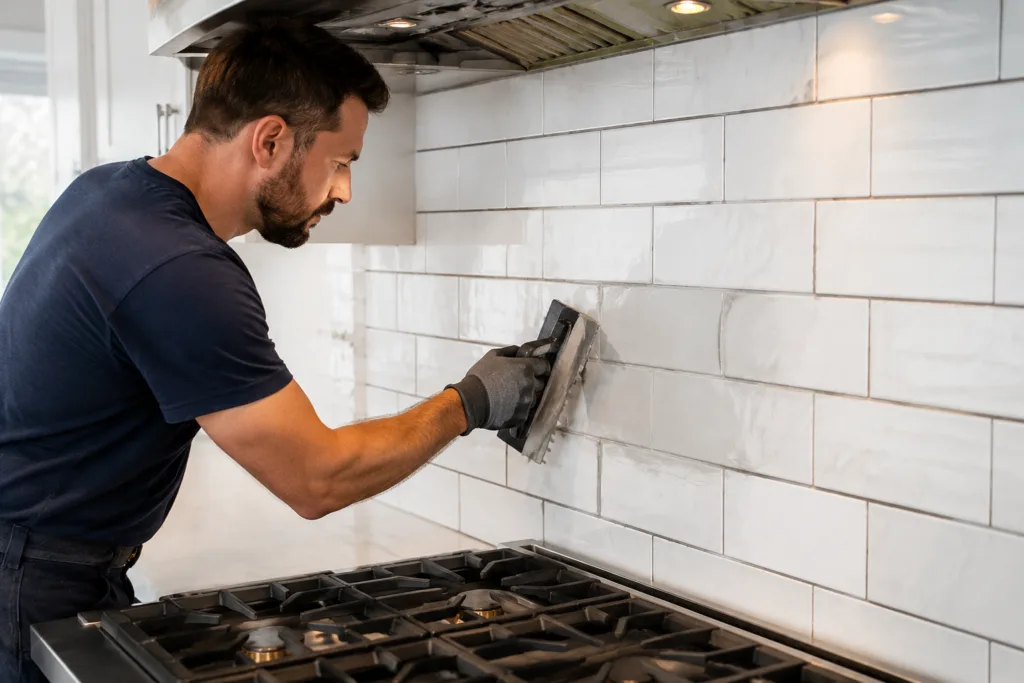
Contractors can use this article to reduce call-backs caused by early staining, haze, soft joints, and poor cleaning outcomes. Specifiers can use it to turn broad product descriptions into measurable requirements. Procurement teams can use it to compare supplier data sheets more critically. Facility managers can use it to align grout selection with actual maintenance routines instead of relying on showroom appearance.
At the start of the evaluation process, it helps to review an overview: what is epoxy grout and why it matters for kitchen hygiene so all stakeholders are working from the same technical baseline. That is particularly useful when a project team is comparing residential-style expectations with commercial cleaning demands.
Epoxy grout compared with cementitious and modified systems
| Grout type | Main advantages | Main limitations | Kitchen suitability |
|---|---|---|---|
| Epoxy grout | Low porosity, strong stain resistance, good chemical resistance, easier routine cleaning, strong color consistency | Higher material cost, tighter installation control, cleanup timing matters, some products may yellow under UV exposure | Very suitable for backsplashes, food-prep areas, and grease-prone walls |
| Cementitious grout | Lower upfront cost, familiar installation, broad availability | Porous, more stain-prone, may require sealing, often harder to keep clean long term | Suitable for lower-demand areas where heavy grease and repeated cleaning are limited |
| Modified epoxy or hybrid systems | May improve workability or cost balance | Performance varies by formulation, some claims are not equivalent to full epoxy performance | Needs careful technical review before use in hygiene-sensitive kitchens |
For many decision-makers, the most helpful comparison is epoxy grout vs cement: stain resistance and maintenance for kitchens. That comparison often clarifies why projects with white tile, open cooking, or aggressive cleaning benefit from denser, less absorbent grout joints.
Key performance requirements for kitchen and backsplash grout
Grease and oil resistance
Grease resistance is not just about whether oil wipes off immediately. The more important question is whether repeated oil exposure penetrates the joint surface, causes darkening, or leaves a permanent residue film. In epoxy systems, resistance depends on resin chemistry, filler package, cure completeness, and final surface finish. A properly cured, dense joint should resist surface penetration from common food oils better than porous grout. In specification work, we recommend requesting chemical spot testing or immersion data where available, and field mock-up testing with cooking oil or grease under realistic dwell times.
Stain resistance and color stability
Kitchen staining agents include turmeric, chili oil, tomato sauce, coffee, soy-based sauces, wine, tea, and food dyes. Light-colored grout should be tested against the specific stain risks expected in use, not just generic “stain resistant” marketing language. Color stability also depends on cleanup technique during installation, because residue left on the surface can create blotchy appearance that is mistaken for product failure. On pale backsplash systems, non-yellowing behavior and resistance to discoloration from cleaners should also be reviewed.
Chemical and cleaning-agent resistance
Kitchen cleaning introduces another layer of performance demand. Mild detergents are rarely a problem, but alkaline degreasers, bleach solutions, acidic food spills, and occasional solvent-based cleaners can affect long-term appearance if the grout is not designed for that environment. From our formulation work, the correct question is not whether the grout is “chemical resistant” in general, but which chemicals, at what concentration, for what contact duration, and after what cure age. This is why application-specific supplier data matters more than broad category claims.
Non-porosity and hygienic surface behavior
Epoxy grout is not a food-contact coating, but lower porosity can still support cleaner, more sanitary surfaces because residues remain closer to the surface instead of being absorbed deeply into the joint. Joint profile matters here. Smooth, properly tooled, fully packed joints are easier to wipe down than rough, recessed, or pinholed joints. Hygiene performance is often won or lost in finishing quality rather than in chemistry alone.
Heat resistance and thermal cycling
Backsplashes behind ranges and cooktops may not see extreme temperatures continuously, but they do experience repeated warming and cooling. That means the grout should tolerate thermal cycling without becoming brittle, debonding from tile edges, or showing early cracking where assembly movement exists. Heat resistance should always be considered together with movement accommodation, especially where metal trims, dissimilar substrates, or large-format tile are present.
Abrasion, scratch resistance, and touch durability
Although backsplash joints are not floor joints, they still face repeated wiping, scrubbing, utensil contact near counters, and hand traffic in busy food areas. A cured epoxy grout with suitable hardness can retain a neat surface longer under repeated cleaning. However, overly hard systems without enough toughness may become less forgiving in assemblies subject to movement. Balance matters.
Flexibility and movement accommodation
Epoxy grout does not replace movement joints. Where tile transitions, substrate joints, corners, or thermal breaks exist, proper movement-joint design is still required. For kitchen walls and backsplashes, the goal is a grout system that bonds well and resists service stress, while sealants handle areas designed for movement.
Technical properties worth specifying
When a manufacturer or supplier is being evaluated, request measurable properties rather than broad descriptors. The exact target values differ by product family, but the following categories are useful in project specifications and procurement reviews.
| Property | Why it matters in kitchens | What to request |
|---|---|---|
| Shore hardness | Indicates cured surface firmness and wear behavior | Test method, cure age, typical range, and tolerance |
| Compressive strength | Shows resistance to crushing and dense joint performance | Typical tested value and standard used |
| Flexural strength | Useful for understanding brittleness versus toughness balance | Typical tested value and cure condition |
| Pot life | Affects installer working window and waste rate | Pot life at stated temperature, not generic room temperature only |
| Open time | Important for spreading and cleaning sequence on walls | Recommended application window by temperature band |
| Light-use time | Supports scheduling and handover planning | Time to light cleaning or light service |
| Full-cure time | Critical before aggressive cleaning or heavy exposure | Time to chemical service and full duty |
| Consistency or viscosity | Determines sag resistance and joint filling in vertical work | Recommended joint widths and wall application notes |
For narrow joints on smooth wall tile, installers usually benefit from a formulation that is creamy enough to pack fully but structured enough to resist sag on vertical surfaces. Fast-cure options can help phased installations, but they narrow cleanup timing and should be specified carefully for labor conditions and ambient temperature.
In our epoxy resin formulation work, we also pay close attention to storage stability, color consistency between batches, filler dispersion, and cure behavior at lower site temperatures. Those practical factors are often more important in the field than a single headline strength number.
Tests and evidence to request from suppliers
Kitchen projects benefit from a disciplined review of available test evidence. That does not mean every job needs a laboratory program, but suppliers should be able to explain how key claims are supported. Where relevant, ask for test methods related to hardness, abrasion, adhesion, chemical exposure, water absorption, and color stability. Engineers and specifiers may also request clarifications on sample age at testing, cure conditions, and whether the reported values come from the finished grout system rather than raw resin alone.
For project teams needing a more detailed technical screening, this resource on epoxy tile grout selection and specs for food-prep areas can help frame what to ask for in submittals and mock-up approval.
Useful verification steps include:
- Spot exposure testing with cooking oil, tomato sauce, coffee, turmeric, and bleach on cured samples
- Side-by-side cleaning trials after controlled dwell times
- Abrasion checks after repeated wipe cycles
- Color observation under strong lighting after chemical exposure
- Mock-up review of final joint smoothness, pinholes, and ease of cleaning
Where light-colored grout is proposed near sunny windows, accelerated yellowing review may also be relevant. Not every backsplash sees UV exposure, but projects with natural daylight should not ignore it.
Food-area hygiene and compliance considerations
Grout in a kitchen backsplash is not normally a direct food-contact surface, but it can influence how cleanable the surrounding wall assembly remains. Specifiers should avoid overstating food-safety claims and instead focus on practical hygiene outcomes: lower porosity, easier residue removal, compatibility with regular cleaning, and reduced staining that can hide contamination. If suppliers cite certifications or regulatory alignment, confirm that the claim applies to the actual finished product and intended use, not just to a component material.
It is also reasonable to ask about VOC positioning, batch traceability, and regional compliance documentation where the project requires it. Procurement teams should verify whether those declarations are current and project-relevant rather than generic marketing attachments.
Tile, substrate, and joint compatibility
Ceramic and porcelain tile
These are usually the most straightforward pairings because the tile surface is generally dense and relatively easy to clean during installation. Even so, textured surfaces can trap epoxy residue, so installers should confirm cleanup procedure on a sample board before full application.
Natural stone and porous tile
These materials deserve extra caution because some stones can darken, edge-stain, or retain haze if the grout or cleanup method is not compatible. Pretesting is strongly recommended. A grout that performs well on porcelain may not be safe on absorptive stone without protective measures.

Glass tile, coated surfaces, and trims
Glass can reveal smears and edge residue more easily than opaque tile. Metal trims and painted surfaces may also react differently to cleaners used during installation. Transition details should be reviewed in advance, especially where exposed finish quality is critical.
Joint dimensions, profile, and specification detail
Kitchen backsplash grout performance depends heavily on full joint packing, proper depth, and a smooth final profile. Narrow decorative joints demand a different consistency than wider rustic tile joints. If the grout is too stiff, voids can remain behind the visible face. If it is too loose, slump and surface washout can occur. Specifications should reference the intended joint width range and require installer confirmation that the selected product is suitable for vertical use in that range.
A slightly concave but dense, smooth profile often cleans more easily than rough or underfilled joints. Deep recesses hold residue and complicate wipe-down routines, particularly behind ranges.
Surface preparation before grouting
Preparation is especially important in kitchens because oils, adhesive residue, dust, release agents, and detergent films can interfere with bond and cure quality. Joints should be clean, dry as required by product guidance, and free of contaminants before grouting begins. Any tile adhesive protruding into the grout path should be removed to ensure full grout depth and a continuous, dense joint.
Safe cleaning choices depend on tile type and surrounding finishes, but the general rule is simple: remove grease completely, then allow any cleaning solvent or detergent residue to dissipate before grout installation. Residual cleaners can create bond reduction, surface blush, or uneven cure. Pretesting the cleaning sequence is worthwhile on high-visibility kitchen work.
Mixing and application best practices
Epoxy grout rewards disciplined installation. Ratio accuracy, complete mixing, and temperature control all affect workability and final performance. Improper dilution or field modification should be avoided unless the manufacturer explicitly permits it. Adding unapproved solvent, water, or extra filler to change handling often creates more problems than it solves.
For wall tile and backsplash work, anti-sag behavior is critical. Installers should use a method that fully packs the joint, removes trapped air, and limits residue on the tile face. Cleanup timing matters: too early and the joint can be washed low; too late and film removal becomes difficult. Smooth, non-pitted finishing is one of the strongest predictors of easy long-term cleaning.
Some useful handling practices include:
- Condition materials to the recommended application temperature before mixing
- Mix full units only when required by the product design, unless partial-unit metering is specifically allowed
- Keep batch records for color tracking on larger projects
- Use mock-ups to confirm wall workability and final appearance
- Train crews on residue removal timing before starting visible kitchen areas
From a manufacturer support standpoint, ZDSpoxy often sees that installation consistency matters as much as chemistry selection when a project is trying to keep light-colored backsplash grout clean-looking over time.
Curing management and return-to-use planning
Freshly installed grout may feel firm before it is ready for aggressive cleaning or full-duty kitchen exposure. Light touch, light cleaning, and full chemical service are different milestones. Contractors should protect the installation from premature washing, steam, grease deposition, and chemical exposure until the product reaches the stated cure stage for those conditions. Cooler temperatures generally extend cure time; warmer conditions may shorten pot life and accelerate set.
In fast-track projects, it is better to specify a system with a defined early-service profile than to assume all epoxies cure quickly enough for accelerated turnover.
Cleaning protocols after installation and in daily service
Daily routine cleaning
For routine maintenance, pH-neutral to mild alkaline cleaners are typically the most practical starting point. The goal is frequent removal of light grease before it builds into a more stubborn film. Soft cloths, non-aggressive pads, and controlled dwell times usually maintain appearance without dulling the joint surface.
Heavy-duty degreasing and stain removal
Where oils, food pigments, or neglected buildup are present, stronger degreasers may be appropriate if they are compatible with the cured grout and surrounding tile. Mechanical action often matters as much as chemistry. In some cases, controlled stain treatment, repeated wiping, or localized poultice-style cleaning may be more effective than one strong cleaner application. Aggressive solvents should not be used casually, especially on mixed-finish installations.
Cleaners to avoid
Highly abrasive pads can dull the joint and nearby tile finish. Unverified solvent cleaners may soften some surrounding materials or leave films that attract more soil. Strong acids and harsh oxidizers should not be treated as routine maintenance tools unless the system has been verified for that exposure and the tile assembly can tolerate it.
For teams managing kitchen zones with wet cleaning expectations, there are useful parallels in waterproofing and cleaning lessons from epoxy grout in wet areas, especially around cure discipline, residue removal, and maintenance-compatible cleaner selection.
Maintenance, repair, and lifecycle planning
Well-installed epoxy grout usually reduces maintenance intensity, but no grout is maintenance-free. Over time, localized damage can occur from impact, substrate movement, poor original packing, or repeated abuse from aggressive cleaning tools. Facility teams should document approved cleaners, cleaning frequency, and stain response procedures so the grout system is maintained consistently across shifts or contractors.
Localized repairs are often possible, but color matching and edge preparation need attention. If damage is isolated, removal and replacement of a limited section may be practical. If widespread discoloration stems from installation residue or unsuitable cleaners, diagnosis should happen before deciding on regrouting.
Common field problems and how to correct them
| Problem | Likely cause | Corrective approach |
|---|---|---|
| Poor adhesion | Contaminated joints, residue, insufficient joint depth | Remove failed areas, clean thoroughly, verify substrate condition, reinstall with proper prep |
| Blush or surface contamination | Moisture, cleaner residue, improper cure environment | Clean affected surface per supplier guidance, improve environmental control, verify prep chemicals |
| Pinholes or voids | Air entrapment, incomplete packing, over-aggressive wash | Refill affected joints, adjust placement technique, improve tooling method |
| Color blotching | Inconsistent mixing, residue film, uneven cleanup timing | Evaluate whether issue is surface film or true color variation; standardize mixing and cleanup |
| Early staining | Premature service, incomplete cure, unsuitable cleaner or stain dwell | Allow full cure, deep clean carefully, confirm chemical compatibility and service timeline |
Specification checklist for procurement teams
For procurement and project specification, a short but disciplined checklist helps prevent vague substitutions:
- Define the kitchen use case: residential backsplash, café prep wall, commercial food area, or heavy grease zone
- State tile type, joint width, joint depth, and whether the work is vertical only or includes horizontal transitions
- Require documented resistance information for grease, common food stains, and intended cleaning chemicals
- Request pot life, application temperature range, light-use time, and full-cure time
- Confirm suitability for light-colored joints if appearance retention matters
- Request batch traceability and color consistency information for larger projects
- Require mock-up approval for stain removal, cleanup finish, and final joint profile
- Identify movement-joint locations separately from grout scope
For engineers and buyers, the most useful technical submittal is rarely the thickest one. It is the one that clearly links tested performance, installation limits, and cleaning compatibility to the actual kitchen environment.
How to evaluate an epoxy grout supplier
When comparing suppliers, look beyond the label description. A credible manufacturer should be able to discuss formulation options, technical limitations, cure behavior, color control, and support for mock-up validation. If the project has unusual requirements such as fast return to service, low odor expectations, improved yellowing resistance, or private-label packaging, those needs should be discussed early rather than after product selection.
Useful supplier evaluation points include manufacturing consistency, ability to explain chemical resistance realistically, sample support, batch traceability, and technical responsiveness during installation planning. For OEM and specification-driven projects, custom formulation capability can also matter if a standard product does not quite fit the application.
Conclusion
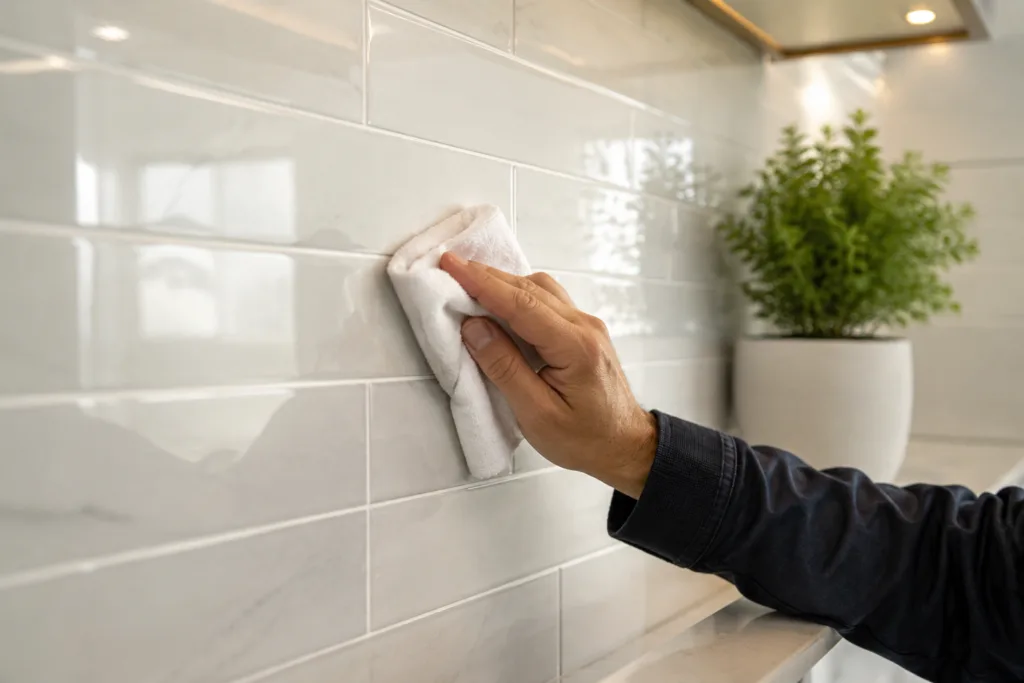
Specifying epoxy grout for kitchen tile and backsplashes is most successful when the project team treats grout as a performance material, not just a color accessory. Kitchens challenge grout with grease, pigments, repeated cleaning, touch abrasion, and hygiene expectations that quickly expose weak choices. A good epoxy grout specification should address stain resistance, chemical exposure, cure timing, wall workability, joint finish quality, and cleaning compatibility in one coordinated package. When those factors are reviewed early, contractors install with fewer surprises, procurement compares suppliers more accurately, and kitchen owners get a joint system that stays cleaner and more serviceable over time.
FAQs
Is epoxy grout better than cement grout for kitchen backsplashes?
In many kitchens, yes, because epoxy grout is typically less porous and more resistant to grease, food staining, and frequent cleaning than cement grout. The advantage is strongest in areas behind ranges, around prep counters, and on light-colored tile where absorbed stains are more visible.
Can epoxy grout handle cooking grease and oil splatter?
Properly cured epoxy grout usually resists surface penetration from common cooking oils much better than porous grout, but performance still depends on formulation, cure completeness, and how quickly residues are cleaned off. For demanding projects, mock-up testing with real kitchen contaminants is a smart specification step.
What cleaners are usually safe for epoxy grout in kitchens?
Routine cleaning is generally best done with pH-neutral or mild alkaline cleaners and non-abrasive tools. Before using stronger degreasers, bleach solutions, or specialty solvents, verify compatibility with the cured grout, tile surface, and any adjacent trim or sealant.
Does epoxy grout improve hygiene in food-prep areas?
It can support cleaner surfaces because dense, smooth joints are easier to wipe down and less likely to absorb residues deeply. That said, hygiene still depends on correct installation, full cure, proper joint finishing, and regular cleaning rather than on grout chemistry alone.
How soon can a kitchen backsplash be used after epoxy grouting?
That depends on the product, site temperature, and humidity, because light touch, light cleaning, and full chemical service can occur at different times. Installers and project managers should follow the manufacturer’s cure schedule instead of assuming the grout is ready as soon as it feels hard.
What should specifiers ask an epoxy grout manufacturer to provide?
At minimum, ask for technical data on pot life, cure time, joint-width suitability, hardness or strength indicators, chemical resistance, stain resistance guidance, and cleaning compatibility. For visible or high-demand kitchens, also request mock-up support, color consistency information, and clarification on any regulatory or compliance claims.