
Epoxy grout for swimming pools is specified when the project needs more than basic gap filling. In pool construction and renovation, grout has to tolerate constant moisture, sanitizer exposure, periodic pH variation, cleaning chemicals, tile movement, and in many outdoor projects, direct sunlight. From our manufacturer perspective, pool grout selection should be treated as a performance decision rather than a color-only decision. The right system can improve stain resistance, reduce water ingress, support easier cleaning, and hold up better in chemically aggressive service, but only if the resin chemistry, substrate preparation, joint design, and curing conditions are aligned with the actual pool environment.
explore epoxy grout system options for pool and submerged use
This guide is written for pool builders, maintenance teams, specifiers, engineers, procurement staff, and contractors who need practical selection criteria and installation logic. The goal is to help you compare epoxy grout with alternative grout types, define realistic performance targets, and reduce failure risk before installation begins. We also include specification-ready considerations such as adhesion, water absorption, chemical resistance, cure timing, and what documentation to request before approving a material for submerged service.
When epoxy grout makes sense in pool projects
Epoxy grout is commonly selected for pools where long-term water resistance, lower porosity, and stronger chemical tolerance matter more than lowest initial installation cost. It is especially relevant in commercial pools, spas, therapy pools, competition facilities, water features, and premium residential pools using glass mosaic or dense porcelain tile.
Compared with cementitious grout, epoxy systems usually provide lower absorption, better stain resistance, and stronger resistance to many cleaning and sanitizing conditions. Compared with urethane systems, epoxy often offers higher chemical durability and a harder cured joint, though the trade-off can be lower flexibility if movement joints are not designed properly.
- Choose epoxy grout when: the pool will be submerged continuously, cleaned frequently, exposed to chlorinated or brominated water, or built with tile that needs dense, easy-to-clean joints.
- Use caution when: the substrate is moving excessively, UV exposure is severe and color sensitivity is high, or the installation crew has limited experience with multi-component resin systems.
- Do not rely on grout alone: expansion joints, waterproofing details, and structural movement accommodation still need separate design attention.
Core performance requirements for pool-grade grout
Low water absorption and water impermeability
For submerged installations, the first question is not whether the grout gets wet, but how it behaves after long-term wet exposure. A suitable pool grout should resist softening, swelling, washout, and absorption-driven staining. In specification reviews, we recommend asking for water absorption data, immersion performance information, and evidence that the cured system retains bond and hardness after wet conditioning.
Very low absorption helps reduce discoloration from dissolved contaminants and can limit nutrient retention that supports biological growth on the grout surface. In practice, low porosity also makes routine cleaning more predictable.
Chemical resistance under real pool conditions
Pool water chemistry is not constant. Sanitizer levels fluctuate, shock treatments can create short-term oxidizing stress, pH control may drift, and saltwater pools introduce additional ionic exposure. Spa and hydrotherapy environments add heat, which accelerates many degradation mechanisms. A pool-grade epoxy grout should be evaluated for resistance to:
- free chlorine and bromine in routine service
- periodic shock oxidizer exposure
- acidic or alkaline cleaning cycles
- saltwater chlorination environments
- body oils, cosmetics, and organic residues in high-use facilities
Not all epoxies perform equally here. Crosslink density, curing agent selection, filler package, and pigment stability all influence chemical resistance. For chemically demanding projects, a finishing system such as ZDS-2186AB chemical-resistant underwater epoxy coating for pools and marine use may also be considered on adjacent structures where grout alone is not the full protection strategy.
UV stability and color retention
Outdoor pools raise a separate concern: yellowing and color shift. Standard epoxy systems can chalk or discolor over time under ultraviolet exposure, especially with light colors or decorative tile layouts where joint appearance is highly visible. UV-stable pigments, stabilizers, and in some cases aliphatic protective layers can improve appearance retention, but no material should be approved on assumption alone. Conservative buyers should request color stability information, weathering data if available, and sample panels exposed on site when appearance matters.
Adhesion to tile and substrate types
Grout performance depends on adhesion at tile edges and the condition of the setting bed or substrate. Ceramic and porcelain tile are typically straightforward if edges are clean and the joint is properly prepared. Glass mosaic can be more demanding because smooth surfaces and tight joint tolerances increase sensitivity to mixing quality and placement technique. Natural stone requires extra review because porosity, staining sensitivity, and thermal behavior vary. Fiberglass and preformed pool assemblies may require compatibility checks and trial bonding before broad use.
Mechanical balance: hardness, abrasion, and movement tolerance
Hardness is useful for wear resistance and cleanability, but extreme hardness without accommodation for movement can contribute to edge cracking or debonding. Pool assemblies cycle thermally, especially in outdoor pools and spas. For that reason, specifiers should look beyond a single hardness number and ask how the cured grout balances Shore hardness, flexural behavior, edge adhesion, and crack resistance under expected service conditions.
Mold and biological staining resistance
Epoxy itself is not a substitute for proper water chemistry and cleaning, but dense, lower-porosity grout can reduce the tendency for biological staining compared with more absorbent materials. This is particularly valuable at splash zones, waterlines, stairs, overflow channels, and deck transitions where contamination loads are higher.
Epoxy chemistry variables that matter in swimming pools
From our formulation work, the most important mistake buyers make is treating all epoxy grout as one category. Pool performance changes significantly with resin backbone, curing agent chemistry, filler content, and rheology control.
Base resin and crosslink density
Higher crosslink density usually improves chemical resistance, hardness, and heat resistance, but can also make the cured material less forgiving where movement is present. A well-designed pool grout often needs a balanced network: dense enough to resist water and chemicals, but not so brittle that routine thermal cycling causes edge distress.
Curing agents and cure schedule
Ambient-cure epoxy grouts are common for field installation, but their practical performance depends heavily on temperature. Low temperatures can extend cure time and delay refill, while high temperatures can shorten pot life and increase installation waste. Some systems also develop better final properties only after sufficient post-cure time, even if they appear surface-hard earlier.
Before approval, check:
- mix ratio tolerance
- pot life at expected jobsite temperature
- working time for the planned crew size
- initial set time
- minimum cure before water exposure
- minimum cure before full chemical service
Fillers, pigments, and additives
Fillers affect shrinkage control, sag resistance, workability, and final texture. Pigments affect UV response and color consistency between batches. Additives may improve anti-sag performance for vertical joints, support color retention, or modify toughness. These details matter in overhead gutters, vertical walls, stepped entries, and mosaic installations with narrow joints.
Viscosity and thixotropy
For floors and benches, some flow is helpful to fully pack joints. For walls and waterline details, too much flow can create sagging, wash lines, or voids. Thixotropic formulations are often preferred where joints run vertically or overhead. Where substrate moisture is difficult to eliminate completely, preparation may include systems such as ZDS-2870AB high-adhesion epoxy primer for wet concrete and tile substrates in compatible assemblies, but primer use should always match the grout manufacturer’s guidance.
Tile and substrate compatibility matrix
| Tile or substrate | Typical compatibility | Main risk | Recommended verification |
|---|---|---|---|
| Ceramic tile | Generally good | Contaminated edges or weak setting bed | Joint cleanliness check and trial panel |
| Porcelain tile | Generally good | Tight joints and incomplete packing | Mock-up and cut-open inspection |
| Glass mosaic | Good with proper formulation | Edge visibility, sag, adhesion sensitivity | Sample board, color review, pull-off check |
| Natural stone | Case specific | Staining, thermal mismatch, surface marking | Compatibility panel and appearance approval |
| Fiberglass or preformed pool surfaces | Conditional | Surface energy and movement issues | Site adhesion trial before full use |
| Wet or dense concrete backgrounds | Conditional | Residual moisture and weak laitance | Surface prep verification and bond testing |
For field verification, a practical approach is to prepare a small representative area, allow full cure per the technical data sheet, and then assess edge bond, fill quality, and surface finish before scaling up. A conservative adhesion protocol can include a pull-off style check on mock-up areas or destructive review of sample joints cut open after cure.
Joint design and movement accommodation
Grout is not a movement joint material. That distinction is critical in pools. Joint width and depth should match tile size, substrate stability, and expected thermal movement. Narrow mosaic joints need complete filling and careful wash technique, while larger joints around transitions may require separate elastomeric movement materials.
- Use dedicated movement joints at changes in plane, structural joints, and long uninterrupted runs.
- Do not bridge expansion joints with rigid epoxy grout.
- Use suitable backer rod and bond-breaker details where elastomeric sealants are required.
- Review differential movement at waterline edges, overflow channels, stair corners, and spa transitions.
Many early grout failures are actually movement design failures. If the assembly moves beyond what the rigid joint can tolerate, edge cracking and debonding are likely even when the grout chemistry is sound.
Surface preparation and installation workflow
Cleaning and preparation
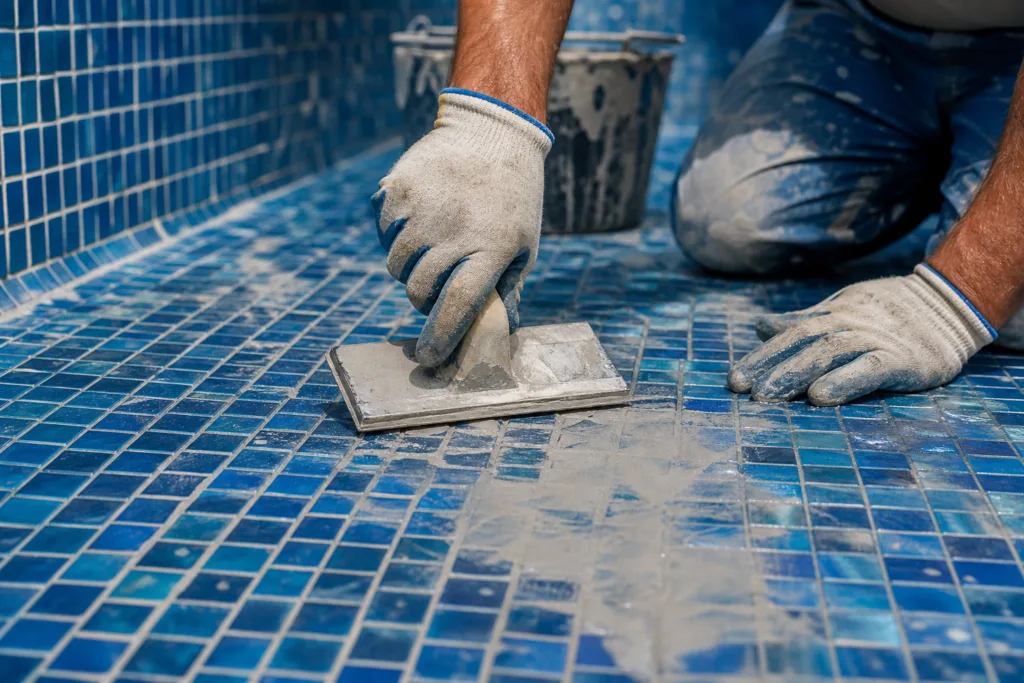
Joint faces should be clean, dry enough for the selected system, and free from dust, oils, release agents, laitance, old cleaners, and standing water. Residual contaminants at tile edges are a common cause of localized failure. In renovation work, mechanical removal of weak or contaminated existing material is often more important than the new grout selection itself.
Moisture and temperature control
Even when a system is intended for wet-service environments, installation conditions still matter. Check substrate temperature, ambient temperature, and dew point. Condensation on tile or concrete can interfere with adhesion. Water temperature also matters if refill is planned soon after cure, because cold water can mask incomplete cure while sanitizer introduction may stress the joint too early.

Mixing and application technique
Use complete units where possible to avoid ratio error. Mix thoroughly but avoid introducing unnecessary air. Apply with tools that fully force material into the joint, then strike and finish within the stated working window. Do not spread more area than the crew can clean before the wash window closes. In our experience, many visual complaints about epoxy grout come from timing errors during wash-off rather than from the chemistry itself.
Where submerged joints, drains, or structurally damp areas demand a higher-duty material, some contractors review systems such as ZDS-1417AB high-strength underwater epoxy grout for submerged joints for compatibility with the job conditions and required service profile.
When to refill the pool
Do not base refill timing on touch-dry appearance. Re-immersion should follow the product’s stated cure requirements at the actual site temperature. A prudent specification will distinguish between:
- time to light foot traffic
- time to wash and final clean
- time to water exposure
- time to full chemical service
For critical projects, especially commercial pools and spas, an on-site mock-up cured under actual ambient conditions is a practical way to confirm schedule assumptions before the entire basin is committed.
Chemical exposure management and long-term durability
Routine chlorination is not the same as repeated shock dosing, and a warm spa is not the same as an outdoor lap pool. Service life depends on the full exposure pattern. High sanitizer peaks, aggressive acid cleaning, and elevated temperature can accelerate discoloration or embrittlement even in otherwise durable systems.
Good long-term performance usually comes from matching the grout to the operating regime:
- Indoor chlorinated pool: focus on chemical resistance, cleanability, and color control under artificial lighting.
- Outdoor saltwater pool: add UV and color-stability review.
- Spa or thermal pool: prioritize heat tolerance, chemical resistance, and movement management.
- Commercial heavy-use pool: specify maintenance protocols and inspection intervals from the start.
At ZDSpoxy, we usually advise buyers to review not only generic chemical-resistance charts, but also the expected concentration range, exposure frequency, cleaning chemistry, and service temperature. Those details often determine whether a standard formulation is sufficient or whether a custom adjustment is worth considering.
UV exposure and outdoor pool considerations
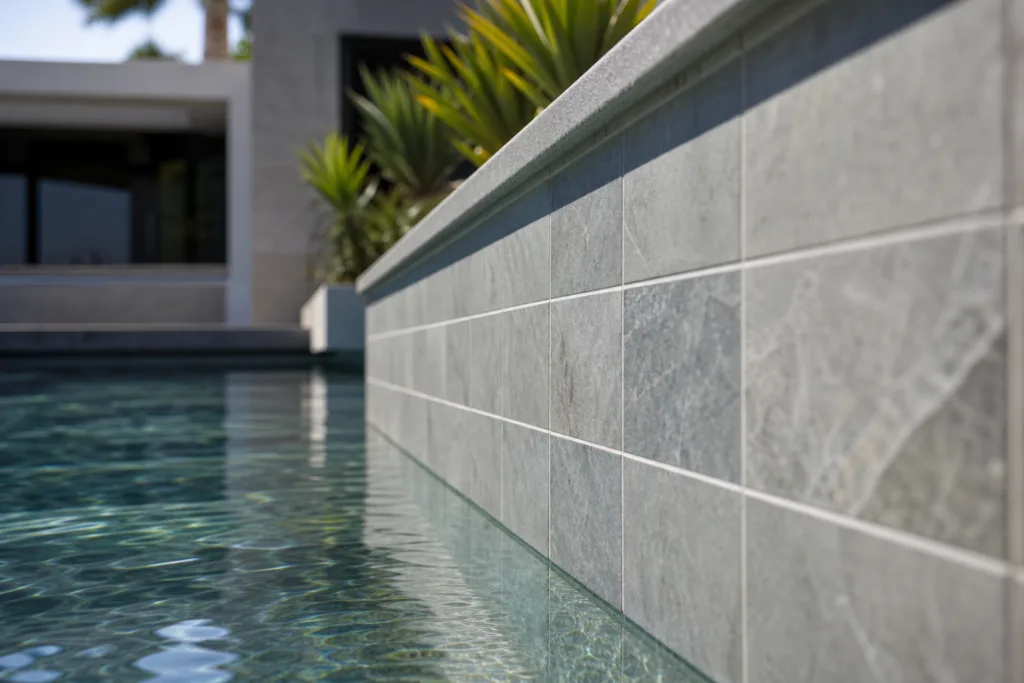
Yellowing risk is highest in exterior applications with light-colored grout and strong sun exposure. This does not automatically mean epoxy is unsuitable outdoors, but it does mean appearance expectations should be discussed early. Darker colors may mask slight change better. UV-stable pigment packages and protective design choices can also help. If appearance is critical, build a small trial panel in the same orientation as the finished pool area and monitor it before final sign-off.
Common failure modes and fast diagnosis
| Observed issue | Likely causes | Immediate action | Longer-term correction |
|---|---|---|---|
| Delamination at tile edge | Contamination, moisture, poor packing, movement | Remove loose sections and inspect substrate | Improve prep, verify adhesion, regrout |
| Cracking in rigid joints | Movement, overwide unsupported joints, brittle selection | Map crack pattern and identify movement source | Add proper movement joints, selective repair |
| Discoloration or yellowing | UV exposure, chemical attack, incorrect cleaning agents | Review water chemistry and cleaner history | Use more UV-stable or chemically resistant system |
| Soft or undercured grout | Incorrect mix ratio, low cure temperature, premature immersion | Test hardness and remove weak material | Reinstall under controlled conditions |
| Biological staining | Surface contamination, poor circulation, maintenance gaps | Clean and sanitize affected area | Improve maintenance routine and water balance |
Do not assume every failure is a resin defect. Field issues often combine several factors: marginal substrate preparation, incomplete joint filling, movement, and premature return to service.
Repair and maintenance protocols
Small isolated failures can often be cut out and repaired if surrounding grout is sound and the root cause is local. Widespread discoloration, recurring edge failure, or repeated cracking may justify broader removal and regrouting. Before any repair campaign, identify whether the problem came from water chemistry, movement, bond failure, or cure error. Otherwise, the same problem can return after patching.
For localized defects, patch materials such as ZDS-1007AB underwater-cure marine epoxy putty for patching and repairs may be useful in specific repair situations, especially where damp service conditions complicate conventional repair timing, but compatibility with the surrounding system should be confirmed first.
Preventive maintenance should include seasonal visual inspection, review of waterline deposits, checks for movement-joint integrity, and documentation of any areas that show repeated chemical staining or mechanical wear.
Specification checklist and sample performance targets
For contract documents, clear acceptance criteria are more useful than broad wording such as “high performance.” Reasonable project-specific targets may include the following, subject to the selected product data sheet and test method:
- very low water absorption after full cure
- documented resistance to pool sanitizers and routine cleaning chemicals
- minimum pull-off adhesion target on representative substrate after cure and wet conditioning
- defined Shore hardness range after full cure
- declared pot life at stated temperature
- minimum and maximum application temperature
- minimum cure before water fill
- service temperature range for standard pool or spa use
- batch traceability and shelf-life declaration
Specifiers should request the technical data sheet, safety data sheet, installation instructions, storage conditions, and any available immersion, chemical-resistance, or color-stability test information. On important projects, a mock-up panel and site trial are sensible risk controls rather than unnecessary delay.
Procurement, coverage, packaging, and storage guidance
Procurement teams should not compare pool grout only by unit price. Coverage depends on tile size, joint width, joint depth, waste factor, and crew experience. Packaging format affects ratio control and jobsite efficiency. Shelf life matters because partially aged epoxy components may show viscosity shift or slower cure behavior.
- Confirm packaging size matches the crew’s application speed.
- Check shelf life and storage temperature requirements before delivery.
- Request batch numbers for traceability on larger projects.
- Review color consistency expectations across multiple batches.
- Use a volume calculator before ordering rather than relying on rough area estimates.
How to choose the right grade for different pool types
A practical decision flow is to start with the environment, then narrow by tile, appearance sensitivity, and schedule:
- Indoor pool with ceramic or porcelain tile: prioritize low absorption, chemical resistance, and workable installation window.
- Outdoor decorative pool with glass mosaic: prioritize UV appearance retention, non-sag handling, and mock-up approval.
- Saltwater residential pool: prioritize chemical durability and outdoor color stability.
- Commercial therapy pool or spa: prioritize heat resistance, sanitizer tolerance, and strict cure-to-service scheduling.
- Renovation over damp or questionable substrate: prioritize bond verification, substrate stabilization, and trial installation before full commitment.
Manufacturer evaluation questions before approval
Whether you source from us or from another producer, the right procurement questions are usually the same. Ask for:
- TDS and SDS documents
- mix ratio and pot life details at multiple temperatures
- recommended cure time before immersion
- chemical-resistance guidance relevant to chlorine, bromine, and cleaners
- UV and color-stability information if the pool is outdoors
- adhesion or immersion test data where available
- batch traceability and shelf-life statement
- site trial or sample panel recommendations
This type of review helps separate a general-purpose resin product from a system that is actually suitable for submerged tiled environments.
Conclusion
Choosing epoxy grout for swimming pools is a specification and execution decision, not a simple material swap. The best results come when the grout is matched to the tile type, chemical regime, UV exposure, movement profile, and refill schedule of the project. For buyers and contractors, the most reliable path is conservative: verify substrate compatibility, request clear technical documents, run a site mock-up, and avoid premature immersion. When those basics are handled properly, epoxy grout can deliver durable joints with lower absorption, strong cleanability, and better resistance to the demanding service conditions found in pools and spas.
FAQs
Can epoxy grout be used underwater?
Standard epoxy grout is usually installed before immersion and allowed to cure fully, but some specialized epoxy systems are designed for underwater or submerged-condition repair work. For pool tile joints, the safer approach is to follow the product’s stated cure-before-immersion window and verify that the material is specifically intended for submerged service rather than assuming all epoxy grouts perform the same way.
How soon can a pool be filled after epoxy grouting?
The refill timeline depends on the specific product, ambient temperature, joint depth, and whether the pool will enter full chemical service immediately. Many failures come from filling too early, so the correct practice is to follow the technical data sheet, check actual site temperature, and use a mock-up when the project schedule is tight or the pool is a commercial facility.
Is epoxy grout better than cement grout for pool tile?
Epoxy grout is often preferred for pool tile when low absorption, stain resistance, and stronger chemical durability are priorities. Cement grout may still be used in some projects, but it is generally more porous and more sensitive to staining and moisture-related maintenance, so the right choice depends on service conditions, budget, appearance goals, and installation capability.
Will epoxy grout turn yellow in an outdoor swimming pool?
Yellowing can happen in outdoor exposure, especially with standard epoxy chemistry, light colors, and strong sunlight. The risk can be reduced by selecting more UV-stable formulations, reviewing pigment choices, and approving a field sample panel before full installation when color retention is a major project requirement.
What tests should specifiers request before approving pool epoxy grout?
At minimum, specifiers should ask for the technical data sheet, safety data sheet, cure-before-immersion guidance, and available information on water absorption, chemical resistance, adhesion, and color stability. For higher-risk projects, it is also sensible to request batch traceability, review test methods used by the manufacturer, and require a site mock-up or trial panel under actual project conditions.
Can damaged epoxy grout in a pool be repaired locally?
Yes, localized repair is often possible if the surrounding grout is sound and the root cause is limited to a small area such as poor packing or isolated impact damage. If the problem is widespread, linked to movement, or caused by incorrect cure or chemical attack, a larger repair program or regrout may be more reliable than repeated spot patching.