
For boatbuilders and repair yards, the marine epoxy vs polyester resin strength comparison is not just a materials question. It affects structural reliability, bond durability, moisture protection, rework risk, shop workflow, and total project cost over the service life of the vessel. In our manufacturing work, we usually see the decision become clearer when the application is defined precisely: new lamination versus secondary bonding, cosmetic repair versus structural repair, dry indoor production versus wet in-service restoration, and low-cost mold work versus long-term marine durability.
Explore epoxy systems for boat repair and marine use if you are comparing resin types for hull work, core bonding, sealing, or structural repair and need a clearer view of where epoxy systems fit in real marine service.
The short version is practical. For structural bonding, core repairs, through-hull reinforcement, wet-service durability, and repair over existing cured laminates, epoxy is usually the safer engineering choice because it offers stronger adhesion, lower water uptake, and better fatigue behavior. Polyester still has a valid place in boatbuilding, especially for cost-sensitive production laminates, molds, and non-structural repairs where fast throughput and compatibility with existing polyester systems matter more than maximum bond strength. The right choice depends on load path, substrate, process, and expected exposure.
This guide is written for boatbuilders, naval architects, surveyors, OEM teams, and marine repair technicians who need a decision-focused view rather than generic resin definitions. We will compare mechanical properties, adhesion logic, water resistance, cure behavior, process fit, and cost-performance tradeoffs in the way a manufacturer evaluates a specification.
Quick verdicts by application
If the job is structural lamination or core bonding, epoxy is generally preferred because the combination of adhesive strength, lower shrinkage, and better fatigue resistance supports more reliable long-term load transfer. For through-hull repairs, transom repairs, chainplate zones, and wet secondary bonding, epoxy is usually the more dependable option because bond quality on prepared cured substrates matters more than raw resin price. For small gelcoat-adjacent cosmetic repairs where the objective is a quick non-structural surface fix and compatibility with existing polyester finishing systems, polyester may be adequate if moisture exposure and bond demands are limited. For fiberglass hull production at scale, polyester remains common because it is process-efficient and lower cost, but that does not automatically make it the right choice for later repairs. For marine plywood sealing and localized timber restoration, epoxy is typically the better system because it penetrates, bonds, and moisture-seals more effectively.
Who this comparison helps
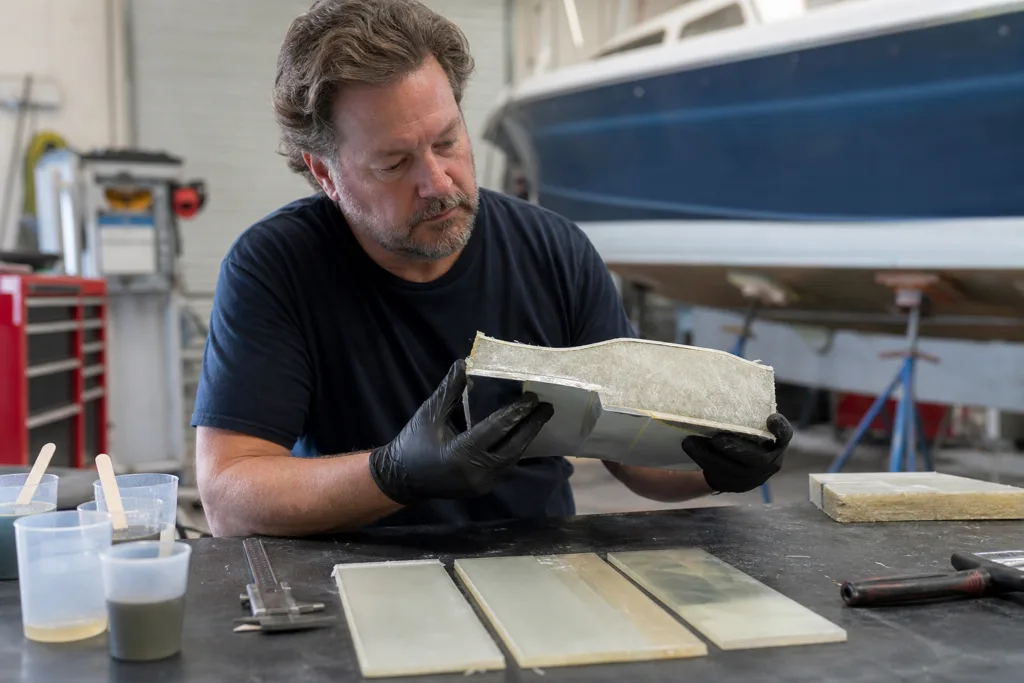
This article helps readers who need to choose a resin system rather than simply define one. That includes production boatbuilders choosing between process economy and performance margin, repair yards deciding whether a laminate should be rebuilt with polyester or upgraded to epoxy, surveyors evaluating whether a repair specification is credible, and procurement teams reviewing technical data sheets and supplier claims. It is also useful for OEM brands and private label marine material programs that need consistent cure profile, viscosity control, and documentation across repeated builds.
Where wood-cored structures or marine plywood are involved, resin selection becomes even more sensitive because moisture damage often combines with substrate degradation. In those cases, a penetrating primer such as ZDS-2060AB solvent-free wood rot primer for marine plywood and transoms may be part of the repair workflow before any structural rebuilding begins.
Key differences at a glance
| Factor | Marine Epoxy | Polyester Resin |
|---|---|---|
| Cure chemistry | Resin and hardener reaction | Unsaturated polyester cured with catalyst |
| Secondary bonding | Typically stronger and more reliable | Usually weaker on fully cured substrates |
| Shrinkage on cure | Lower | Higher |
| Water resistance | Usually better | More vulnerable to long-term moisture issues |
| Fatigue performance | Often better in cyclic marine loading | Generally lower |
| Cost | Higher upfront | Lower upfront |
| Process speed in production | Can be tailored but often slower | Often favored for fast economical throughput |
| Gelcoat system compatibility | Needs planning and barrier strategy | Directly aligned with polyester production systems |
The important point is that these are not isolated properties. A resin with lower shrinkage often supports better bond retention and lower residual stress. A resin with better water resistance can reduce blister risk and preserve laminate properties longer. A cheaper resin may become more expensive if it causes rework, dry laminate repair, or premature failure in wet-service structures.
How to read strength claims in marine structures
A boatbuilder should be cautious with simplified strength claims because cured resin numbers alone do not predict finished laminate behavior. In practice, the useful metrics depend on how the resin will function in the laminate or repair.
What the main laboratory metrics mean
- Tensile strength often referenced through ASTM D638, indicating how the cured material resists pulling loads.
- Flexural strength and modulus often referenced through ASTM D790, showing bending resistance, which matters in hull panels and decks.
- Compressive strength commonly considered through ASTM D695, useful in core support zones, bolted areas, and localized bearing loads.
- Interlaminar shear strength often associated with ASTM D2344, important for layered composite behavior and delamination resistance.
- Lap-shear or adhesive bond tests such as ASTM D3163 variants, useful when evaluating secondary bonding.
- Pull-off adhesion such as ASTM D4541 style testing, practical for repair verification on prepared substrates.
- Water absorption commonly linked to ASTM D570, relevant for long-term marine exposure.
For new fiberglass production, resin strength must be read together with fiber volume fraction, reinforcement type, laminate schedule, consolidation quality, and cure completeness. For repairs, adhesive bond behavior and water resistance usually matter more than neat resin tensile strength alone. That is one reason the marine epoxy vs polyester resin strength comparison should never be reduced to a single catalog number.
Mechanical strength and laminate performance
In general engineering practice, epoxy systems often provide higher tensile and flexural performance, better strain accommodation before failure, and stronger fiber-to-matrix bonding than standard polyester systems. The exact range depends heavily on formulation, cure state, fillers, and reinforcement, but the pattern is consistent: epoxy usually delivers a tougher and more structurally efficient matrix for demanding marine laminates.
However, the finished laminate is influenced by workmanship as much as by chemistry. A well-consolidated polyester laminate with proper glass schedule can outperform a poorly mixed or under-cured epoxy repair. From our formulation perspective, resin choice improves the performance window, but process control determines whether that window is actually reached.
Epoxy also tends to support better interlaminar performance, which matters when a hull or deck sees repeated flexing, slamming loads, or localized impact. This advantage becomes more meaningful in sandwich structures, stringer tabbing, bulkhead bonding, and repairs where the old laminate surface is already cured and mechanically aged.
How fiber content changes the answer
If the laminate design is optimized for production economy, polyester can still be appropriate in many OEM fiberglass hulls, especially where the original design, gelcoat system, and mold process were built around it. But if the objective is to maximize structural efficiency at a given laminate weight, epoxy frequently offers better fiber wet-out, stronger matrix adhesion, and improved long-term retention under marine cycling. For a deeper process view, our article with guidance on selecting epoxy for fiberglass hull repairs and lamination discusses how epoxy fits hand layup, reinforcement bonding, and repair logic.
Adhesion and bonding behavior on real boat substrates
This is where epoxy most often separates itself from polyester in repair practice. Polyester performs adequately when curing into a fresh laminate during primary lamination, but its performance in secondary bonding is usually less forgiving. Once a polyester laminate is fully cured, creating a strong new bond relies heavily on aggressive surface preparation and mechanical keying. Epoxy also requires careful preparation, but its adhesive chemistry usually gives it a wider safety margin on cured fiberglass, timber, and many properly prepared metals.
Bonding to GRP, wood, and metal
On cured fiberglass reinforced plastic, epoxy commonly produces more dependable bonds in repairs because it tolerates real-world substrate variability better. On wood, epoxy typically penetrates and seals more effectively, which is important in marine plywood bulkheads, transoms, soles, and stringer repairs. On metals, both systems require thoughtful surface prep and corrosion planning, but epoxy primers and bonding systems are usually better suited where moisture exclusion is critical.
For localized rebuilds in degraded wood structures, gap-filling behavior matters as much as raw adhesion. Products such as ZDS-1240 epoxy wood gap filler for marine plywood repairs fit cases where void filling, edge stabilization, and moisture-resistant rebuilding are part of the repair rather than simply resin wet-out.
Surface preparation still decides the result
Neither resin family can overcome contamination, gloss, amine-unfriendly moisture, or weak oxidized substrate. A sound marine bonding workflow includes degreasing where needed, grinding to a stable profile, removing dust completely, drying the substrate, and matching the repair resin to the service environment. Epoxy is more tolerant of difficult repair conditions than polyester, but it is not immune to poor preparation.
Water resistance, osmosis, and long-term marine exposure
Water resistance is one of the most practical reasons epoxy is chosen for marine repairs. Over time, water diffuses into resin matrices at different rates. In wet marine service, lower water uptake supports better dimensional stability, improved bond retention, and reduced risk of osmotic blistering pathways. Polyester systems can be entirely serviceable in many production boats, but they are generally more vulnerable to hydrolysis-related degradation and long-term moisture issues than well-formulated marine epoxy systems.
ASTM D570 water absorption data can help compare systems, but interpretation matters. A low neat resin absorption result is useful, yet real boat performance also depends on cure completeness, void content, fiber wet-out, edge sealing, and whether the laminate includes cracked gelcoat, exposed fastener paths, or damaged core. In our experience, many wet-service failures blamed on “bad resin” are actually a combination of moisture entry points, incomplete sealing, and weak secondary bonding.
Where a repair must resist repeated immersion, bilge moisture, spray, freeze-thaw cycling, or long dwell periods in marinas, epoxy generally offers a more conservative durability choice. Polyester may still be acceptable for above-waterline cosmetic areas or controlled low-demand applications, but the risk profile changes once water ingress becomes likely.
Fatigue, impact, and cyclic loading
Marine structures rarely fail from one static load alone. Hull bottoms, decks, transoms, stringers, and hardware zones face repeated vibration, slamming, engine loads, and local impact. This is where epoxy often outperforms polyester in service even when the original static strength numbers do not appear dramatically different.
Because epoxy commonly has better toughness and bond retention, it tends to perform better in cyclic loading and impact-prone structures. In practical terms, that can mean fewer microcracks, slower crack growth, stronger tabbing retention, and lower risk of a repair edge printing through or debonding after repeated use. Surveyors and repair specifiers often value this because fatigue resistance is difficult to restore once a poor repair has already been sealed and painted over.
Chemical and thermal resistance
Neither resin should be treated as universally resistant to all fuels, solvents, and heat sources. The correct view is formulation-specific. That said, epoxy systems are often chosen where stronger resistance to water, oils, cleaning chemicals, and intermittent thermal excursions is needed. Polyester may be sufficient in many general-purpose laminates, especially when the environment is not chemically severe and temperatures remain moderate.
Thermal performance should be linked to glass transition temperature, cure schedule, and any post-cure plan. A room-temperature cure epoxy may still benefit significantly from controlled post-cure if the part will see elevated deck temperatures, dark surface heat buildup, or machinery-adjacent conditions. Polyester can also be processed efficiently, but its thermal limitations and shrinkage behavior must align with the application. If service temperature and dimensional stability are critical, the technical data sheet should be reviewed more closely than the sales description.
Processing and workshop considerations
Cure chemistry, pot life, and exotherm
Polyester cures through catalyzed reaction and is familiar to many high-throughput fiberglass shops. It can be process-efficient, but catalyst ratio control, temperature management, and styrene emissions require discipline. Epoxy cures through resin-hardener stoichiometry and usually rewards accurate measuring, controlled mixing, and attention to pot life and section thickness. Both systems can overheat in mass, but epoxy users often underestimate how strongly batch size and ambient temperature affect gel time.
For teams that need tighter process control, 2-part marine epoxy mix ratios, pot life and cure control for reliable bonding is one of the most important operational topics because under-mixing, over-potting, or working outside the cure window can erase the advantages epoxy should have delivered.
Viscosity, wet-out, and process fit
Resin viscosity should be selected by process, not by habit. Lower-viscosity systems may suit infusion or dense reinforcement wet-out, while medium-viscosity systems may give better gap control and anti-sag behavior in vertical repairs. In our formulation work, marine users often need a balance: low enough viscosity for fiber wetting and penetration, but high enough stability for bonding cores, filling bevels, and preventing runoff in overhead work.
Boatbuilders should ask whether the resin will be used for hand layup, vacuum bagging, infusion, filleting, fairing, sealing, or a mixed workflow. One resin rarely performs optimally in all those roles without modifiers or companion products. That is why manufacturer-side specification support matters more than simply choosing a resin family name.
Gelcoat and topcoat compatibility
Polyester integrates naturally into polyester gelcoat-based production systems. Epoxy can still be used effectively beneath later finishing layers, but the interface must be planned properly. Depending on the system, this may involve sanding, full cure verification, tie-coat logic, or an epoxy primer or barrier layer before topcoating. Boatyards sometimes create avoidable failure by assuming all coatings will adhere equally over any cured epoxy surface without checking cure state and manufacturer guidance.
Repair workflows that influence resin choice
Structural delamination and core repair
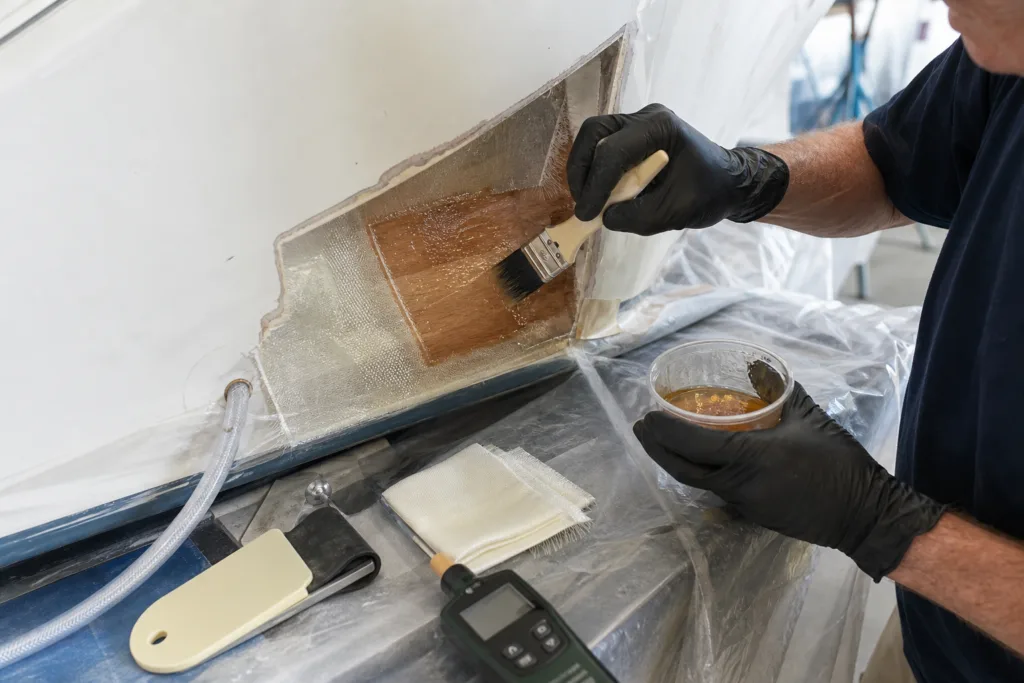
For structural delamination, the repair sequence usually involves moisture assessment, removal of damaged laminate, taper preparation, core evaluation, substrate drying, rebuild scheduling, and final sealing. In these cases, epoxy often makes more sense because the repair depends on secondary bond quality more than raw speed. Core bonding, edge sealing, and tabbing benefit from low shrinkage and stronger adhesion.
Through-hull and hardware reinforcement
Where loads concentrate around through-hulls, backing areas, or deck hardware, the repair resin needs to maintain bond under compression, moisture, and vibration. Epoxy is usually the more conservative choice for these zones, especially when bonding to existing cured laminate or mixed materials such as fiberglass to wood.
When polyester repair still makes sense
Polyester can still be the right material for fast, low-cost, non-structural cosmetic work, mold maintenance, and some production-oriented glass repairs where the substrate is compatible and long-term immersion resistance is not the main risk. The key is to define it clearly as a lower-demand repair and to keep quality controls in place rather than treating it as interchangeable with epoxy in all cases.
Health, safety, and shop environment
Workshop conditions matter more than many teams admit. Polyester systems commonly involve styrene exposure, which makes ventilation, operator training, and air management particularly important. Epoxy avoids styrene but still requires disciplined PPE, skin protection, and clean handling to reduce sensitization risk. Neither chemistry should be treated casually.
Temperature and humidity control also affect both systems. Cold substrates slow cure and can trap moisture-related problems. Hot workshops can shorten pot life sharply. A technically strong resin still fails if mixed in large uncontrolled batches, applied to damp laminate, or cured outside its intended thermal window.
Cost analysis beyond resin price
Raw material price is where polyester often looks attractive. On a per kilogram or per liter basis, polyester is usually cheaper, and in production that difference can be significant. But marine repair economics should include labor hours, rework exposure, consumables, downtime, finishing steps, and the probability that a repair must survive years of wet service without reopening.
| Cost factor | Epoxy tendency | Polyester tendency |
|---|---|---|
| Initial resin cost | Higher | Lower |
| Secondary bonding reliability | Higher | Lower |
| Rework risk in structural repair | Usually lower | Usually higher |
| Production speed | Depends on formulation and cure plan | Often faster in conventional shops |
| Long-term moisture durability | Usually better | More condition-dependent |
| Lifecycle cost in critical repairs | Often favorable | Can rise if failures occur |
In boatyard budgeting, epoxy often becomes the lower total-cost option when failure would require reopening interior joinery, removing hardware, drying core again, or handling warranty claims. Polyester remains cost-efficient where the repair is superficial, dry-service, and non-structural. This is why the correct decision is not “which resin is cheaper” but “which resin gives the lowest lifecycle cost for this exact repair or build stage.”
Specification and selection checklist
- Define the job: primary lamination, secondary bonding, core repair, cosmetic repair, sealing, or hardware reinforcement.
- Set performance targets: required adhesion, flexural behavior, water absorption, toughness, and thermal range.
- Check substrate compatibility: cured polyester laminate, fresh laminate, marine plywood, foam core, metal insert, or mixed-material assembly.
- Review process constraints: hand layup, infusion, vertical repair, low-temperature shop, fast turnaround, or post-cure availability.
- Assess environment: continuous immersion, bilge exposure, splash zone, deck heat, fuel contact, or freeze-thaw cycling.
- Request supplier documents: technical data sheets, mixing instructions, cure profile, storage stability, and batch traceability.
- Ask formulation questions: viscosity range, pot life options, low-odor variants, moisture-tolerant repair behavior, and barrier-coat compatibility.
From our manufacturer perspective at ZDSpoxy, the most useful customer questions are rarely about only one strength number. The better questions focus on substrate condition, cure temperature, required working time, expected water exposure, and whether the resin must also fill, seal, or bond dissimilar materials in the same workflow.
Testing, inspection, and quality assurance
Boatyards do not need a full laboratory to improve quality, but they do need repeatable checks. Practical in-shop controls include test coupons, mixed sample pots to confirm cure progression, hardness comparison after cure, visual wet-out inspection, and documented substrate prep steps. For critical repairs, small pull-off or lap-shear witness samples can be more useful than relying only on operator experience.
For acceptance work, lab testing may include tensile, flexural, compressive, interlaminar shear, pull-off, and water absorption methods aligned with ASTM references already discussed. The point is not to over-test every repair. It is to verify that the chosen system and process can deliver the expected structural result before the boat is closed, painted, or returned to service.
Common mistakes and troubleshooting
Choosing polyester where epoxy is required
One of the most common marine failures is using polyester for a secondary bond that really needed epoxy. The visible results may include edge lifting, delamination, print-through, recurring moisture problems, and reduced confidence in the repair. This usually happens around transoms, wet core zones, tabbing over old laminate, and hardware reinforcement where adhesion and moisture sealing are doing most of the work.
Mixing and ambient condition errors
With polyester, catalyst control errors can cause incomplete cure, excessive brittleness, or uneven reaction. With epoxy, incorrect ratio, inadequate mixing, or large hot batches can create soft spots, weak bond lines, or shortened working time that compromises laminate quality. Cold weather application is another frequent root cause because both systems can appear cured on the surface before full properties develop internally.
Gelcoat-related assumptions
Another mistake is assuming that finishing compatibility is automatic. If epoxy is used under a later topcoat or gelcoat-related system, cure status, sanding profile, and tie-coat planning all need to be checked. The technical interface is manageable, but it should never be guessed.
When polyester is the right choice
Polyester is a reasonable choice when the job is non-structural, budget-driven, compatible with an existing polyester production environment, and not highly dependent on secondary bond durability. Typical examples include mold work, some cosmetic fiberglass repairs, quick fairing-adjacent rebuilds above the waterline, and certain production hull laminates where the entire process has been engineered around polyester chemistry. The required quality controls are still important: correct catalyst ratio, environmental control, full wet-out, proper laminate consolidation, and realistic service expectations.
When epoxy is the right choice
Epoxy is generally the right choice for structural marine repair, core bonding, wet-service sealing, mixed-material bonding, marine plywood restoration, through-hull reinforcement, and any job where long-term bond confidence matters more than lowest initial resin price. It is especially valuable in secondary bonding over cured laminates, repairs with uncertain substrate history, and applications exposed to repeated water intrusion risk or cyclic mechanical loads.
At the formulation level, this is also where custom epoxy options can make a measurable difference. Marine users may need low-viscosity wet-out systems, slower gel profiles for larger laminates, low-odor shop-friendly variants, or more hydrophobic barrier-oriented systems for osmotic protection planning. Those are specification questions, not just product label questions.
A practical decision flow
If the work is structural, bonded to cured laminate, exposed to immersion, or expected to survive long cyclic loading, start with epoxy. If the work is cosmetic, cost-limited, process-speed driven, and staying within an existing polyester manufacturing system, polyester may be acceptable. If mixed materials are involved, if the substrate includes wood, or if the repair zone has a history of moisture, move back toward epoxy unless a very specific reason argues otherwise. When uncertainty remains, trial laminates and small bond tests are usually cheaper than full rework later.
Conclusion

For most marine repair professionals, the decision is less about resin tradition and more about service risk. Polyester remains useful in the right situations, especially for economical production and lower-demand repairs. But for structural bonding, marine plywood restoration, wet-service durability, and repairs over cured laminates, epoxy usually offers the better safety margin in the marine epoxy vs polyester resin strength comparison. The practical next step is to define the substrate, loading, water exposure, cure conditions, and finishing system before requesting samples or finalizing a specification. That approach leads to more reliable material selection than comparing price alone.
FAQs
Can epoxy bond to an existing polyester laminate?
Yes, in many marine repairs epoxy can bond very effectively to a properly prepared cured polyester laminate, provided the surface is clean, dry, abraded to sound material, and free of wax, contamination, and weak oxidized layers.
Can polyester bond over cured epoxy?
That depends on the exact system and finishing plan, but it is generally less straightforward than epoxy bonding over polyester, so surface preparation, cure completeness, and compatibility checks are important before using polyester or gelcoat-related layers over epoxy.
Is epoxy always stronger than polyester in a boat hull?
Not automatically, because hull strength depends on laminate design, reinforcement schedule, fiber content, consolidation quality, and cure control, but epoxy usually offers stronger secondary bonding, lower water uptake, and better toughness in demanding marine structures.
When is polyester acceptable for boat repair?
Polyester is often acceptable for non-structural cosmetic repairs, mold work, and cost-sensitive fiberglass work where the substrate is compatible, water exposure is limited, and long-term adhesive performance is not the main requirement.
Do marine epoxy repairs need post-cure?
Not every repair needs a formal post-cure, but controlled warm curing can improve final properties, especially when higher heat resistance, faster property development, or better dimensional stability is needed for structural or temperature-exposed parts.
What should buyers ask a marine resin supplier before specifying a system?
Buyers should ask about viscosity, pot life, cure temperature range, water resistance, substrate compatibility, recommended surface preparation, post-cure options, test data, storage stability, and whether the supplier can tailor the formulation to the intended marine process and repair environment.
Related Reading
- marine epoxy resin selection basics for boat repair and composites
- how marine-grade epoxy differs for real-world boat use
- epoxy for marine plywood: sealing, bonding and moisture protection
- avoiding epoxy delamination in boat repairs
- buyer’s checklist for marine epoxy resin suppliers and bulk purchases